International Oil Prices Rise, Plastic Futures Oscillate
I. Overnight Crude Oil Market Dynamics
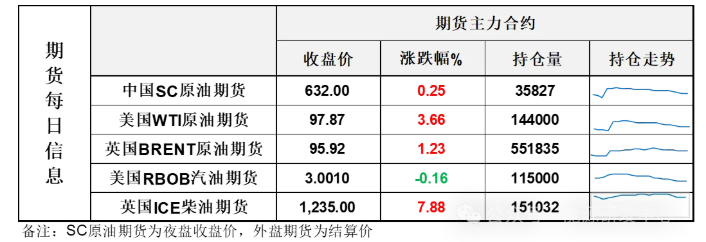
4/9: Israel's attack on Lebanon raised market concerns about its impact on the US-Iran talks, leading to an increase in international oil prices. However, the US pressured Israel to cease fire, narrowing the gain. NYMEX crude oil futures May contract rose $3.46 to $97.87 per barrel, up 3.66% month-on-month; ICE Brent crude oil futures June contract increased by $1.17 to $95.92 per barrel, up 1.23% month-on-month. China's INE crude oil futures 2605 contract fell 34 to 630.4 yuan per barrel, and the night session rose 1.6 to 632 yuan per barrel.
Market Outlook
WTI plunged to above $100 during the overnight session on Thursday, but then retreated by almost $7 in the early hours, nearly wiping out the day's large gain, as Israel said it would quickly start direct talks with Lebanon in response to Trump's request. However, oil prices eventually rebounded and closed higher. The oil price showed significant volatility. Before the outcome of the talks between the US and Iran in Islamabad, Pakistan, investors are expected to remain cautious and watchful.
The White House announced on the 8th that the first round of US-Iran talks is scheduled to take place in Islamabad, Pakistan, on the 11th. However, with the U.S. overturning the 10-point proposal by Iran that former President Trump had agreed to as the basis for negotiations, the talks are now in question. Iran had previously agreed to the negotiations, considering that the U.S. President had accepted Iran's '10-point plan' as the negotiation basis. With the U.S. Vice President Vans stating that Iran's 10-point proposal was immediately thrown in the trash and rejected, it remains uncertain whether the talks will proceed as scheduled. The Iranian Deputy Foreign Minister stated that the Iranian delegation will travel to Islamabad for the peace talks, but on the condition that Israel stops its attacks on Lebanon. Earlier, the Iranian ambassador to Pakistan removed a post about the Iranian delegation's arrival that night, which may suggest that the negotiations are in flux. However, with Israeli Prime Minister Benjamin Netanyahu announcing late Thursday that he has instructed the cabinet to start direct negotiations with Lebanon as soon as possible, focusing on the disarmament of Hezbollah and the establishment of formal peace relations between the two countries, the U.S.-Iran negotiations have once again seen a turning point.
Based on current statements from U.S. officials at all levels, the United States is unlikely to accept Iran’s 10-point proposal. White House Press Secretary Levitt told reporters that Iran had revised its initial proposal, presenting a more reasonable and streamlined plan, which made it possible for the U.S. to consider agreeing to a ceasefire. Mediators revealed late Wednesday that Iran has already made several concessions from its original list, softening its stance on issues such as the withdrawal of U.S. military forces from the region, war reparations, and uranium enrichment. Although significant differences remain, both sides have expressed willingness to end hostilities, suggesting they might each make further compromises. Nevertheless, it remains difficult to draw a clear assessment for now; a clearer picture will likely emerge only after Saturday’s negotiations.
Iranian Parliament Speaker Qalibaf’s violation of the ceasefire agreement would entail clear costs and consequences. Following Israel’s “violation of the ceasefire agreement,” Iran has intensified its control over the Strait of Hormuz, strictly regulating the number of vessels permitted to transit the strait. Currently, the most significant factor influencing oil prices is the progress of U.S.-Iran ceasefire negotiations; markets are expected to remain in a wait-and-see stance until a definitive outcome is reached. In the medium to long term, the continuous conflict has already inflicted irreversible damage to the crude oil supply side, and even if a ceasefire agreement is reached, market recovery will require substantial time. According to the U.S. Energy Information Administration’s (EIA) Short-Term Energy Outlook, the crude oil market will remain supply-tight through 2026, with particularly pronounced supply shortages expected in the second quarter. There is a low probability of a sharp, sustained decline in oil prices in the near term; instead, prices are expected to remain at elevated levels with wide-ranging volatility. Recent sharp price drops may present opportunities for buying at lower levels. Given the high volatility and considerable market uncertainty, enhanced risk management and cautious participation are advised.
II. Macroeconomic Market Dynamics
1. Iran Situation
① Iranian Deputy Foreign Minister: The Strait of Hormuz remains open, but passage requires coordination with Iran. The Iranian delegation will travel to Islamabad for negotiations. Iran was on the verge of responding to Israel’s violation of the ceasefire.
②The Israeli Prime Minister ordered direct negotiations with Lebanon, stating that Israel will not halt its fighting in Lebanon until Hezbollah is disarmed.Trump stated he has asked Netanyahu to make Israel’s operations in Lebanon “lower-key.” Direct negotiations between Lebanon and Israel will commence in Washington next week.
③Trump warned Iran not to collect tolls on the Strait of Hormuz, "Iran has been performing very poorly in oil transportation through the strait. This is completely inconsistent with the agreement we reached."
④ Yemen's Houthi forces threatened to tighten Red Sea passage in response to the attack in Lebanon.
Iran denied launching missiles to other countries during the ceasefire.
⑥Sources say Iran will not negotiate with the U.S. until a ceasefire is achieved in Lebanon.
2. Putin announced a 32-hour ceasefire for Orthodox Easter, and Ukraine announced it would follow suit.
3. US media: US government is expected to extend the oil sanction exemption for Russian oil this week, possibly paving the way for an exemption for Iranian oil.
Four ministries hold a symposium with enterprises in the power and energy storage battery industry: continuously promote the early warning and regulation of production capacity, standardize price competition, and govern "internal competition and external transfer".
Mao Ning, spokesperson for China's Foreign Ministry, hosted a regular press conference yesterday. A journalist asked about President Trump's statement that any country providing military weapons to Iran would face an "immediate 50% tariff on any and all goods" sold to the United States, with the measure "effective immediately" and "without any exclusions or exemptions." Mao Ning stated that China's position is very clear: there are no winners in a tariff war.
III. Plastic Market Dynamics
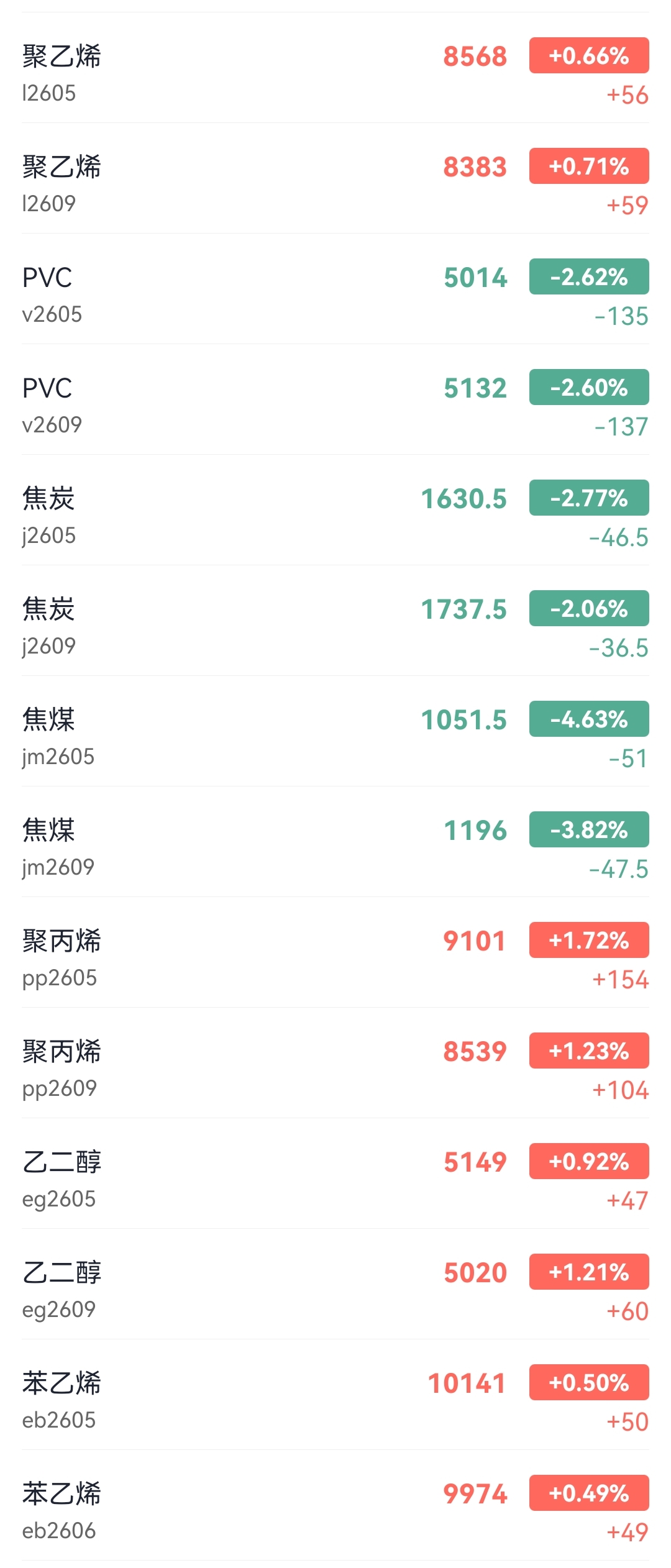
In the late hours of April 9, international oil prices plunged intraday due to factors including the easing of tensions in the Middle East, while plastic futures traded with volatility.
The PE 2605 futures contract is quoted at 8,568 yuan per ton, up 0.66% from the previous trading day.
PP2605 contract quoted at 9101 yuan/ton, up 1.72% from the previous trading day.
The PVC2605 contract was quoted at RMB 5,014 per ton, down 2.62% from the previous trading day.
The styrene 2605 contract is reported at 10,141 yuan/ton, up 0.5% from the previous trading day.
Four. Market Forecast
PE:Overall, supply and demand data have weakened compared to the previous period, and polyethylene prices are expected to fluctuate downward next week.
PP:The market is expected to experience volatility next week, with potential upside opportunities. High raw material costs and reduced supply are becoming evident, providing clear bullish drivers. However, downstream demand is significantly weaker than the rise in raw material prices, causing high market prices to remain unsupported and hindering a surge in trading volume.
PVC:PVC market is expected to remain weak next week. Geopolitical conflicts still exist with uncertainties, and crude oil and other major commodities continue to be affected. However, downstream demand remains weak, and foreign trade is mainly on the sidelines. Meanwhile, cost support is weakening, and the PVC market is expected to continue a weak and oscillating trend.
【Copyright and Disclaimer】This article is the property of PlastMatch. For business cooperation, media interviews, article reprints, or suggestions, please call the PlastMatch customer service hotline at +86-18030158354 or via email at service@zhuansushijie.com. The information and data provided by PlastMatch are for reference only and do not constitute direct advice for client decision-making. Any decisions made by clients based on such information and data, and all resulting direct or indirect losses and legal consequences, shall be borne by the clients themselves and are unrelated to PlastMatch. Unauthorized reprinting is strictly prohibited.
Most Popular
-
Continental Plans to Begin Sale of ContiTech in Early 2026
-

$4 Billion! Medtronic Makes Another Acquisition
-

BASF Delivers First Batch of Innovative Cathode Materials for Semi-Solid-State Batteries to Weilan New Energy
-
Profit and Revenue Growth Struggle to Conceal Debt Repayment Pressure; Success of Kingfa Sci & Tech's High-End Strategy Yet to Be Seen
-
Why did a century-old european dental instrument giant relocate its manufacturing hub to china?