International Oil Prices Decline! Effectiveness of US and Russia Sanctions Questioned! Futures Main Contracts Mostly Rise, PE Demand Shows Positive Signals
Overnight crude oil market dynamics
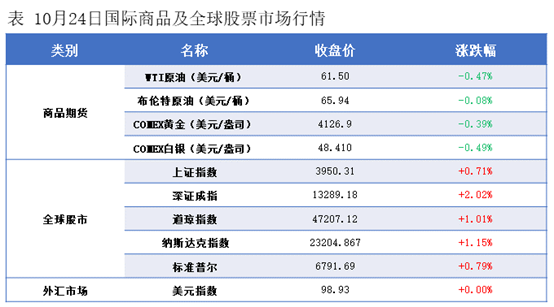
The market questions the actual effect of new U.S. sanctions on Russia, combined with persistently weak demand, leading to a drop in international oil prices. NYMEXCrude oil futuresThe December WTI contract fell by $0.29/barrel to $61.50, a month-on-month decrease of 0.47%; the ICE Brent December contract fell by $0.05/barrel to $65.94, a month-on-month decrease of 0.08%. China's INE crude oil futures December 2512 contract rose by 12.2 to 466.2 yuan/barrel, with an increase of 1.4 to 467.6 yuan/barrel in the night session.
Market Forecast
The new round of sanctions against Russia has led to a dramatic adjustment in market sentiment, with oil prices rebounding over $6 in just three trading days. According to the latest position report from the Intercontinental Exchange, speculative funds continued to increase their bearish bets before the sanctions. Data shows that for the week ending October 21, Brent crude oil speculators significantly reduced their net long positions by 57,085 contracts, bringing the total down to 52,521 contracts. In less than a month since the end of September, net long positions have decreased by nearly 200,000 contracts, with funds clearly increasing their short positions. This reallocation of positions is likely to change again following the announcement of a new round of sanctions by the U.S. and the EU on Wednesday, and it is expected that speculative funds will passively cover their net long positions after Wednesday. This sudden change will undoubtedly increase the operational difficulty for funds.
The trading logic of oversupply pressure has temporarily cooled, and the impact of sanctions on Russia has been preliminarily priced in. The market will need more time for a more comprehensive assessment. This round of sanctions is clearly more severe than previous ones, creating difficulties for Russian oil exports from both the buying and selling sides, which will disrupt oil supply for some time. The rapid rebound of $6 in oil prices indicates that the market has quickly adjusted its expectations; oil prices are unlikely to return to the previous downward trend in the short term. Taking Brent crude oil as an example, it is more likely to remain within the range of $60-70. Oil prices will continue to exhibit high volatility, so attention to timing is essential.
Section 2: Macroeconomic Developments
The MLF has increased in volume for eight consecutive months. The central bank announced that it will conduct a 900 billion yuan MLF operation on October 27, with a term of one year. Given that 700 billion yuan of MLF is maturing this month, the net MLF injection for October will be 200 billion yuan, marking eight consecutive months of increased issuance.
Several provinces have released their GDP data for the first three quarters. Among them, Guangdong Province's GDP reached 10.52 trillion yuan, a year-on-year increase of 4.1%. Zhejiang's GDP was 6.85 trillion yuan, growing by 5.7%. Anhui's GDP was 3.98 trillion yuan, with a growth of 5.4%. Chongqing's GDP was 2.44 trillion yuan, increasing by 5.3%. Guangxi's GDP was 2.15 trillion yuan, also increasing by 5.3%.
The central bank held a party committee meeting emphasizing the need to build a scientifically sound and robust monetary policy system, grasping the intensity, timing, and rhythm of monetary policy to fully unleash the effectiveness of various monetary policies. It called for dynamically improving the monetary policy framework and strengthening the execution and transmission of monetary policy. The meeting also highlighted the expansion and enhancement of the central bank's macroprudential and financial stability functions to maintain stable operations in financial markets such as the stock market, bond market, and foreign exchange market. Additionally, it aimed to expand the use of the renminbi in trade items and promote the development of the offshore renminbi market.
The Party Leadership Group of the State Administration of Foreign Exchange held a meeting to emphasize steadily expanding high-level institutional opening in the foreign exchange sector, coordinating the advancement of RMB internationalization and high-quality opening of the capital account. It aims to build an open, diverse, functionally sound, and competitively orderly foreign exchange market, and to improve the efficiency of resource allocation in the foreign exchange market.
The State-owned Assets Supervision and Administration Commission (SASAC) Party Committee held an expanded meeting and emphasized the need to direct more state capital towards forward-looking strategic emerging industries, promote the advancement of traditional industries towards high-end, intelligent, and green development, and facilitate the optimization and structural adjustment of the layout of the state-owned economy.
In September, the U.S. CPI rose by 3% year-on-year, marking the highest since January this year, but below the market expectation of 3.1%. The core CPI slowed to 0.2% month-on-month, also below market expectations. Inflation in the services sector slowed to its weakest level since November 2021. After the data was released, the market has fully priced in the expectation of two more 25-basis-point rate cuts by the Federal Reserve for the remainder of the year.
3. Early Morning Dynamics of the Plastic Market
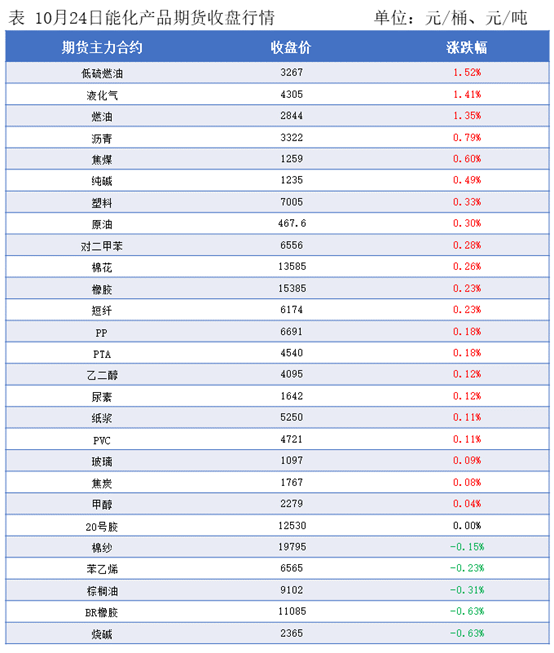
Oil prices rebounded more than 7% in a single week, marking the largest weekly increase in the second half of the year! Overnight, the main contracts of domestic plastic futures showed partial gains.
The plastic 2601 contract is quoted at 7005 yuan/ton, an increase of 0.33% compared to the previous trading day.
The PP2601 contract is priced at 6,991 yuan/ton, an increase of 0.18% compared to the previous trading day.
The PVC2601 contract is quoted at 4721 yuan/ton, up 0.11% from the previous trading day.
The styrene 2511 contract is quoted at 6565 yuan/ton, down 0.23% from the previous trading day.
4. Market Forecast
PE: The current PE market supply side is stable, with smooth operations and no large-scale shutdowns for maintenance or concentrated resumption of production. The continuous and stable supply keeps the overall market supply relatively abundant, compounded by the slow pace of inventory digestion. Under the dual pressure, the market atmosphere remains weak. To alleviate inventory pressure, traders generally adopt active destocking strategies, leading to increasingly fierce low-price competition, further exacerbating the market's weak tone. However, there are some positive signals on the demand side. On one hand, the approach of e-commerce festivals is leading to a slight recovery in the operating rates of downstream related industries, providing temporary support for PE demand. On the other hand, the drop in temperature is boosting demand for cold-resistant PE products such as agricultural films and packaging, providing additional increments to the demand side. Overall, it is expected that in the short term, the polyethylene market will most likely maintain a pattern of "weak and stable fluctuations, with localized slight improvements."
From the perspective of the industrial fundamentals, the operation of PP plants is generally stable, and the supply side remains relatively steady. However, due to insufficient cost transmission from upstream, the cost support for polypropylene is relatively weak. On the demand side, a cautious attitude continues, with downstream enterprises mainly replenishing inventory based on just-in-time needs, and the market shows a tendency for cautious price increases. However, with the approaching "Double Eleven" e-commerce festival, terminal factories have begun to take actions to stock up appropriately. Overall, it is expected that the polypropylene market will likely maintain a fluctuating and slightly strong operational pattern in the short term.
From the supply side, although the profitability of the PVC industry is poor, the "compensating chlorine with alkali" model, where the profit from caustic soda offsets the losses from PVC, reduces the motivation for integrated enterprises to cut production, keeping supply at a high level. On the demand side, under the main theme of the sluggish real estate industry, the performance is unlikely to be good. Supply and demand are in a constant struggle between the capacity expansion cycle and weak demand recovery, and the overall market sentiment is also poor at present. On the external front, oil prices have risen sharply, reaching a two-week high due to U.S. sanctions on a large Russian oil company. Additionally, investors expect that despite persistent inflation, the Federal Reserve may still cut interest rates next week. Overall, in the short term, the PVC spot market is expected to remain in a narrow adjustment phase.
【Copyright and Disclaimer】This article is the property of PlastMatch. For business cooperation, media interviews, article reprints, or suggestions, please call the PlastMatch customer service hotline at +86-18030158354 or via email at service@zhuansushijie.com. The information and data provided by PlastMatch are for reference only and do not constitute direct advice for client decision-making. Any decisions made by clients based on such information and data, and all resulting direct or indirect losses and legal consequences, shall be borne by the clients themselves and are unrelated to PlastMatch. Unauthorized reprinting is strictly prohibited.
Most Popular
-

Mexico Imposes Tariff Up to 36% on Cross-Border E-Commerce Products, Effective January 1, 2026; Plastic Shows Partial Fluctuation Today
-
4.5 Million Tons! Wanhua Chemical Dominates Globally in MDI, Heavy Investment in Battery Materials Spurs New Storm
-

Trump Delays Tariff Increase on Furniture, Cabinets, and Vanities
-
Wanhua Chemical Invests $27.3 Billion, 2026 Investment Map Revealed, $1.1 Billion Bet on Battery Materials
-
Back-to-back major joker moves! covestro’s 1.32 million ton mdi dual-line expansion and hdi acquisition reshape global polyurethane landscape