Independent Refiners Secure Additional Quotas, But the Real Signal Lies Beyond the Quotas Themselves
Yesterday, a Bloomberg report on newly allocated crude oil import quotas for China’s independent refineries (“local refineries”) quickly drew market attention.
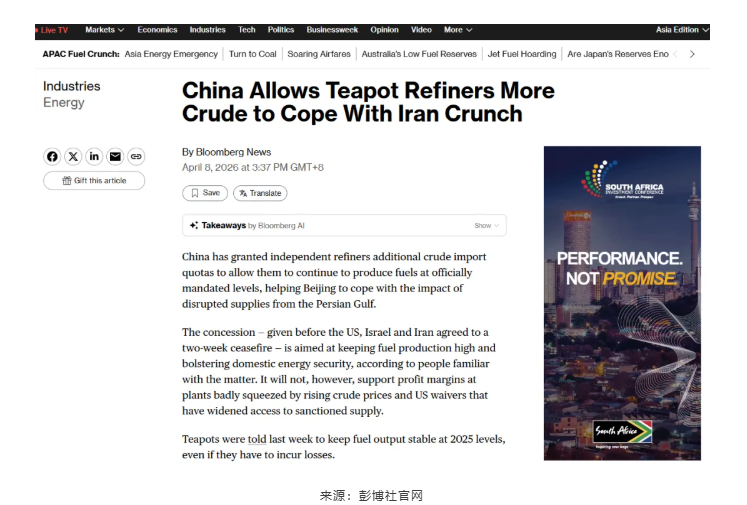
The report mentioned that China is granting additional quotas to some independent refiners to maintain stable fuel output amid Middle Eastern supply disruptions. In the same report, Liao Na, founder of Mysteel Energy & Chemicals, was also quoted as saying:
China is "making full use of the import capacity of private refineries to provide a buffer for overall crude oil supply amid the current shock."
However, if one understands this matter solely as “an increase in quotas,” it is easy to miss the key point.
This time, what has truly been worth paying attention to has never been the quota itself.
01 Why is the quota being allocated now?
The time point isn't complicated.
Against the backdrop of turmoil in the Middle East and rising shipping risks in the Strait of Hormuz, China faces a more immediate issue: its supply must remain stable.
Under this premise, policy priorities have become very clear: stabilize supply first, then stabilize construction starts, with profits taking a back seat.
Local refineries are "mobilized" for the same straightforward reason: they have more flexible procurement, can bear limited resources, and have higher processing flexibility. Essentially, they serve as a "system buffer."
02 Quotas increased, but margins are tightening
On the surface, the newly added quota is favorable. However, from an operational perspective, pressure is simultaneously increasing.
On one side, raw material costs are rising. The discount on sanctioned oil, which previously supported the profits of independent refineries, is narrowing, and some types of oil are even approaching the Brent system, significantly weakening the cost advantage.
On the other hand, product prices are restricted. Domestic refined oil prices have not fully followed the increase in international oil prices, with policies more inclined towards stabilizing the end consumers.
The outcome is straightforward: upstream prices are rising, downstream prices are controlled, and profits are squeezed in the middle.
Meanwhile, some independent refineries are also required to maintain their existing operating rates, even under profit pressure, to ensure stable output. This means a more realistic situation: they can operate without making a profit, but they cannot cease production.
What role is 03 refinery playing?
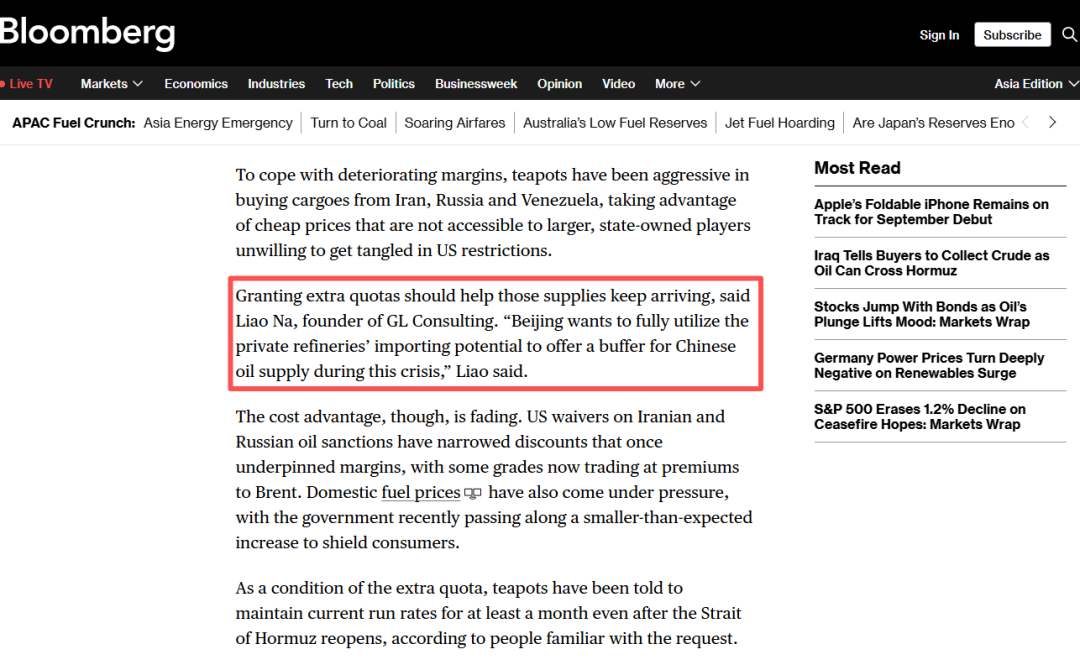
Bloomberg cites Lina's views. Source: Bloomberg.com
When viewed collectively, it becomes clear that the core of this round of changes lies not in quotas, but in the evolving role of independent refineries.
They are no longer merely market-oriented refiners, but have assumed additional "functional roles" during critical periods: supplementing supply, providing flexible feedstock sources, and serving as a backstop when the system is under stress. To some extent, local refineries are becoming the "supplier of last resort" in China's energy system.
Behind this lies a deeper signal: China is reallocating its supply responsibilities.
04 What should the market really look at?
More important than "how much quota has been allocated" are three other issues.
First, whether refinery operating rates will be anchored by long-term policies.
Second, whether the arbitrage space for sanctioned crude oil will continue to narrow.
Third, is the division of labor between integrated refineries and independent refineries being redefined?
These variables truly determine how China's refining system will operate over the coming period.
This quota adjustment appears to be a short-term response. More fundamentally, it represents China’s rebalancing of energy security and supply mechanisms in the face of external shocks.
We are continuously tracking the following developments: the evolution of refining operations and profits, the flow changes of sanctioned crude oil, and the transmission channels of Middle East disruptions on China's import structure.
【Copyright and Disclaimer】The above information is collected and organized by PlastMatch. The copyright belongs to the original author. This article is reprinted for the purpose of providing more information, and it does not imply that PlastMatch endorses the views expressed in the article or guarantees its accuracy. If there are any errors in the source attribution or if your legitimate rights have been infringed, please contact us, and we will promptly correct or remove the content. If other media, websites, or individuals use the aforementioned content, they must clearly indicate the original source and origin of the work and assume legal responsibility on their own.
Most Popular
-
Continental Plans to Begin Sale of ContiTech in Early 2026
-

$4 Billion! Medtronic Makes Another Acquisition
-

BASF Delivers First Batch of Innovative Cathode Materials for Semi-Solid-State Batteries to Weilan New Energy
-
Profit and Revenue Growth Struggle to Conceal Debt Repayment Pressure; Success of Kingfa Sci & Tech's High-End Strategy Yet to Be Seen
-
Why did a century-old european dental instrument giant relocate its manufacturing hub to china?