



In situ polymerization-type flame-retardant and antibacterial polyamide 66: Polymerization Mechanism and Properties
In-situ polymerization technology provides an effective route for the functional modification of polyamide 66 (PA66), primarily by incorporating functional components directly into the polymerization system through copolymerization or composite methods. This approach not only enables durable and stable properties such as flame retardancy and antibacterial activity but also enhances the material’s overall performance through chemical bonding or nanoscale dispersion.
Definition and Classification: Three Pathways of In-situ Polymerization Modification
"In-situ polymerized flame-retardant and antibacterial PA66" typically refers to the direct incorporation of functional components during the synthesis stage of PA66, enabling a "one-step" or multi-step modification. Depending on the method of introducing the functional components, it can be primarily classified into three types:
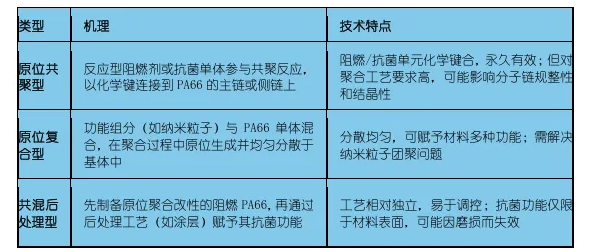
Note: Some studies (e.g., those using melamine cyanurate, MCA) fall between copolymerization and compounding; MCA acts as a physically dispersed phase while simultaneously exhibiting nucleating effects.
Flame Retardant Mechanism: Synergistic Effect of Gas Phase and Condensed Phase
Intumescence-type flame-retardant PA66 primarily functions through two mechanisms working in synergy, achieving the UL 94 V-0 rating and a significant improvement in limiting oxygen index (see the "Flame Retardant Performance" section for details).
Gas phase flame retardant mechanismPhosphorus-containing flame retardants decompose at high temperatures, releasing phosphorus-containing compounds that scavenge key radicals (such as H· and OH·) involved in the combustion chain reaction, thereby interrupting the combustion process and exerting a flame-retardant effect. Additionally, the non-flammable gases generated from the decomposition of the flame retardant dilute the concentrations of oxygen and flammable substances, further suppressing combustion.
Condensed-phase flame retardant mechanismFlame retardants promote the formation of a dense and stable char layer on PA66 during combustion. This char layer acts as a physical barrier, effectively insulating the underlying unburned material from heat and oxygen, and preventing polymer melt dripping to inhibit flame spread.
For example, melamine cyanurate primarily acts in the condensed phase by promoting char formation, while phosphorus-containing flame retardants mainly function in the gas phase by scavenging free radicals. Combining these two components can achieve superior synergistic flame-retardant effects.
Antibacterial mechanism: simultaneous physical contact and ion release
In-situ polymerized antibacterial PA66 mainly achieves broad-spectrum antibacterial properties through the following two mechanisms:
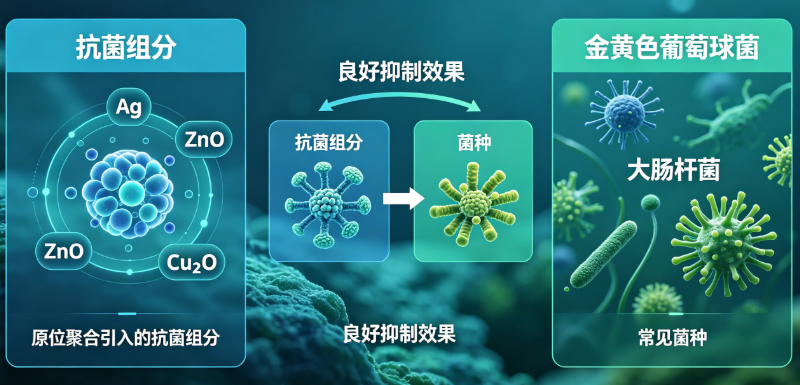
Physical/Chemical Contact DamageAntimicrobial components (such as nano metal oxides and quaternary ammonium salts) interact electrostatically or chemically with bacterial cell walls, disrupting their structure and function and leading to bacterial death. Studies have shown that the Au@Cu₂O-ZnO ternary heterojunction material introduced via in-situ polymerization exhibits excellent antibacterial activity against both Staphylococcus aureus and Escherichia coli.
Metal ion leachingRepresented by Zn²⁺ and Ag⁺, antimicrobial ions are slowly released from the material, enter bacterial cells, bind to thiol groups of enzymes, disrupt their metabolic functions, and ultimately lead to bacterial death.
Polymerization Mechanism: In Situ Copolymerization and Composite Chemical Reaction Pathways
The key to in-situ polymerization modification lies in the precise control of chemical reactions, and the specific pathways vary depending on the functional components introduced.
In-situ copolymerization pathway (taking phosphorus-containing copolymer monomer as an example)
This path is primarily achieved through the following two methods:
Method 1: Copolymerization with reactive monomers
Method 2: Using a flame retardant pre-polymer containing reactive groups
Another common strategy involves first pre-polymerizing a phosphorus-containing flame retardant, a diamine, and a diol to generate a flame retardant prepolymer with reactive end groups, which is then introduced into the PA66 polymerization system to participate in the copolymerization.
2. In-situ Composite Pathway (Taking Nanoparticles as an Example)
This method focuses on physical dispersion, that is, adding pre-prepared functional nanoparticles during the polymerization of PA66. In the liquid phase environment of polymerization, the nanoparticles are uniformly dispersed through stirring, ultrasonication, and other methods, and are finally "frozen" into the PA66 matrix.
Material Properties: Balancing Flame Retardancy, Antibacterial Properties, and Mechanical Performance
The comprehensive properties of PA66 have undergone significant changes through in-situ polymerization modification.
Flame Retardancy
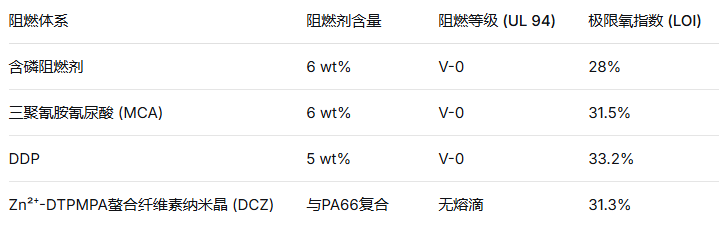
In-situ polymerization significantly improves the flame retardancy of PA66. The specific effects can be referred to in the following table:
Antibacterial properties
Effectiveness: Antibacterial components (e.g., Ag, ZnO, Cu₂O) introduced via in-situ polymerization exhibit good inhibitory effects against common bacterial strains such as Staphylococcus aureus and Escherichia coli.
Stability: Since the antimicrobial components are uniformly dispersed throughout the material, the antimicrobial effect is long-lasting and stable, outperforming simple surface coatings.
Mechanics and Thermal Properties
The introduction of flame retardants typically leads to changes in mechanical properties.
Strength: Tensile strength may decrease slightly (e.g., 58.44 MPa after DDP modification) but can be increased by up to 61.9% through specific techniques (such as chelation cross-linking interface design).
Toughness: In-situ polymerized composite systems often lead to a decrease in toughness, manifested as a reduction in elongation at break.
Crystallization behavior: The introduction of flame retardants typically hinders molecular chain movement, leading to a decrease in crystallization temperature and crystallization rate, and the formation of smaller crystal grain sizes.
Thermal stability: The introduced flame retardant may act as an impurity, triggering degradation and leading to a decrease in the initial thermal decomposition temperature.
Technological Innovation and Frontier Development
Multi-functionality Synergy: Developing “integrated” additives that combine flame retardancy, antibacterial properties, and anti-dripping performance has become a recent research hotspot. For instance, the incorporation of Zn²⁺-DTPMPA-chelated cellulose nanocrystals (DCZ) simultaneously enhances flame retardancy and antibacterial activity, suppresses melt dripping, and improves mechanical properties.
Bio-based and Environmentally Friendly: Eco-friendly PA66 is prepared using biomass-derived flame retardants (e.g., phytic acid, tannic acid) and antimicrobial agents to meet sustainability requirements.
Performance-Process Balance: Future research will focus on how to enhance flame retardancy through molecular design while minimizing negative impacts on mechanical properties and processability.
In-situ polymerization technology provides a reliable platform for preparing high-performance, multifunctional PA66 materials. By incorporating functional components during the polymerization stage, this technology enables uniform and durable distribution of flame-retardant and antibacterial properties, while achieving multifunctional integration through synergistic effects. Current research has entered a new developmental stage characterized by multifunctionality, high performance, and green sustainability.
【Copyright and Disclaimer】The above information is collected and organized by PlastMatch. The copyright belongs to the original author. This article is reprinted for the purpose of providing more information, and it does not imply that PlastMatch endorses the views expressed in the article or guarantees its accuracy. If there are any errors in the source attribution or if your legitimate rights have been infringed, please contact us, and we will promptly correct or remove the content. If other media, websites, or individuals use the aforementioned content, they must clearly indicate the original source and origin of the work and assume legal responsibility on their own.
Most Popular
-

A Look at the Material Suppliers Behind SpaceX
-

Government's Triple Action, Enterprises' Three Arrows in Five Days, Semiconductor Reshuffle! What Signal Does Japan's Chemical Industry Release?
-
Fire breaks out at jiangsu meiside!
-
Name change without tax change: POM Anti-Dumping Duty Rate Inheritance Implemented
-
Ethylene: Production Capacity Accelerates Expansion, Global Industry Landscape Is Being Reshaped


