



Implementation Details of the Quality Supervision and Spot Check for Fully Biodegradable Plastic Products in Hainan Province XZ02-2025
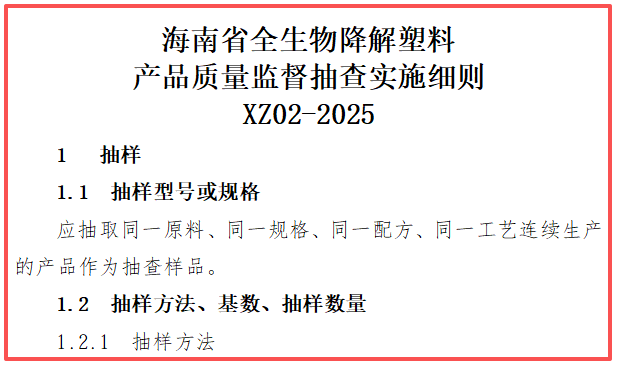
1 Sampling
1.1 Sampled model or specification
Samples for inspection should be drawn from products continuously produced with the same raw materials, the same specifications, the same formula, and the same process.
1.2 Sampling Method, Population, and Sample Size
1.2.1 Sampling Methods
Randomly sample products that have been inspected and deemed qualified by the manufacturer, or are indicated as qualified by any means, from the finished goods warehouse of the manufacturing enterprise or within the circulation sector.
For fully biodegradable plastic products, fully biodegradable agricultural mulch films, biodegradable plastic shopping bags, biodegradable garbage bags, and disposable degradable tableware, products shall be randomly sampled from piles of finished products that have passed self-inspection in the finished-product warehouse of the manufacturing enterprise. Finished products continuously produced with the same raw materials, same specifications, same formulation, and same process shall constitute one inspection batch.
When samples are taken in the distribution sector, the sampling base only needs to meet the sampling quantity.
1.2.2 Sampling Base
In the finished product warehouse of a manufacturing enterprise, among products that have passed self-inspection, the total quantity of products made from the same raw materials, of the same specifications, with the same formulation and the same process, not exceeding 5 tons, shall be taken as the sampling base, and shall not be less than the minimum sampling quantity; for products exceeding 5 tons, each 5 tons shall be regarded as one batch, and any quantity less than 5 tons shall be counted as one batch.
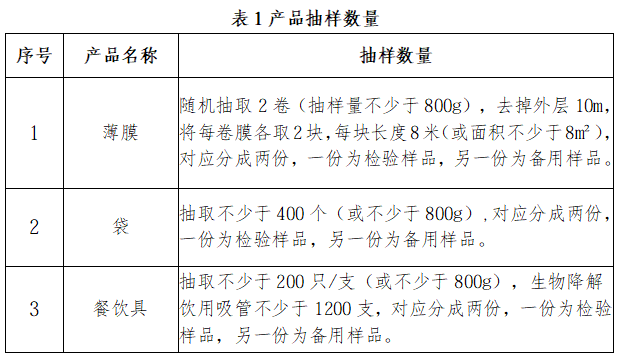
1.2.3 The product sampling quantity is shown in Table 1.
1.3 Sampling Precautions
1.3.1 For sampling in the distribution sector, the distributor shall be required to provide purchase invoices or inspection receipts and the business license for recordation, and the manufacturer indicated on the product packaging or nameplate shall be notified in writing for confirmation, or the manufacturer shall be requested to be present for on-site confirmation.
1.3.2 For finished goods or products, sampling shall be carried out in their intended form of use. For products with different thicknesses and densities, if their chemical structure and composition are identical, only the product with the greatest thickness and density needs to be sampled.
1.3.3 The sampling form shall be completed in accordance with the relevant requirements, and information on the products and the enterprise subject to inspection shall be recorded. At the same time, record the total sales amount of the products produced by the inspected enterprise in the previous year; for products not produced in the previous year, record the total sales amount for the current year, in ten-thousand yuan, and indicate this accordingly. In the specifications column of the sampling form, the product nominal load-bearing capacity, nominal capacity, dimensions (length, width, thickness), and for biodegradable straws, the following shall be indicated: nominal outer diameter, nominal length, nominal mass per 100 straws, as well as type and material (e.g., PBAT, PLA), etc. Such information shall be obtained at the sampling site and confirmed by the enterprise.
1.3.4 When collecting samples, attention should be paid to the samples’ shelf life. Samples that have exceeded their shelf life or have less than 30 days remaining before expiration shall not be collected.
2 Inspection
2.1 Test Basis
GB/T 27590-2022 Paper Cups
GB/T 41008-2021 Biodegradable Drinking Straws
GB/T 35795-2017 Fully Biodegradable Agricultural Mulching Film
GB/T 38082-2019 Biodegradable Plastic Shopping Bags
GB/T 33798-2017 Biopolyester Roll Bags
GB/T 28018-2011 Biodegradable Plastic Refuse Sacks
GB/T 18006.3-2020 General Technical Requirements for Disposable Degradable Tableware
QB/T 4012-2010 Starch-based Plastics
DB46/T 505-2020 General Technical Requirements for Fully Biodegradable Plastic Products
GB/T 6040-2019 General Principles of Infrared Spectroscopic Analysis Methods
DB46/T 520-2020 Rapid Detection Method for Fully Biodegradable Plastic Products by Nuclear Magnetic Resonance Spectroscopy
GB 4806.7-2023 National Food Safety Standard Plastic Materials and Articles for Food Contact Use
Regulations on Prohibiting Single-Use Non-Biodegradable Plastic Products in Hainan Economic Special Zone
Current and valid enterprise standards, association standards, local standards, and expressly stated product quality requirements.
2.2 Inspection Items
The provincial supervision and random inspection items for biodegradable plastic products are detailed in Table 2-10.
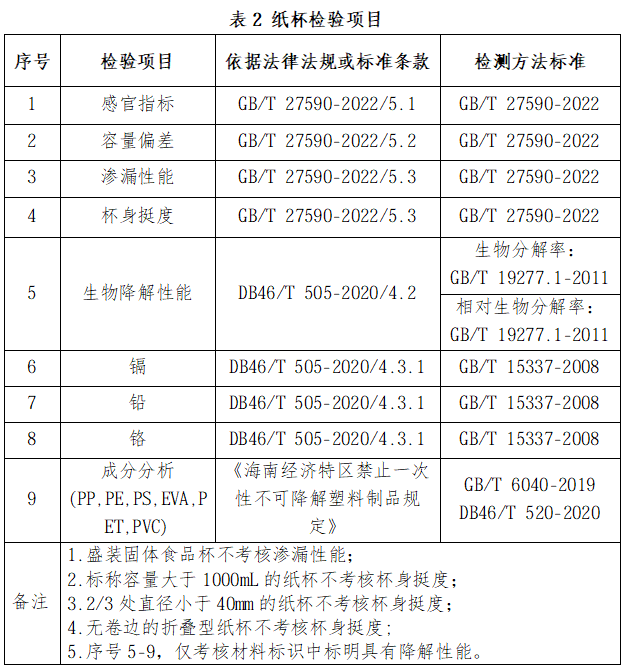
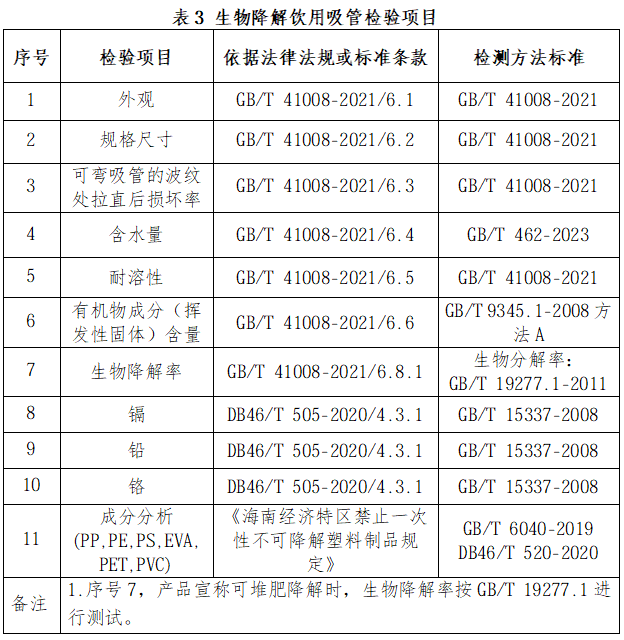
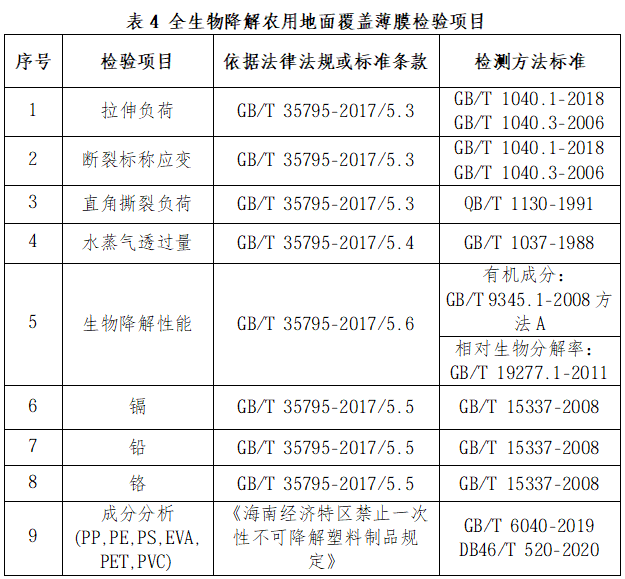
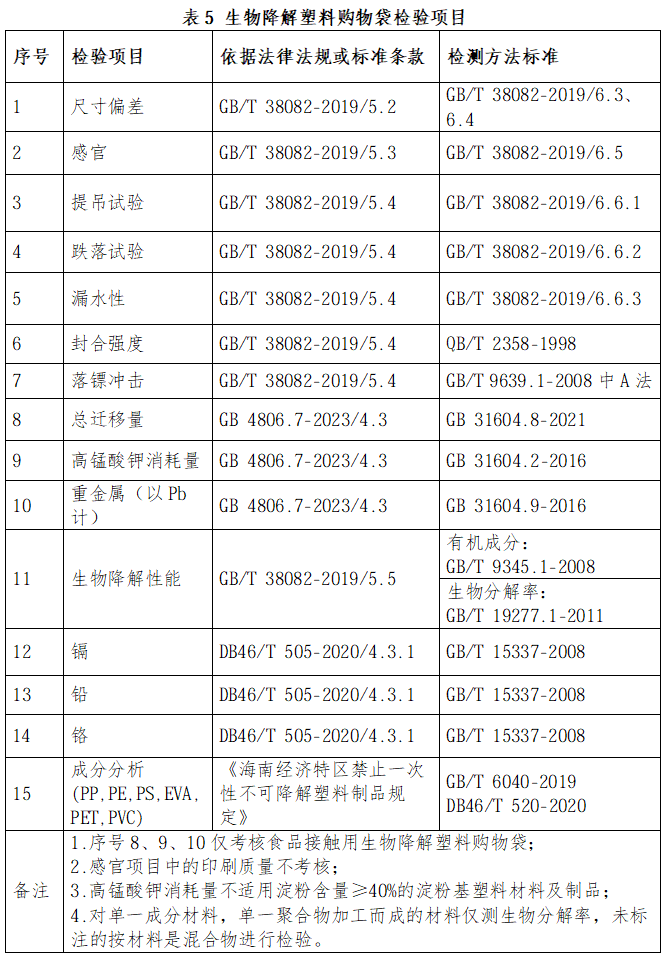
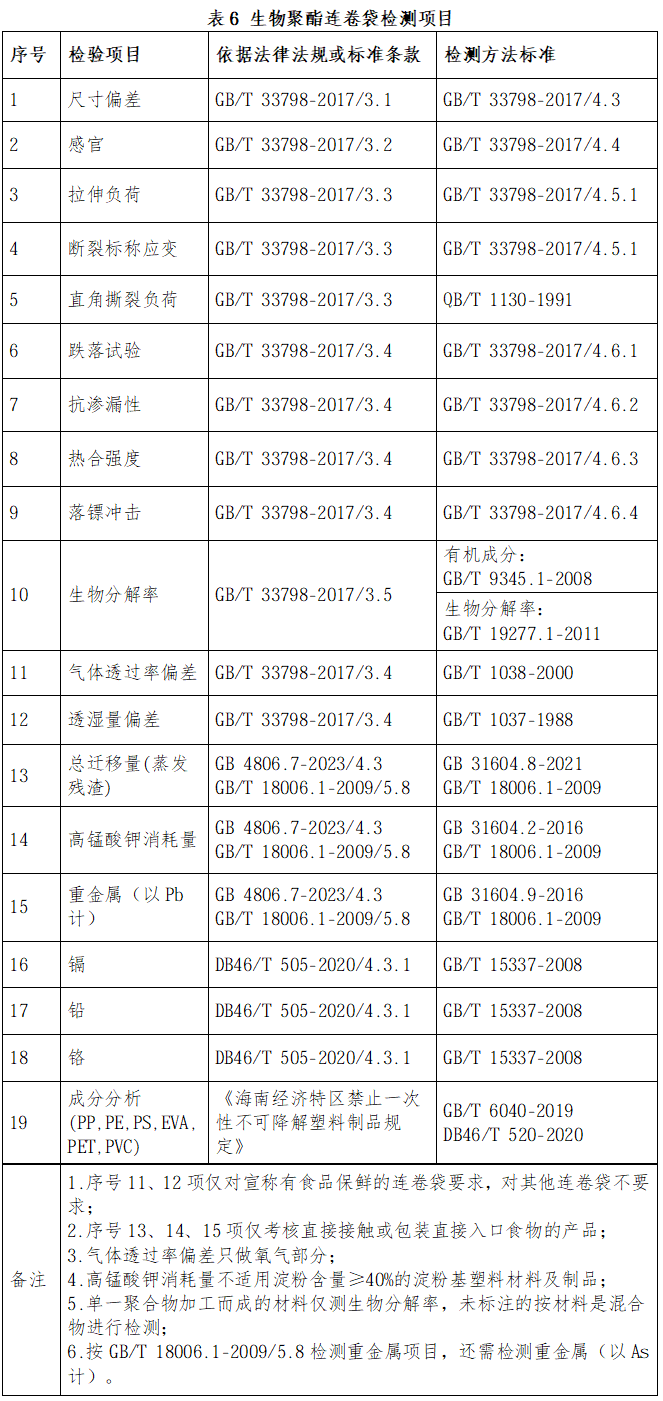
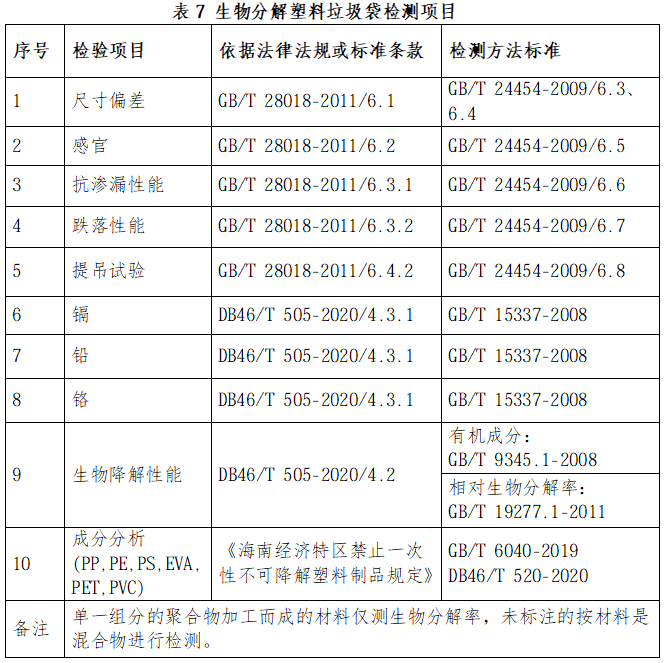
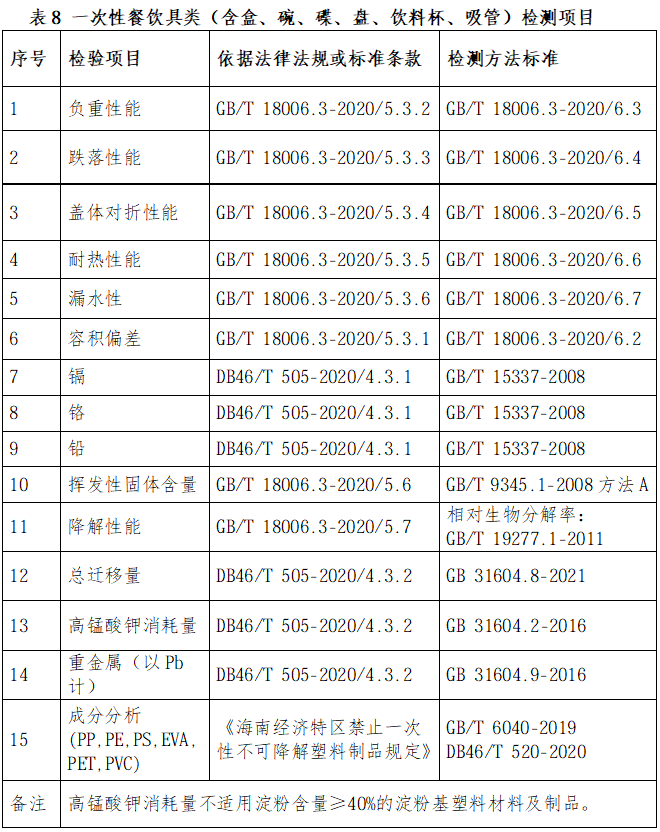
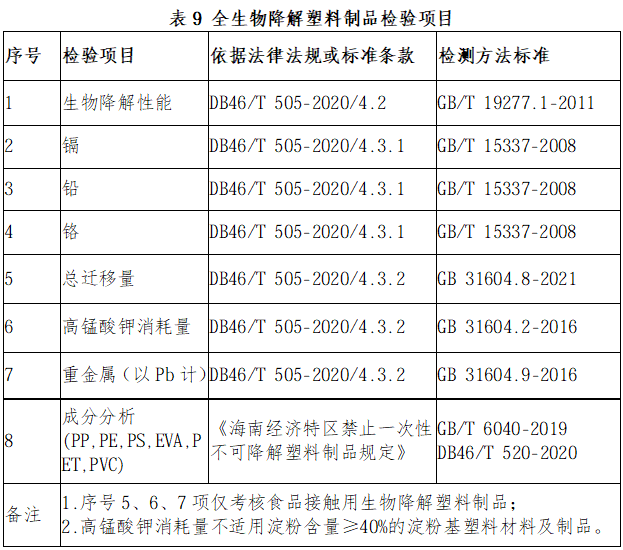
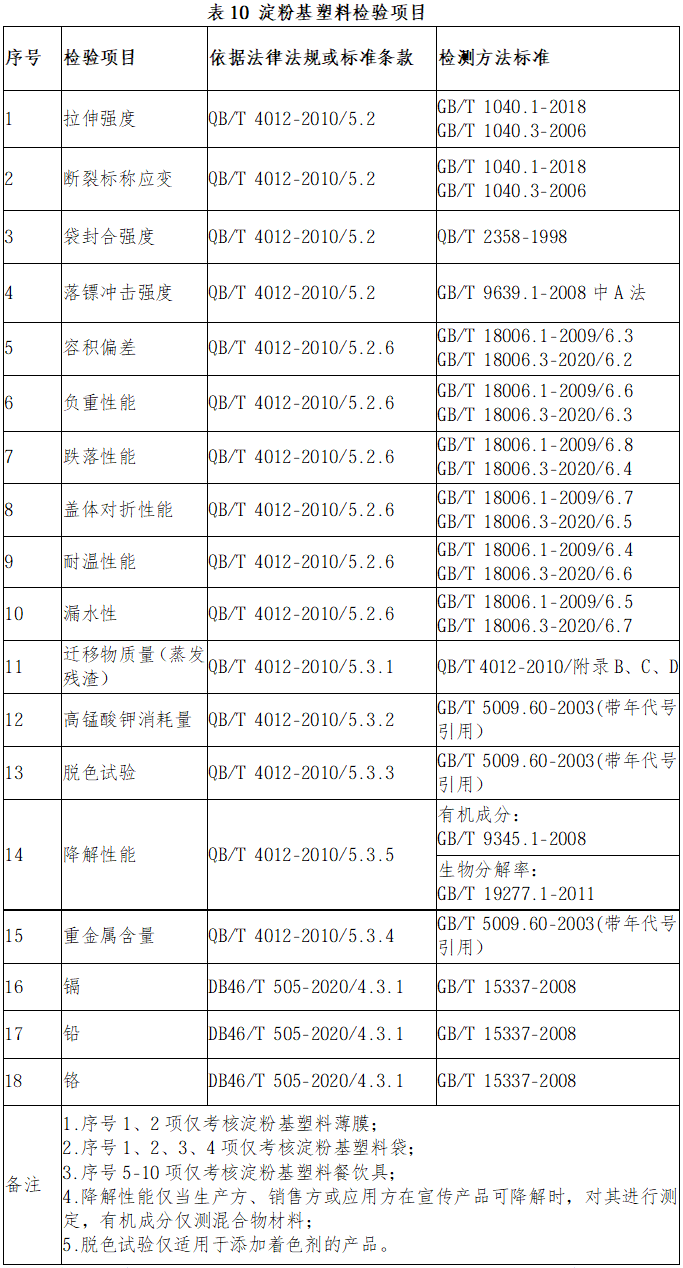
If the implementation standard for the sampled product is not listed in these detailed rules, and the sample label indicates degradable properties, the inspection items shall be carried out with reference to DB46/T 505-2020. For cadmium, lead, and chromium as heavy metals in DB46/T 505-2020, only the contents in plastic products before composting shall be tested. The composition of the sample shall be analyzed; if the main components of the sample are biodegradable materials, the biodegradability test shall not be conducted. If the product contains non-biodegradable materials, the biodegradability test shall be conducted. If the biodegradability item is unqualified, no retest shall be conducted. If the tested material is a mixture, the biodegradation rate of each organic component accounting for ≥1% of the material shall not be tested individually, nor shall it be tested whether the total amount of organic components with a content of <1% in the mixture is <5%. For products implementing enterprise standards, association standards, or local standards, the inspection items shall be carried out with reference to the above content.
3 Decision Rules
Upon inspection, if all test items are qualified, the sampled product is deemed qualified; if any one or more test items are unqualified, the sampled product is deemed unqualified.
If the quality requirements explicitly stated for the inspected product are higher than the standard requirements based on the inspection items in this specification, the determination should be made according to the explicitly stated quality requirements of the inspected product.
If the quality requirements explicitly stated for the inspected product are lower than the mandatory standard requirements based on the inspection items in this specification, the determination should be made according to the mandatory standard requirements.
If the explicitly stated quality requirements of the inspected product are lower than, or include, the requirements of the recommended standards on which the inspection items in these rules are based, the explicitly stated quality requirements of the inspected product shall prevail in making the determination.
If the stated quality requirements of the inspected product do not include the mandatory standard requirements that serve as the basis for the inspection items in these detailed rules, the determination shall be made in accordance with the mandatory standard requirements.
If the explicitly stated quality requirements of the inspected product do not include the requirements of the recommended standards on which the inspection items in these Detailed Rules are based, such items shall not be included in the determination.
【Copyright and Disclaimer】The above information is collected and organized by PlastMatch. The copyright belongs to the original author. This article is reprinted for the purpose of providing more information, and it does not imply that PlastMatch endorses the views expressed in the article or guarantees its accuracy. If there are any errors in the source attribution or if your legitimate rights have been infringed, please contact us, and we will promptly correct or remove the content. If other media, websites, or individuals use the aforementioned content, they must clearly indicate the original source and origin of the work and assume legal responsibility on their own.
Most Popular
-
Ascend Adipic Acid Hit By Force Majeure, Market Expects Supply Resumption In Mid-September
-

Layoffs, Divestments, Plant Closures While Pouring Billions: BASF Undergoes Major Transformation!
-
LG Chem And TK Chemical Sign PBAT Cooperation MOU
-

[Overseas News] Dow Considering Exit From Joint Venture With Saudi Aramco; US Government Pressures Ford to Cut Ties With China
-
AI Computing Power Demand Ignites Electronic Fabrics! China Jushi Hits Limit Up! Domestic Substitution Welcomes Golden Window


