



How to advance automotive technology innovation during the 15th five-year plan
The year 2026 marks the beginning of the 15th Five-Year Plan period, and China's automotive industry is at a critical juncture of transitioning from being large to becoming strong. At the press conference of the China Society of Automotive Engineers Annual Conference and Exhibition and the AITX Automotive Innovation Technology Exhibition held on June 3rd, Hou Fushen, Vice Chairman and Secretary-General of the China Society of Automotive Engineers, systematically outlined the landscape of automotive technological innovation for the next five years.
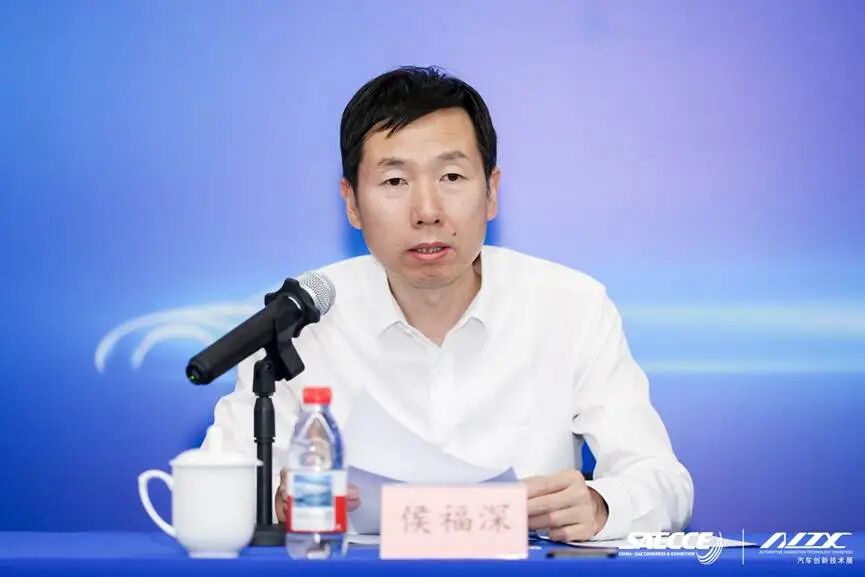
Image source: China Society of Automotive Engineers
Hou Fushen pointed out that over the next five years, China’s automotive industry will usher in a new stage of development featuring electrification, intelligence, and internationalization.
First, electrification technologies are accelerating their upgrade and iteration, and new energy vehicles are dominating the market.Intrinsic wide-temperature-range high-safety liquid power batteries, solid-liquid hybrid batteries, all-solid-state batteries, as well as new materials and new topological drive motors, will significantly enhance the competitiveness of new energy vehicles. It is expected that by 2030, the share of new energy vehicles in passenger car sales will exceed 70%.
Second, AI-driven industrial transformation is accelerating comprehensively, with digital and intelligent transformation expanding from single products to the entire industry chain.Fully end-to-end large models, vision-language-action models, world models, and other technologies will be applied at scale over the next five years, driving the full popularization of L2 combined driver-assistance systems and enabling L3 and L4 autonomous driving to move from pilot demonstrations to scaled deployment, with penetration in new passenger vehicles exceeding 35%. “AI + Automotive” will extend from products to the entire chain of R&D, production, supply, sales, and service, profoundly transforming the R&D paradigms, production methods, and business models of the traditional automotive manufacturing industry and reshaping the industrial ecosystem.
The competitive landscape of the automotive industry is being reshaped, with internationalization becoming an important growth driver.China will become a global hub for cutting-edge automotive technology innovation and an important market for large-scale validation and pioneering application of new technologies and new business models. The role of overseas markets in driving sales will become more prominent. It is expected that by 2030, China’s overseas automobile sales will reach nearly 10 million units, of which about 40% will come from local production and sales overseas.
Facing new trends and changes in development, Hou Fushen believes that China’s automotive technological innovation should focus on three core tasks over the next five years.
First, strengthen basic research and innovation in cutting-edge technologies.The current development of automotive technology has entered a "deep water zone" and an "unexplored area," making the importance of original, forward-looking, and disruptive innovation more prominent than ever before. He emphasized that enhancing basic research and the capability for original innovation in cutting-edge technologies will be the top priority for industrial scientific and technological innovation in the next five years. Accurately grasping the trends and directions of frontier technologies will become a crucial prerequisite for the industry to carry out high-level scientific and technological innovation.
Second, promote the deep integration of technological innovation and industrial innovation.To promote the deep integration of the innovation chain and the industrial chain from the source of automotive technological innovation, it is essential to foster collaborative innovation across production, education, and research, as well as upstream and downstream sectors and cross-disciplinary fields. This involves vertically connecting the entire chain from key materials, components and parts, system assembly, to manufacturing processes and equipment, and horizontally breaking through all stages including technology research and development, pilot testing and verification, transfer and transformation, and application promotion. This approach ensures that innovation achievements genuinely serve industrial development and benefit the broad market and users.
Third, deepening the transformation of the technological innovation paradigm with artificial intelligence.Artificial intelligence is reshaping the fundamental logic of automotive technology innovation at an unprecedented speed, depth, and breadth, having a disruptive impact on traditional development models such as "trial and error iterations" and "rule-driven" approaches. It has been pointed out that promoting "AI for Science" (AI4S) to better integrate into the automotive industry's innovation system, reshape the innovation paradigm, and unleash innovative efficiency has become an important issue facing high-level innovative development in the industry.
【Copyright and Disclaimer】The above information is collected and organized by PlastMatch. The copyright belongs to the original author. This article is reprinted for the purpose of providing more information, and it does not imply that PlastMatch endorses the views expressed in the article or guarantees its accuracy. If there are any errors in the source attribution or if your legitimate rights have been infringed, please contact us, and we will promptly correct or remove the content. If other media, websites, or individuals use the aforementioned content, they must clearly indicate the original source and origin of the work and assume legal responsibility on their own.
Most Popular
-

Layoffs, Divestments, Plant Closures While Pouring Billions: BASF Undergoes Major Transformation!
-

Ascend Adipic Acid Hit By Force Majeure, Market Expects Supply Resumption In Mid-September
-

Raw Material Supply Shortage! INEOS Phenol Declares Force Majeure on Phenol and Acetone Businesses
-
South Korea initiates anti-dumping investigation against Chinese PVC suspension resin! The target is Tianjin Bohua and Wanhua Chemical. How to break through?
-

Sixth national procurement set to be implemented: A “Reshuffling” Moment for the $10-Billion Medical Device Market


