



How This Domestic Chip Company Achieved "A+H" Dual Listing in Three Years
Recently, Naxin Microelectronics rang the bell for its listing on the Hong Kong Stock Exchange, officially completing its "A+H" dual capital market layout. From its 2022 debut on the A-share STAR Market to its 2025 listing in Hong Kong, this company, focused on analog and mixed-signal chips, achieved this in less than three years. This is considered legendary against the backdrop of a persistently sluggish capital market and volatile semiconductor industry cycles.

Image Source: Naxin Micro
At the same time, recent financial data shows that the growth trajectory of Naxinwei can be described as "counter-cyclical."。
After going public in the A-share market in 2022, the company faced the end of the global chip "shortage" in 2023, leading the industry into a situation of high inventory pressure and fierce price wars. At that time, Naxin Micro's quarterly revenue was approximately 250 million yuan. However, in just over two years, by the third quarter of 2025, the company's quarterly revenue had skyrocketed to 840 million yuan, achieving ten consecutive quarters of sequential growth. Looking at the entire domestic analog chip sector, Naxin Micro's growth rate is also considered very rapid. According to the financial report, in the first three quarters of 2025, the company's revenue growth rate exceeded 70% year-on-year, and even after excluding the additional revenue contribution from the acquisition of Magen, the year-on-year growth still reached 50%, indicating strong growth momentum.
What did this domestic chip company do right to achieve impressive results? What are the driving factors behind its rapid development? Additionally, why did it choose to list on the Hong Kong stock exchange? After listing, how does it plan and strategize its layout?
Recently, Gasgoo Auto interviewed Wang Shengyang, the founder, chairman, and CEO of Naxin Micro, Sheng Yun, the co-founder, vice president, and CTO, and Wang Yifeng, the co-founder, vice president, and COO, to explore the growth secrets behind the company for industry reference.
Since the company's establishment in 2013, the three individuals have each taken on their roles, working hand in hand from their youthful beginnings to their forties, pushing the company from obscurity to the pinnacle of the industry, collectively writing a remarkable entrepreneurial story.
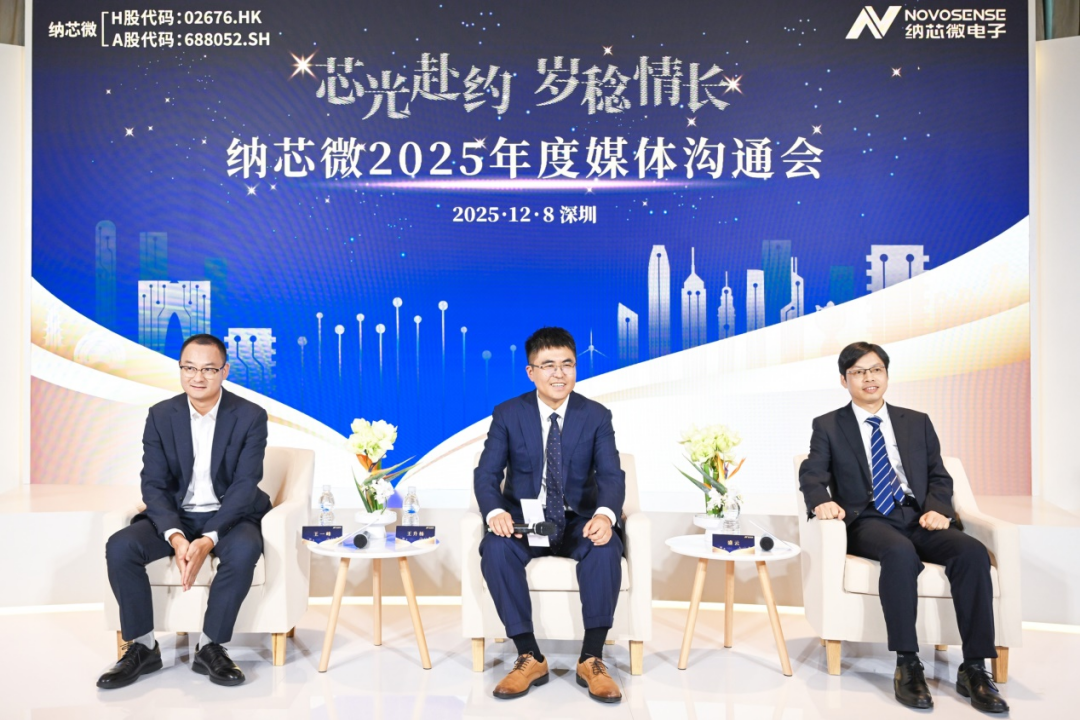 The people in the picture are introduced as follows: Wang Shengyang (in the picture), founder, chairman, and CEO of Naxinwei; Sheng Yun (on the right), co-founder, vice president, and CTO; Wang Yifeng (on the left), co-founder, vice president, and COO.
The driving "code" behind rapid development
Talking about his journey, Wang Shengyang stated that since its establishment in 2013, Naxinwei has faced numerous challenges. Especially since 2023, the company has gradually emerged from the quagmire of destocking, going through intense market competition and rapid changes in the entire industry during this process. "However, despite the difficult external environment, we have always insisted on doing the right things: focusing on our core sectors, continuously developing products, building core capabilities, and doing everything possible to serve key clients in various industries. This commitment to long-term value has resulted in relatively impressive performance."
Driving Force 1: Accurately capturing industry trends and focusing on high-growth sectors.
Naxin Micro's success first stems from strategic determination in choosing its field. The company early on focused onComprehensive Energy and Automotive ElectronicsTwo major fields, while simultaneously expanding into consumer electronics, communications, and other areas.
In the past five years, the global analog semiconductor market has been growing at an approximate annual rate of 10.2%. Looking ahead, the expected growth rate for the next four years will remain around 7.9%. The overall growth rate of analog chips in China, whether in the past five years (12.7%) or the expected rate for the next four years (11.0%), is expected to be slightly faster than the global market rate.
From the perspective of downstream industries, the growth in the fields of general energy and automotive electronics is particularly remarkable, providing a vast market space for Naxinwei's development. In the first half of 2025, the revenue from Naxinwei's automotive and general energy sectors accounted for 34% and 52.7%, respectively.
Pan-energyThe concept of this name was proposed by Naxin Micro, which combines various scenarios related to the generation side, transmission side, and consumption side (mainly the power consumption side) of new energy, and refers to it as Pan-energy. From the perspective of industry trends, the Pan-energy sector is undergoing a structural transformation from traditional fossil fuels to new energy sources. The rapid development of industries such as photovoltaics, energy storage, and new energy generation has led to a significant demand for new types of chips. Over the past few years, Pan-energy has consistently accounted for more than 50% of Naxin Micro's revenue, and the company has achieved comprehensive coverage of part numbers for typical business scenarios. According to financial report data, the revenue for the first three quarters of this year has already exceeded that of the entire previous year.
The automotive business is the most vigorous growth driver for Naixin Micro. A car contains only a few large chips (such as autonomous driving chips and domain control chips), but the number of analog chips can reach hundreds or even thousands. Especially in recent years, as the automotive industry accelerates its transition towards electrification and intelligence, the demand for power devices and sensors driven by electrification has surged, while the demand for in-vehicle interfaces, audio amplifiers, radar chips, and other products spurred by intelligence has exploded, creating unprecedented market opportunities for analog chip companies.
Naxin Micro operates in the high-barrier field of automotive analog chips, where the domestic production rate is only about 10%.Revenue from 386 million yuan in 2022,Growing against the trend to 404 million yuan in 2023, and then soaring to 719 million yuan in 2024.Expected to rise to 12 in 2025.~1.3 billion yuan. The shipment volume has also increased exponentially: 100 million units in 2022, 363 million units in 2024.It is expected that the total shipment volume for the year 2025 will exceed 700 million units.。Nowadays, the average Chinese-produced car is equipped with over 20 microchips, while in new energy vehicles, this number is 40-50. In some mainstream models, the single-vehicle value (CPV) of microchips is close to 350 yuan.

Image source: Naxin Micro
Driving Force 2: Continuously improving the product matrix and accelerating commercial implementation.
The business growth of Naxin Micro is closely related to its continuous expansion of product lines and the rapid implementation of new products. According to Wang Shengyang, currently, The number of sellable product part numbers has explosively increased from over 800 in 2021 to over 4,000 by the third quarter of 2025.Achieved a fivefold growth in four years, forming a diverse product matrix covering multiple categories such as analog signal chain, power management, sensors, and MCUs.This means that every day, Naxin Micro has new chip models launched in the market.
In the automotive electronics field, Naxinwei has formed a mature production, rapid growth, and recently mass-produced product lineup.
Mature mass-produced products focus on the three electric systems of new energy vehicles and the powertrain of fuel vehicles, contributing approximately 70% of the revenue from the automotive business.
The rapidly growing products include motor drives, power management, and automotive lighting drivers, becoming new growth engines.
Recently, mass-produced products successfully entered high-end fields such as intelligent cockpits, autonomous driving, chassis, and safety.Automotive-grade SerDes chipset, AK2 ultrasonic radar suite, wheel speed sensor based on AMR technology, four-channel digital input Class D audio power amplifier, automotive-grade SBC system basic chip, etc. have been released and achieved breakthroughs. Some products have been designated by leading global customers, and are expected to become new growth lines for the company in the future.

Overview of Naxin Micro Automotive Electronics Product Line (Image Source: Naxin Micro)
In the pan-energy field, the NSSine™ series released by Naxinwei in 2024 has shown significant progress in the M7 single-core real-time control MCU products, and has now expanded to a large number of customers, with automotive customers accounting for a considerable proportion. Several have completed porting development and small batch verification.
Driving Force Three: From "P2P Substitution" to "Collaborative Innovation," Creating Differentiated Advantages
With the continuous rise of domestic brands, domestic substitution has become the focus of industry attention. In this regard, Wang Shengyang has shared his views.The true value of Chinese chip companies is not simply to replace foreign manufacturers.Of course, P2P alternatives are meaningful because they are the first step into the market. However, moving forward, it should be based on a deep understanding of the future application trends in the industry, collaborating on joint innovation with automotive companies and excellent supply chain enterprises.
Sheng Yun further stated that in the past few years, Naxinwei has adopted a Pin-to-Pin compatible product form for simple or general-purpose analog materials, addressing the "yes or no problem" of domestic substitution for customers. In the past two years, Naxinwei has begun to explore further innovative opportunities in these general products in collaboration with leading customers, seeking product breakthroughs that are more forward-looking than those of overseas competitors.
Over the past year, we have co-developed automotive pressure sensor chips with functional safety features in collaboration with leading global automotive component companies, enhancing product reliability and accuracy. These chips can be widely used in critical systems such as automotive airbags and battery pack collision monitoring. We have also worked with leading new energy vehicle manufacturers to develop the next generation of automotive tail light driver chips, offering customized LED animation effects and improving system load capacity. These products are not merely simple import substitutes but are differentiated joint innovation achievements.
In the view of Naxin Micro, collaborative innovation is the core of creating product differentiation advantages and enhancing corporate competitiveness. Wang Shengyang pointed out that.In the future, differentiated and customized innovative products will account for 70% of new product development.
Driving Force Four: Not just leading in products, but winning with a superior system.
If product innovation is the "spear" of Naxinwei, then systematic capability is the company's "shield." During rapid expansion, Naxinwei has focused on building a research and development system and quality management system that meet international standards, providing sustainable support for business growth.
● Replicable R&D System
Since 2018-2019, Naxin Micro began establishing a research and development process, building a research and development system in accordance with the IPD process. This has formed a complete process from product demand research and project initiation to official mass production and full lifecycle management. Additionally, it has been solidified through a self-developed R&D management system, achieving standardized product development.
"Many people say that NaXinwei releases products quickly, but behind the rapid product launch is actually the support of this R&D system. By 2025, the company will have more than 100 projects under development simultaneously, releasing hundreds or even thousands of new products each year. An efficient R&D system has become the core support for rapid product iteration," Wang Shengyang pointed out.
The Iron Law of Quality Embedded in Genes
"Quality and safety are always the bottom line. As a chip company in the automotive field, we deeply understand this principle. Our chips are extensively used in various automotive components, and any issues can pose serious safety risks to end users. Therefore, in the past few years, Naxin Micro has invested a significant amount of resources and effort to focus on building our comprehensive quality management system," said Wang Shengyang.
Project Initiation PhaseNaxin Micro conducts feasibility analysis and comprehensive quality planning in seven major aspects, carefully selects the supply chain, and exercises cross-level management over key secondary suppliers.Product design phaseSet up 10+ technical review nodes, develop a checklist with 1000+ review points, specify 50+ R&D deliverables, and establish a comprehensive FMEA system.Chip verification stageAchieve 100% coverage of planning parameters across all temperature zones, conduct individual limit verification, complex system application environment testing, and rigorous electromagnetic compatibility and electrostatic protection testing.Mass Production Introduction StageThrough multi-batch process offset validation, packaging DOE experiments, and tri-temperature testing, further screening of process defects was conducted.Reliability Testing PhaseConduct multiple tests, including high acceleration stress testing and temperature cycling shock testing, in strict accordance with AEC-Q100 requirements.Trial Production / Mass Production StageThrough the OneData system, continuously collect and analyze mass production data to implement 100% batch DPA/ORT monitoring.
This comprehensive, high-standard quality management system ensures product reliability and stability, and has helped Naxin Micro achieve rapid business growth.
Platform-based technological foundation
In addition to the quality system, the underlying technical capabilities are also very important.
In terms of process technology, Naxin Micro has established a dedicated process development team to create a competitive process platform that meets the needs of the next generation, focusing on target application scenarios. In circuit design, we achieve flexible combinations and rapid innovations of core technologies such as power conversion, signal processing, isolation, and interfaces through a platform-based technical solution, forming a complete technical IP portfolio that enables quick product iteration and innovation. In packaging, we collaborate closely with top packaging manufacturers to develop a series of differentiated packaging solutions, such as ultra-thin QFN packaging (thickness = 0.23mm) and ultra-wide SOIC packaging (creepage distance ≥ 15mm) among other specialized packaging technologies. On the engineering technology front, we have built a comprehensive reliability assessment and failure analysis laboratory certified by CNAS, equipped with the capability to perform reliability testing for all types of products.
The continuous investment in these underlying technology platforms forms the "soil" of product competitiveness.
In summary, the three-year "A+H" journey of Naxin Micro is a story about choices, perseverance, and evolution. It seized the historic opportunity of industrial upgrading and supply chain independence in China, focusing on high-end alternatives to replace low-end competition, surpassing simple substitution through collaborative innovation, and supporting sustained high-speed growth through systematic success.

Image source: Naxinwei
So, where will the company go after being listed on the Hong Kong Stock Exchange?
Anchor on Hong Kong stock listing to accelerate global expansion.
The "A+H" listing resolved the capital and brand issues during the early stages of development for A-shares, while the Hong Kong stock market is clearly defined by Naxinwei as "an important foothold in the journey of globalization."
Wang Shengyang pointed out that in the future, Nexchip Microelectronics will establish Hong Kong as its overseas operations and sales headquarters. In addition to serving overseas customers, it will also build an overseas supply chain system—taking Hong Kong as the operations center, placing orders with overseas wafer fabs, and after the wafer production is completed, there will be no need to return them to China. Instead, they will be directly transferred in Hong Kong to overseas packaging and testing partners. The entire logistics turnover will be completed overseas and then distributed through Hong Kong to various regional subsidiaries, which will ultimately complete sales to end customers. This layout can improve overseas operational efficiency and avoid the efficiency loss caused by separate operations in each region and settlement with the headquarters. The relevant plans will be gradually implemented after the Hong Kong company is established.
In the future, the company plans to establish a research and development center in Hong Kong to attract top global R&D talent. The resources of Hong Kong's universities and its international environment make it an ideal platform for connecting global R&D efforts. The company adheres to a "expatriate + localization" talent strategy, aiming to build a team with a truly global perspective and cultural integration capabilities.
"Hong Kong, as a hub connecting China with global capital and talent, closely collaborates with China's industrial advantages while also gathering global resources. Starting today, we hope to use the opportunity of being listed in Hong Kong to continuously attract top global talent, deepen global strategic cooperation, and serve global customers well, gradually transforming Naxin Micro from a local chip company into an international chip enterprise rooted in China and embracing the world. This is the goal we strive to achieve together in the new strategic cycle ahead."
Regarding how to expand overseas markets, Wang Yifeng mentioned the "three-step" strategy when Nanxinwei announced its globalization strategy in 2024.local for local,local for global,global for globalToday, we can make this strategy a bit more concrete.
1) The concept of "local for local" actually refers to what we've been doing over the past two to three years. During the time frame of 2019 to 2020, leveraging the global chip shortage, we were able to capture the attention of these international clients and help them solve their current challenges.
During the collaboration process, international clients have gained a deeper understanding of us. They have seen our planning in product platform development and the construction of systematic capabilities, considering us as partners who can accompany their development in the long term.We not only solved their current supply chain issues but also provided collaboration opportunities for their platform project.Based on this, we have entered the stage of local for global. We can see that in the past year or two, we have actually had a large number of projects that have gradually expanded from domestic collaborative projects to platform projects for international clients.
Next, we will enter the stage of "global for global." For example, using this Hong Kong listing as an opportunity, we have opened new capital channels, gained more brand exposure opportunities, received recognition from overseas capital, and promoted the development of our own global operational capabilities. We also hope to better serve these international clients on a global platform.
In fact, before its listing on the Hong Kong stock market, Naxin Micro had already made significant progress in overseas markets, especially achieving key breakthroughs in Europe and East Asia.
In the European market, Naxin Micro has achieved mass production with 15 global leading customers, including the world's leading suppliers of brake and chassis control systems, and the top 3 global suppliers of thermal management and vehicle lighting. It has been introduced to 5 customers, including the world's leading suppliers of digital cockpits and in-car entertainment systems, with the proportion of mass production customers increasing from less than 50% last year to over 60%. In East Asian regions such as Japan and Korea, the company has achieved mass production with 8 customers, including the world's leading battery technology suppliers and the top 10 global automotive parts suppliers. It has been introduced to the world's leading power and in-car charging system suppliers and the top 3 global automobile manufacturers.
"This progress has given us a lot of confidence. It shows us that Chinese chip companies actually have the opportunity to go global, and as long as we do our part and enhance our core capabilities, we are capable of establishing ourselves in the global market," Wang Shengyang stated.
In the face of challenges such as geopolitical issues and cultural integration when going overseas, Naxinwei's response is practical and clear: establish a comprehensive compliance system, actively learn from overseas clients about their processes and cultures, and win long-term cooperation with rigor and reliability. At the same time, clear goals have been set:By 2029, overseas revenue will account for 20% of the company's total revenue.
Strategic cycle iteration, formulating the development blueprint towards 2029.
For future development, Naxin Micro will take 2025 as the starting point of a new strategic cycle and has formulated a development strategy aimed at 2029. The core directions include the following aspects:
1. Focus on target industries: In the coming years, we will further expand the range of targeted industries. We will systematically expand one industry at a time, continuously improving the product planning and deployment specific to each focused target industry.
2. Around application innovation: In the future, innovative products will be the primary direction for new product development, with differentiated, innovative, and customized products accounting for 70% of new products.
3. Strengthening Core Competencies: Reinforce underlying core capabilities such as research and development, quality, and technology to support sustained business growth. "While a company's short-term development may rely on market capabilities and product performance, in the long run, there are many deeper capabilities that support the continuous advancement of products and markets. How to enhance these underlying core competencies is a very important direction for us over the next four years," said Wang Shengyang.
4. Operating in the Global Market: As a chip company, if you want to truly become a global leader, relying solely on the Chinese market is not enough—even though China is already the largest single market in the world. Companies must adopt an open mindset to attract global talent, embrace global collaboration, and serve global customers. This represents the future of the industry and the future direction for Chinese chip companies.
5. Building Organizational Capability: Enhance organizational efficiency through optimizing the organization, processes, and IT systems, achieving the transformation from founder-driven and core team-driven to multidimensional organizational-driven.
However, Wang Shengyang did not shy away from the company's profitability issues and market challenges and provided candid responses.
● Do not pursue rapid profitability with low revenue scale.
In recent years, Naxinwei's revenue has been on the rise, but net profit has experienced consecutive losses in 2023 and 2024 (with a net loss of 305 million yuan in 2023 and a net loss of 403 million yuan in 2024). However, in the first half of 2025, the loss narrowed to 78 million yuan, a year-on-year decrease of 70.6%. In this regard, Wang Shengyang provided a detailed explanation of the underlying reasons and solutions.
Increased market competition has led to a decline in gross profit margins; previously, the intense price war in the market has caused significant challenges for enterprises.
Regarding this issue,The short-term solution is to maintain market share, ensure continuous revenue growth, and address issues during development.This is the strategy we have been adhering to over the past few years, and we have already seen significant results, with the market competition situation easing.The long-term solution is to enhance the core competitiveness of the product.In the past, although our products have achieved mass production, there is still a gap in the underlying core competitiveness compared to internationally leading companies. For example, in terms of process platforms, we produce similar products with more mask layers, resulting in inherently higher costs and placing us at a disadvantage in price competition. Therefore, in recent years, we have focused on building core capabilities such as process platforms and packaging testing, and we are gradually seeing results with continuous optimization of our cost structure.
Increase investment in the new product direction.,Research and development costs have increased.
Despite significant financial pressure and controversy in the capital markets over the past few years, we have never cut any business direction. Currently, the company's mature products, growth products, and newly launched products in the automotive sector are essentially the results of concentrated investments made during the past few years (loss period). These short-term investments have increased the financial burden but laid a foundation for the company's long-term growth. At present, all the business areas we have invested in are progressing steadily.
"Our goal is not to pursue quick profits at a low revenue scale, but to achieve healthy and sustainable profitability based on a higher revenue scale and strong core competitiveness. We are now gradually seeing the light."Wang Shengyang said.
● Crossing the $1 billion industry threshold
Most domestic analog chip companies currently operate at a scale of around 3 billion yuan, still some distance from the industry threshold of 1 billion USD. Regarding this, Wang Shengyang stated,For Naxin Micro, the target revenue for 2029 will definitely be higher than 1 billion USD.
At the same time, he pointed out that 1 billion dollars is indeed an important threshold for analog chip companies, and over the past several years, domestic chip companies have consistently failed to break through this barrier. Many companies have stagnated when approaching this scale. This is not an isolated case but rather a systemic issue. The growth of analog chip companies can be roughly divided into three stages:
The first stage is founder-driven.In this model, where 1-3 founders lead the company's development, the company typically remains at a scale of under 1 billion yuan in revenue and one to two hundred employees. Because the founders have limited energy, it is difficult to manage all aspects of the business, leading to potential oversight.
The second phase is driven by the core management team.A core management team of like-minded individuals needs to be formed, with operational rights, responsibilities, and benefits delegated to them, allowing them to work alongside the founder to drive the company's development. In recent years, Naxinwei has done well in this regard, having built a core management team of several dozen members and gradually delegated core operational rights, responsibilities, and benefits. This model can support the company in reaching a scale of up to $1 billion.
Many domestic analog chip companies are currently stuck at this stage because the core management team has limited energy. As the business expands, each member of the management team has to take charge of more business and personnel, making it difficult to further drive company growth.
The third phase requires the establishment of a complete systematic organizational capability, achieving a second or even third level of delegation of rights, responsibilities, and benefits, allowing more grassroots employees to become the driving force behind the company's growth. The key to breaking the $1 billion threshold lies in the company's ability to build systematic organizational capabilities, facilitating the deep delegation of rights, responsibilities, and benefits, and enabling more people to participate in the company's drive. This is also a core focus of Naxinwei's strategic planning.
Regarding the future position of the enterprise in the industry, Wang Shengyang stated: "Our core still lies in doing our own work well, while we also hope that all our competitors can achieve good development. The development of the simulation chip industry requires collective breakthroughs, rather than a single company shining alone; this is the hallmark of a healthy industry ecosystem."
Summary:
The listing journey of Naxin Micro is not merely a capital narrative, but rather a complete epitome of a technology-driven enterprise that achieves business fission, system evolution, and strategic upgrading with the right strategy at the right time and in the right field. Its three years serve as a vivid illustration of the Chinese analog chip industry transitioning from "domestic substitution" to "global competition."。The story of Naxin Micro proves that Chinese chip companies can only secure a place in the global market competition by adhering to long-termism, broadening their perspectives and vision, focusing on core tracks, and building core capabilities.
【Copyright and Disclaimer】The above information is collected and organized by PlastMatch. The copyright belongs to the original author. This article is reprinted for the purpose of providing more information, and it does not imply that PlastMatch endorses the views expressed in the article or guarantees its accuracy. If there are any errors in the source attribution or if your legitimate rights have been infringed, please contact us, and we will promptly correct or remove the content. If other media, websites, or individuals use the aforementioned content, they must clearly indicate the original source and origin of the work and assume legal responsibility on their own.
Most Popular
-

List Released! Mexico Announces 50% Tariff On 1,371 China Product Categories
-

Nissan Cuts Production of New Leaf EV in Half Due to Battery Shortage
-

New Breakthrough in Domestic Adiponitrile! Observing the Rise of China's Nylon Industry Chain from Tianchen Qixiang's Production
-

Mexico officially imposes tariffs on 1,400 chinese products, with rates up to 50%
-
Dow, Wanhua, Huntsman Intensively Raise Prices! Who Controls the Global MDI Prices?

