



Hengli petrochemical pc latest ex-factory price rises 200 yuan/ton from previous period
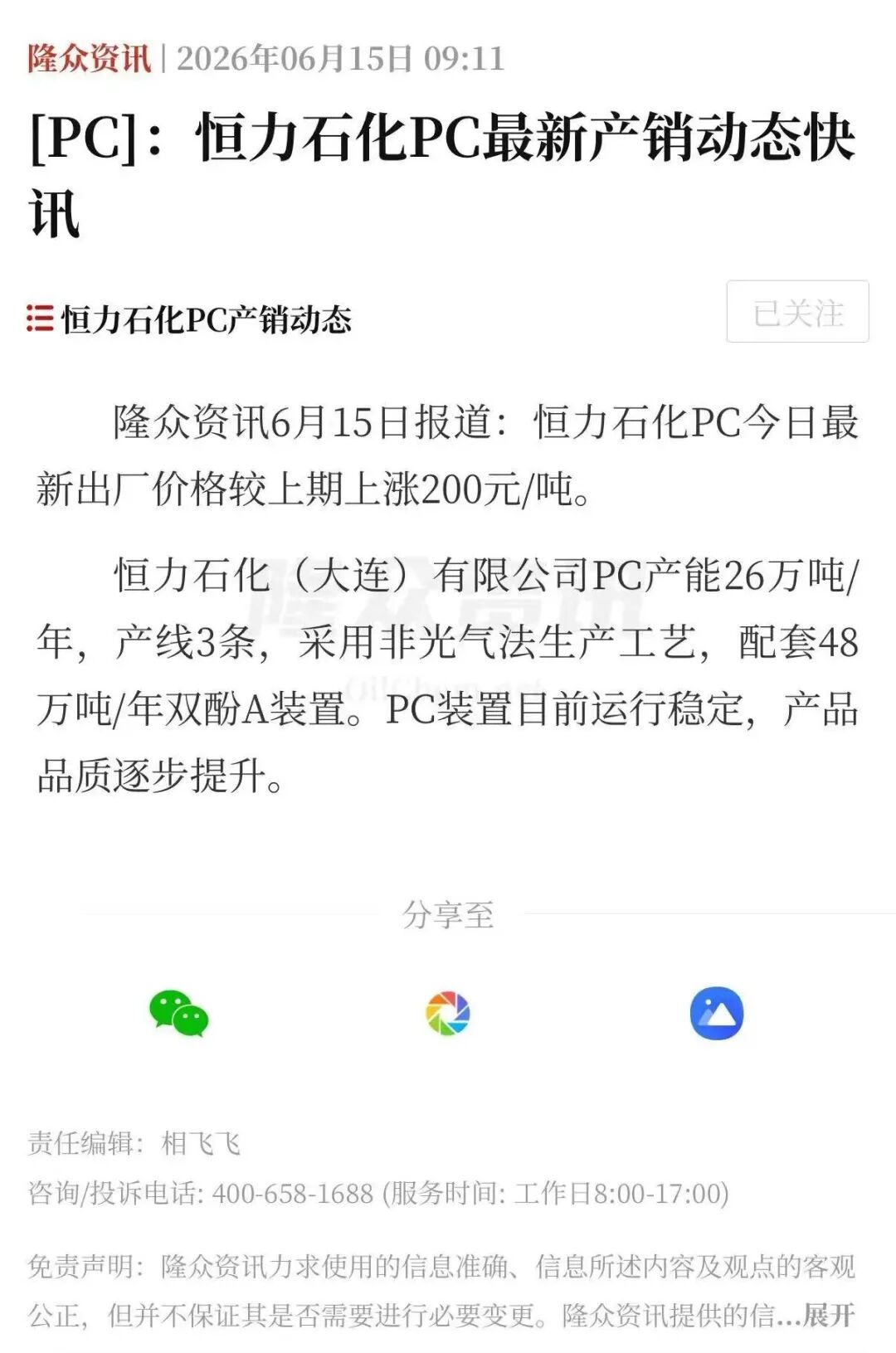
Longzhong Information reported at 9:11 a.m. on June 15 that the key points are as follows: First, the latest ex-factory price of Hengli Petrochemical’s PC today rose by 200 yuan/tonne compared with the previous quotation; second, Hengli Petrochemical (Dalian)’s 260,000 t/y PC unit is operating steadily, supported by a 480,000 t/y bisphenol A unit.
Price and Market Background Analysis
Recently, the overall PC market is in a downward trend, while Hengli Petrochemical has raised its prices against the trend.
In early June, the domestic PC market saw a significant decline. According to iFinD, the spot price of PC on June 12 was 14,200 yuan per ton, down 150 yuan per ton from the previous day; over the past week, the price fell by a total of 1,233.33 yuan per ton, a decline of 7.99%. According to SunSirs, as of June 9, the PC mixed benchmark price was about 14,633.33 yuan per ton, down 8.73% from the beginning of the month.
In this market, most other PC manufacturers adopted price-cutting or price-stabilizing strategies. A forward-looking report on the PC market also noted that “domestic ex-factory prices among PC producers have generally seen relatively significant reductions.” Against this backdrop, Hengli Petrochemical chose to raise prices by RMB 200/ton at this particular point in time, representing a typical counter-trend price adjustment and demonstrating its confidence in its own competitiveness as well as its expectations for the market outlook.
The spot prices are approaching the lows seen at the beginning of the year, and the market fundamentals are under pressure.
On June 12, the reference price for domestically produced PC in the Yuyao market was RMB 12,900/ton, a relatively low level for the year. The reasons underpinning the current market weakness include:
Supply rebound: Entering June, domestic PC operating rates have recovered from low levels. Covestro recently resumed operations, and Luxi Chemical has increased to three production lines, lifting the industry operating rate to above 65%, with average weekly output approaching 60,000 tons.
Weak demand: PC downstream sales have entered the seasonal off-season, with demand for sheets, housings, and other products weakening. End-user enterprises are operating at low utilization rates, and transactions are mainly small orders.
Multidimensional Interpretation of the Reasons for the Adjustment
1. Internal conditions: Stable operation of the equipment and quality improvement
Hengli Petrochemical’s 260,000 tpa PC facility, consisting of three non-phosgene production lines, has been operating steadily, and its “product quality is gradually improving” — indicating that its market competitiveness continues to strengthen. In an industry-wide environment where competitors are cutting prices to reduce inventories, the company relies on quality and stable supply as the basis for its pricing power, which is the fundamental prerequisite for any price adjustment.
Upstream cost side: Bisphenol A price provides support.
The price of bisphenol A (BPA), a direct raw material for polycarbonate (PC), has risen recently. On June 12, the East China BPA market price closed at RMB 8,700/ton, up RMB 200/ton from the previous period. The increase in BPA prices has supported PC production costs and also given manufacturers a reason to pass on cost pressures.
Hengli Petrochemical has established an integrated “feedstock-to-PC” supply chain by supporting its 480,000-ton-per-year bisphenol A facility, effectively reducing the risks associated with external raw material procurement and smoothing out cost fluctuations. Compared with manufacturers that source bisphenol A externally, Hengli has more controllable and stable upstream raw material costs, and is better positioned to maintain pricing autonomy amid market volatility.
3. Market Signals: Supply-Demand Dynamics May Undergo Structural Changes
In April 2026, China’s PC exports reached 63,000 tons, up 46.01% year on year and hitting a new record high; meanwhile, import volume in April fell 20.65% month on month, indicating that the trend of domestic substitution and export growth is continuing to deepen. Huatai Securities expects the PC industry’s operating rates in 2025–2027 to be 87%, 94%, and 95%, respectively, with supply-demand conditions gradually improving. Downstream sectors such as new energy vehicles, 5G base stations, and smart home appliances continue to expand their differentiated demand for PC, further strengthening structural demand support.
Hengli Petrochemical’s latest price hike is both a response to short-term cost pressures and an indication of its expectation that supply and demand will improve over the medium to long term.
Future Impacts and Subsequent Outlook
1. Short-term effects: Possible game between weak market conditions.
Against the backdrop of a rebound in operating rates across the industry and strong wait-and-see sentiment downstream, whether Hengli Petrochemical’s unilateral price increase can be successfully passed on to downstream customers depends on whether other producers follow suit. If the market continues to run weak, traders and downstream customers may prioritize lower-priced sources, putting the actual effectiveness of Hengli’s price hike to the test.
2. Medium- to Long-Term Observation: Upstream Raw Material Prices and the Pace of Demand Recovery
Two key variables warrant close attention: first, whether bisphenol A prices can hold firm above RMB 8,700 per ton, thereby providing further cost support for PC price increases; second, whether actual procurement in sectors such as new energy vehicles will accelerate after the off-season ends, helping absorb the pressure from rising prices.
Against the backdrop of weak performance across the industry, Hengli Petrochemical has chosen to raise prices by RMB 200 per ton against the trend, leveraging its advantages in an integrated industrial chain, stable unit operations, and quality improvements. This move indicates the company’s confidence in its own market competitiveness and also reflects that cost pressures from rising upstream raw material prices have begun to be passed downstream. As for the actual implementation of this price adjustment and its market impact, further observation is needed to see whether other manufacturers follow suit and how actual downstream transactions unfold.
Risk Disclaimer: The above analysis is based on breaking news and the market context in which it occurred. All data is sourced from publicly available and verifiable channels. Prices in the chemical products market are influenced by multiple factors, and actual market movements are subject to considerable uncertainty. This analysis should not be taken as a direct basis for investment or business decisions.
【Copyright and Disclaimer】The above information is collected and organized by PlastMatch. The copyright belongs to the original author. This article is reprinted for the purpose of providing more information, and it does not imply that PlastMatch endorses the views expressed in the article or guarantees its accuracy. If there are any errors in the source attribution or if your legitimate rights have been infringed, please contact us, and we will promptly correct or remove the content. If other media, websites, or individuals use the aforementioned content, they must clearly indicate the original source and origin of the work and assume legal responsibility on their own.
Most Popular
-

A Look at the Material Suppliers Behind SpaceX
-

Government's Triple Action, Enterprises' Three Arrows in Five Days, Semiconductor Reshuffle! What Signal Does Japan's Chemical Industry Release?
-

Next-generation motors of new energy vehicles: Single-Round Thousand Horsepower, Replacing Brakes, How Powerful Are They?
-
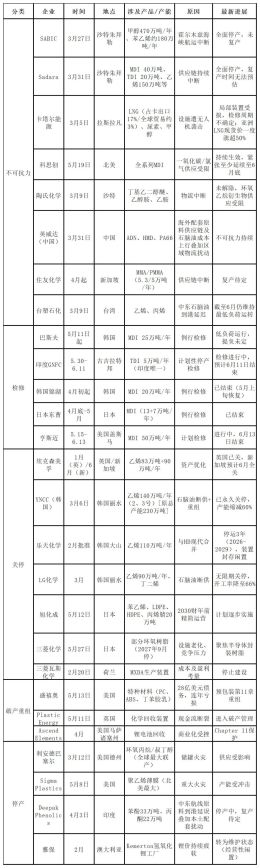
Shutdowns And Production Cuts! Widespread Price Quotes Suspended, Chemical Products May Still Be Easier To Rise Than Fall In June-July!
-
Japan Plans To Sell Lithography Giant JSR! Fujifilm And Mitsubishi Chemical Interested In Taking Over, How Much Time Window Is Left For China?


