Grassroots Medical Market Welcomes Policy Boost! New Logic for Equipment Upgrades Under Hierarchical Diagnosis and Treatment Policy
New Policies Implemented: Graded Medical Treatment Gets an "Accelerator"
Recently, the General Office of the State Council issued the “Several Measures on Accelerating the Construction of a Tiered Medical Treatment System” (Guo Ban Fa [2026] No. 11), which outlines 13 specific measures across four key areas, clarifying the priority directions for building a tiered medical treatment system. The document stipulates that, by 2030, a coordinated tiered medical treatment mechanism, anchored by tightly integrated medical consortia, will be essentially established.
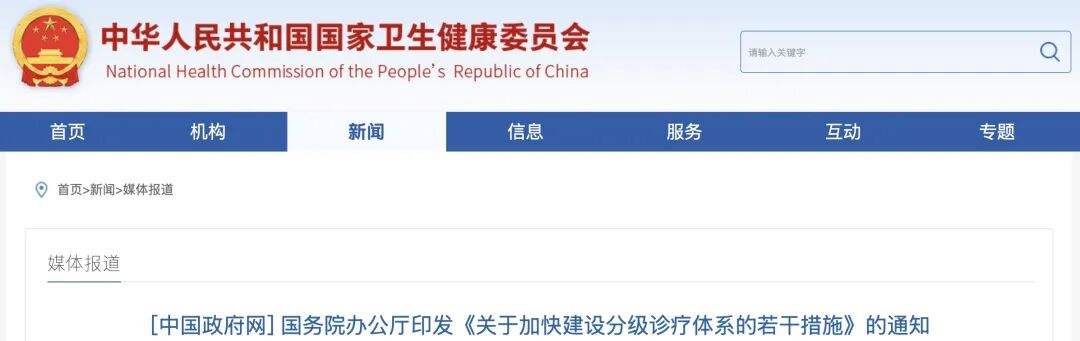
At the regular policy briefing of the State Council held on April 13, Zheng Zhe, Vice Minister of the National Health Commission, provided an illustrative explanation of the tiered medical treatment system: "According to the severity and treatment difficulty of diseases, reasonably guide patients to seek medical care in an orderly manner, allowing common and frequent diseases to be resolved at primary-level facilities, while relatively difficult, critical, and severe cases are treated at higher-level hospitals."
The issuance of these "Measures" coincides with the tenth anniversary of the launch of the tiered diagnosis and treatment system. Since the national rollout of this system in 2015, a decade of dedicated efforts has woven a nationwide primary healthcare safety net covering the entire population. Currently, China has over 1.1 million healthcare institutions spread across urban and rural areas, and more than 90% of residents can reach a nearby medical facility within 15 minutes, achieving universal coverage of essential healthcare services for its 1.4 billion people.
The continuous implementation of policies is profoundly transforming patients’ medical-seeking behavior. Data shows that in 2025, the number of outpatient visits to primary healthcare institutions nationwide reached 5.56 billion, accounting for over half—52.6%—for the first time. Both the volume and share of outpatient visits at primary healthcare institutions continue to rise, reflecting the increasingly evident effectiveness of tiered diagnosis and treatment. Meanwhile, the number of two-way referral cases nationwide is also growing steadily, increasing by over 50% compared with 2020, making it more convenient for patients to be referred between different levels of healthcare institutions.
Accelerating Primary Care Visits: Equipment Procurement Faces Rigid Demand
Driven by policies such as primary care first visit, two-way referral, and Driven by policies such as primary care first visit, two-way referral, and Driven by policies such as primary care first visit, two-way referral, and, the number of patients in primary care will see a rapid increase. The document clearly requires that the focus be on guiding the public to primary care for common and chronic diseases, and that the newly added annual medical insurance funds be appropriately tilted towards primary-level medical and health institutions, reasonably determining the payment coefficients for medical and health institutions of different levels and types.
The growing number of patients has placed higher demands on primary healthcare service capacity, with the most evident gap being in hardware equipment. The "Implementation Plan for Strengthening the Foundation of Healthcare" explicitly states that during the 15th Five-Year Plan period, around 1,000 closely-knit county-level medical consortia will be supported, and efforts will be made to upgrade and enhance the quality of county-level hospitals and key central township health centers. In 2025, the state launched the "Implementation Plan for Strengthening the Foundation of Healthcare," allocating over RMB 8.8 billion in central government budgetary investment to support primary healthcare infrastructure development.
Statistical data indicates that the grassroots medical equipment market holds enormous potential. By the end of 2025, the total number of medical and health institutions nationwide will reach 1.107 million, of which grassroots medical and health institutions—numbering 1.055 million—account for a dominant 95.3%. This implies that even standardized configuration of basic diagnostic and treatment equipment will generate substantial procurement demand.
According to Jiayi Hui, Director of the Primary Health Care Department of the National Health Commission, in the next step, efforts will be made to focus on common diseases and clearly diagnosed chronic diseases at the primary level, and to strengthen the construction of key specialty departments. In addition to general medicine and traditional Chinese medicine departments, priority will be given to strengthening the construction of departments such as pediatrics, rehabilitation, mental health, and otorhinolaryngology (dental). It will enhance the specialized capabilities in diseases such as hypertension, diabetes, chronic obstructive pulmonary disease (COPD), pain, palliative care, and hemodialysis.
In the usage scenarios of primary healthcare, imaging equipment occupies a crucial ecological niche, with both primary care examinations and higher-level diagnoses relying on imaging equipment as a safety net. From the 2025 bidding data, DR (digital X-ray machines) tops the list with 2,768 units sold, accounting for 53.37% of the total, becoming the absolute mainstay in equipment procurement. CT scanners follow closely with 1,196 units, or 23.06% of the total, clearly reflecting the policy orientation of "strengthening weak areas" in primary healthcare.
Device Upgrade New Logic: From "New Replacement" to "New Renewal"
With the acceleration of tiered diagnosis and treatment system construction, a large number of patients are returning to primary healthcare institutions, significantly increasing their demand for medical imaging equipment. However, limited procurement budgets at the primary level pose practical challenges to large-scale equipment replacement. Against this backdrop, AI-powered revitalization of existing equipment is reshaping the traditional logic of equipment upgrades.
At the recent CMEF Spring Expo and the 2026 Medical Equipment Conference, imaging giants such as Mindray, United Imaging, and GE Healthcare showcased new solutions tailored for grassroots imaging infrastructure. Among them, GE Healthcare’s concept of “Intelligent Lifecycle Service Innovation for Equipment” drew particular attention—leveraging cutting-edge technologies like AI to empower its vast installed base of equipment, enabling cost-effective performance upgrades and iterative enhancements.
Zheng Jiemin, Vice President and General Manager of Customer Service Business for GE Healthcare Greater China, stated, "In the opening year of the 14th Five-Year Plan, the medical equipment industry is facing a critical window for intelligent upgrading. GE Healthcare's 'Smart Service' is a solid response to the development direction of 'Intelligent Medical Devices'." According to the introduction, for installed equipment, GE Healthcare has launched intelligent upgrade solutions including Revolution Apex Advanced Pro, Qilin Console CT Advanced, and IQ Engine Smart Imaging Plus, leveraging AI and digital technologies to shift equipment management from reactive maintenance to proactive empowerment, thereby unlocking clinical value throughout the entire equipment lifecycle.
During the CMEF Spring Exhibition, Professor Chayunfei from Renmin Hospital of Wuhan University stated: "Thanks to the advancements in engineering, the actual update cycle of hardware is much longer than people imagine. Although its core functions have fallen behind the current mainstream technological requirements, this does not mean it has lost its vitality; it can still play a role. By intelligently rejuvenating the equipment, we can effectively revitalize this stock of assets."
GE Healthcare’s full-lifecycle service system delivers differentiated solutions based on equipment age: clinical functionality development and training for devices aged 0–4 years; software and hardware upgrades for devices over 4 years old; and critical component renewal for devices over 8 years old. For example, the Qilin Console CT upgrade for 64-slice CT systems enhances image reconstruction speed to 70 frames per second through host software and hardware upgrades, while supporting 12 cm whole-brain perfusion and SSF2 cardiac freezing technology—meeting clinical requirements of stroke centers and chest pain centers.
Professor Liu Jie from the First Affiliated Hospital of Zhengzhou University pointed out at the same forum that upgrading existing CT equipment with deep learning reconstruction algorithms—through both software and hardware enhancements—can significantly improve image quality and reduce radiation dose during examinations without replacing the entire system, thus enabling grassroots-level facilities to undertake more imaging screening for common and chronic diseases.
From “People Searching for Devices” to “AI-Empowered Devices”
The integration of AI technology has not only transformed the economic calculus of equipment upgrades but also reshaped the diagnostic paradigm in primary healthcare. Dr. Cao Kun, Director of the Department of Radiology at Peking University Cancer Hospital, illustrated the technological breakthroughs of the IQ Engine Smart Imaging Plus through the example of precise diagnosis of rectal cancer: traditional high-resolution sequence scanning, which previously required 12 minutes, has been reduced to 7 minutes—significantly shortening scan time while maintaining image quality.
In the primary healthcare setting, the role of AI is not only reflected in the enhancement of hardware performance but also in the "intelligent supplementation" of clinical capabilities. Director Cao Kun pointed out that standardized diagnostic templates provided by AI can serve as a crucial learning tool for junior doctors at the beginning of their careers; various complex post-processing and automatic calculations enabled by AI can help improve work efficiency and diagnostic accuracy.
Furthermore, GE Healthcare’s “Zhi Kaiyuan” service provides grassroots hospitals with expert diagnostic thinking training, on-site departmental guidance, and standardized equipment usage training, helping staff deepen their understanding of equipment capabilities, broaden diagnostic approaches, and foster collaborative development between clinical and imaging departments. This integrated model of “dual hardware-software iteration plus talent training” is fundamentally addressing the long-standing challenge in grassroots healthcare of “having equipment but lacking capability.”
Outlook: A New Ecosystem for Primary Healthcare Emphasizing Both Hardware and Software
With the accelerated implementation of the tiered diagnosis and treatment policy, the primary healthcare market is witnessing a dual opportunity: the return of patients to primary care facilities and the upgrading of medical hardware. In the opening year of the 15th Five-Year Plan, the target to establish 1,000 closely integrated county-level medical consortia, coupled with the equipment upgrade needs of nearly 900,000 primary healthcare institutions, collectively delineate a medical device market space valued in the tens of billions of RMB.
At the same time, the empowerment of cutting-edge technologies like AI is opening up a brand new path for the upgrade and replacement of grassroots equipment. From "replacement" to "rejuvenation," from "people seeking equipment" to "AI empowering equipment," the competition in the medical equipment market has moved from a simple product contest to a new stage where both software and hardware, as well as the full lifecycle service capabilities, are emphasized. In the wave of structural transformation in the grassroots medical market, whoever can help grassroots medical institutions enhance their diagnostic and treatment capabilities in a more cost-effective way will seize the initiative in the new blue ocean of hierarchical medical treatment.
As Song Weiqun, Executive Vice President of GE Healthcare Global and President of GE Healthcare Greater China, stated, the company will continue integrating its technological capabilities and management expertise into medical infrastructure-strengthening initiatives, promoting the deployment of high-end, digital, and intelligent medical equipment in county-level healthcare institutions and ensuring that innovative outcomes benefit more people. With the continuous improvement of the tiered diagnosis and treatment system and the ongoing enhancement of grassroots healthcare service capabilities, the orderly healthcare-seeking model—“minor illnesses treated at grassroots facilities, major illnesses treated at hospitals, and rehabilitation carried out in communities”—is steadily transforming from vision into reality.
【Copyright and Disclaimer】This article is the property of PlastMatch. For business cooperation, media interviews, article reprints, or suggestions, please call the PlastMatch customer service hotline at +86-18030158354 or via email at service@zhuansushijie.com. The information and data provided by PlastMatch are for reference only and do not constitute direct advice for client decision-making. Any decisions made by clients based on such information and data, and all resulting direct or indirect losses and legal consequences, shall be borne by the clients themselves and are unrelated to PlastMatch. Unauthorized reprinting is strictly prohibited.
Most Popular
-

Continental Plans to Begin Sale of ContiTech in Early 2026
-
$4 Billion! Medtronic Makes Another Acquisition
-

BASF Delivers First Batch of Innovative Cathode Materials for Semi-Solid-State Batteries to Weilan New Energy
-

Why did a century-old european dental instrument giant relocate its manufacturing hub to china?
-
Profit and Revenue Growth Struggle to Conceal Debt Repayment Pressure; Success of Kingfa Sci & Tech's High-End Strategy Yet to Be Seen