From "Guide Wire Dilemma" to Material Breakthrough: How Medical Nylon Is Reshaping the Technological Landscape of Vascular Intervention Devices
In modern medical practice, vascular interventional surgery has become a core technology for treating cardiovascular diseases. The clinical use of devices such as catheters, balloons, and stents in interventional procedures imposes stringent requirements on materials regarding mechanical stability, chemical inertness, dimensional accuracy, and biocompatibility. Polyamide (PA), commonly known as nylon, is playing an increasingly critical role in this field thanks to its outstanding comprehensive performance.
The market size is expanding rapidly, and the demand for material upgrades is urgent.
The global burden of cardiovascular diseases continues to rise, which is the fundamental driving force behind the growth of the vascular intervention device market. According to World Health Organization data, in 2022, cardiovascular diseases (including coronary heart disease, stroke, and peripheral arterial disease) remained the leading cause of death globally, accounting for approximately 32% of total deaths. The global market for cardiovascular and peripheral vascular devices was valued at $27.7 billion in 2025 and is expected to grow from $29.8 billion in 2026 to $60.8 billion by 2035, with a compound annual growth rate of 8.2%.
In the Chinese market, this growth momentum is even more robust. According to the data center of the Guangdong Institute of New Biomaterials and High-end Medical Devices, over the past five years, the annual compound growth rate of the cardiovascular interventional device market in our country has reached 10.2%, and it is expected that the market size will exceed 90 billion yuan by 2026.
However, behind the massive market size, the high-end cardiovascular interventional device market in our country is still monopolized by international giants, with Medtronic, Boston Scientific, and others occupying over 60% of the market share. Of particular concern is that, although the domestic production rate of coronary stents has reached 95%, ancillary consumables such as guide wires and catheters still face the dilemma of "low domestic production rate." Behind this "guide wire dilemma," the independent innovation of material technology is the key bottleneck that needs to be broken through. And nylon materials are precisely the core issue that cannot be bypassed on the path to breaking the deadlock.
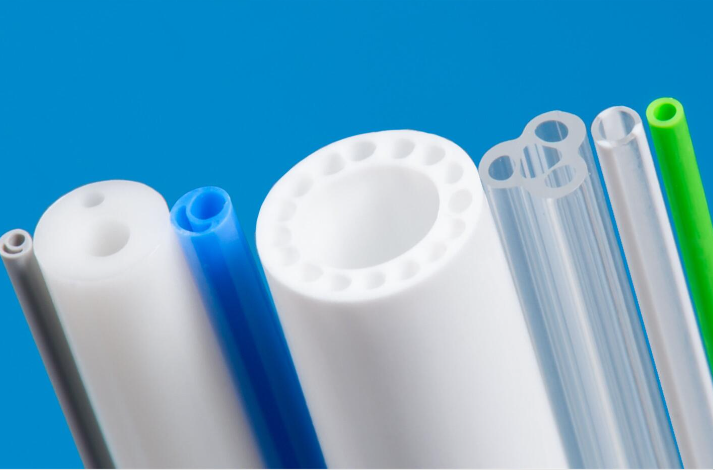
Image source: Denepi Medical
Overview and Core Characteristics of Nylon Material
The polyamide main chain contains repeating amide groups —[NHCO]—, mainly including aliphatic, aliphatic-aromatic, and aromatic PAs. Among them, PA6 and PA66 are the most widely used types globally, accounting for nearly 72% of the total production. Global polyamide capacity has exceeded 9.8 million tons, and polyamide materials account for about 34% of the total consumption of engineering thermoplastics. The polyamide (nylon) market is expected to reach USD 46.317 billion in 2026, and could increase to USD 74.306 billion by 2035.
As a key material for vascular interventional devices, nylon offers a range of outstanding comprehensive advantages. In terms of mechanical properties, PA66 exhibits a tensile strength of up to 65 MPa, combining high strength with excellent wear resistance. Regarding elasticity and resilience, nylon rapidly recovers its shape after deformation, perfectly meeting the dual requirements of flexibility and pushability for interventional devices. With a density of only 1.14 g/cm³—significantly lower than that of metals—nylon substantially enhances device maneuverability and biocompatibility. Chemically, nylon demonstrates stability against acids, bases, oils, and bodily fluids, ensuring consistent performance in physiological environments. In terms of frictional properties, nylon has a dynamic coefficient of friction of approximately 0.4, providing low friction and self-lubricating characteristics that effectively reduce the risk of vascular wall injury. Additionally, nylon possesses excellent electrical insulation properties and good processability, making it suitable for injection molding, extrusion, and modification, and ideal for the high-volume, precision manufacturing of interventional devices.
Typical applications of nylon materials in vascular interventional devices
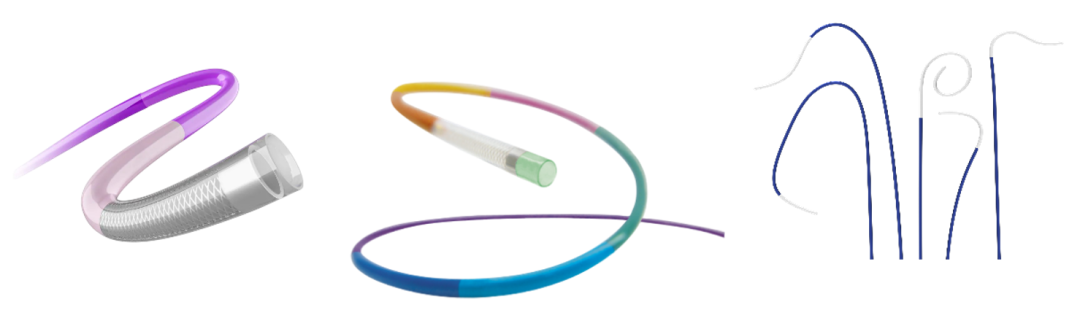
Examples of nylon elastomer applications
Transparent nylon is typically amorphous or microcrystalline, and exhibits outstanding performance among transparent polymers. It has an extremely high transparency, with a visible light transmittance exceeding 90% at a thickness of 2mm. It outperforms PC and PMMA in terms of chemical resistance and environmental stress crack resistance, and has a much lower water absorption rate than PA6/PA66, with better dimensional stability. Transparent nylon complies with food contact regulations of the EU, FDA in the US, and China's C-FDA, and has a complete ISO 10993 biocompatibility evaluation report. Its typical applications include endoscope components and various medical devices requiring clear vision.
Long-chain aliphatic nylon, formed by the polycondensation of long-chain aliphatic diamines and dicarboxylic acids, belongs to the category of high-performance special polyamides. Compared with conventional PA6/PA66, its saturated water absorption rate is only 2%~3%, and it also possesses excellent chemical resistance, weather resistance, hydrolysis resistance, and outstanding dimensional stability. Long-chain aliphatic nylon generally refers to nylon materials with more than 10 methylene groups in the molecular chain. Due to its low water absorption, good low-temperature resistance, dimensional stability, toughness, and wear and shock resistance, it is widely used in devices that require extremely high stability, such as balloon catheters and various precision interventional catheters.
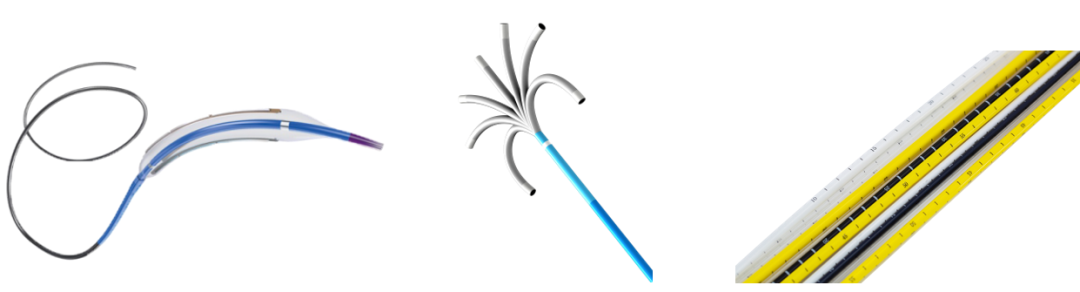
Long-chain nylon application examples
PA6 is polymerized from caprolactam, while PA66 is prepared by condensation polymerization of adipic acid and hexamethylenediamine. It is the engineering plastic with the highest global production. After being reinforced with glass fiber, its rigidity and creep resistance are significantly improved, the molding shrinkage is reduced, and the dimensional accuracy is higher. Glass fiber reinforced polyamide currently accounts for 36% of the engineering-grade nylon usage, and its tensile strength can be increased by up to 45% compared to unfilled grades. Its typical applications include structural components of some implantable medical devices and precision medical device parts.
Biocompatibility – The Core Requirement for Medical-Grade Nylon
The application of nylon in interventional medical devices relies not only on its physical and chemical properties but also requires strict compliance with medical safety standards. According to ISO 10993 and USP Class VI standards, medical-grade materials must pass biological evaluations—including cytotoxicity, irritation, and sensitization—to ensure safety during contact with blood and tissue. DOMO Chemicals’ TECHNYL® series materials have been qualified to meet the biocompatibility requirements of ISO 10993 and USP Class VI. The FDA’s biocompatibility guidance further clarifies risk assessment requirements, emphasizing a complete evidence chain—from chemical characterization, through toxicological assessment, to biological effects.
Future Development Trends
With the continuous advancement of medical technology, nylon materials are accelerating towards higher performance. In the field of nanocomposites and surface modification, researchers have introduced nano-fillers such as titanium nitride and cuprous oxide into PA12 matrices, enhancing mechanical properties while imparting antibacterial functions. In 3D printing and personalized manufacturing, PA12 nanocomposites have been successfully applied in material extrusion 3D printing, achieving simultaneous improvement in antibacterial properties and mechanical performance. Shandong nylon microspheres have become the mainstream material for selective laser sintering, opening up new pathways for the fabrication of personalized medical devices and customized implants.
From a broader perspective, breakthroughs in core material technologies for vascular interventional devices are directly linked to China's self-reliance and controllability in high-end medical device manufacturing. Nylon materials are gradually evolving from general-purpose to high-end and specialized applications, becoming a key driver in advancing vascular interventional devices.
【Copyright and Disclaimer】This article is the property of PlastMatch. For business cooperation, media interviews, article reprints, or suggestions, please call the PlastMatch customer service hotline at +86-18030158354 or via email at service@zhuansushijie.com. The information and data provided by PlastMatch are for reference only and do not constitute direct advice for client decision-making. Any decisions made by clients based on such information and data, and all resulting direct or indirect losses and legal consequences, shall be borne by the clients themselves and are unrelated to PlastMatch. Unauthorized reprinting is strictly prohibited.
Most Popular
-

A Look at the Material Suppliers Behind SpaceX
-

Government's Triple Action, Enterprises' Three Arrows in Five Days, Semiconductor Reshuffle! What Signal Does Japan's Chemical Industry Release?
-
Fire breaks out at jiangsu meiside!
-
Name change without tax change: POM Anti-Dumping Duty Rate Inheritance Implemented
-
Ethylene: Production Capacity Accelerates Expansion, Global Industry Landscape Is Being Reshaped