From automotive “dual crown” to “general intelligence”: Xiangchi Technology Unleashes Multiple Chips in a “Boundary-Breaking” Move
A watershed moment for China’s automotive chip industry is rapidly approaching in the spring of 2026.
On one hand, policy support continues to intensify. In March this year, a joint symposium of three departments clearly emphasized "accelerating the supplementation of automotive chips, basic software and other shortfalls, and promoting the expansion of application scale." The same year's "Government Work Report" also for the first time highlighted "new breakthroughs in chip independent R&D."
On the other hand, market data has provided concrete feedback: data from the China Association of Automotive Industries shows that the domestic production rate of automotive chips in China exceeded 15% for the first time in 2025, reaching 16.8%. Among them, power chips and MCUs have the fastest domesticization process, reaching 24% and 21%, respectively. Fu Bingfeng, vice president of the China Association of Automotive Industries, expects that by 2027, the domestic production rate of automotive chips is expected to reach 25%-30%.
At such a historical moment, Xinchí Technology presented a substantial achievement at the 2026 Beijing Auto Show: the cumulative shipment of its entire series of automotive-grade chips has exceeded 12 million units, and the market share of its intelligent cockpit SoC and domestic intelligent control MCU chips both ranked first in the local market. It officially announced its Strategy 2.0 — a leap from "driving intelligence" to "general intelligence".
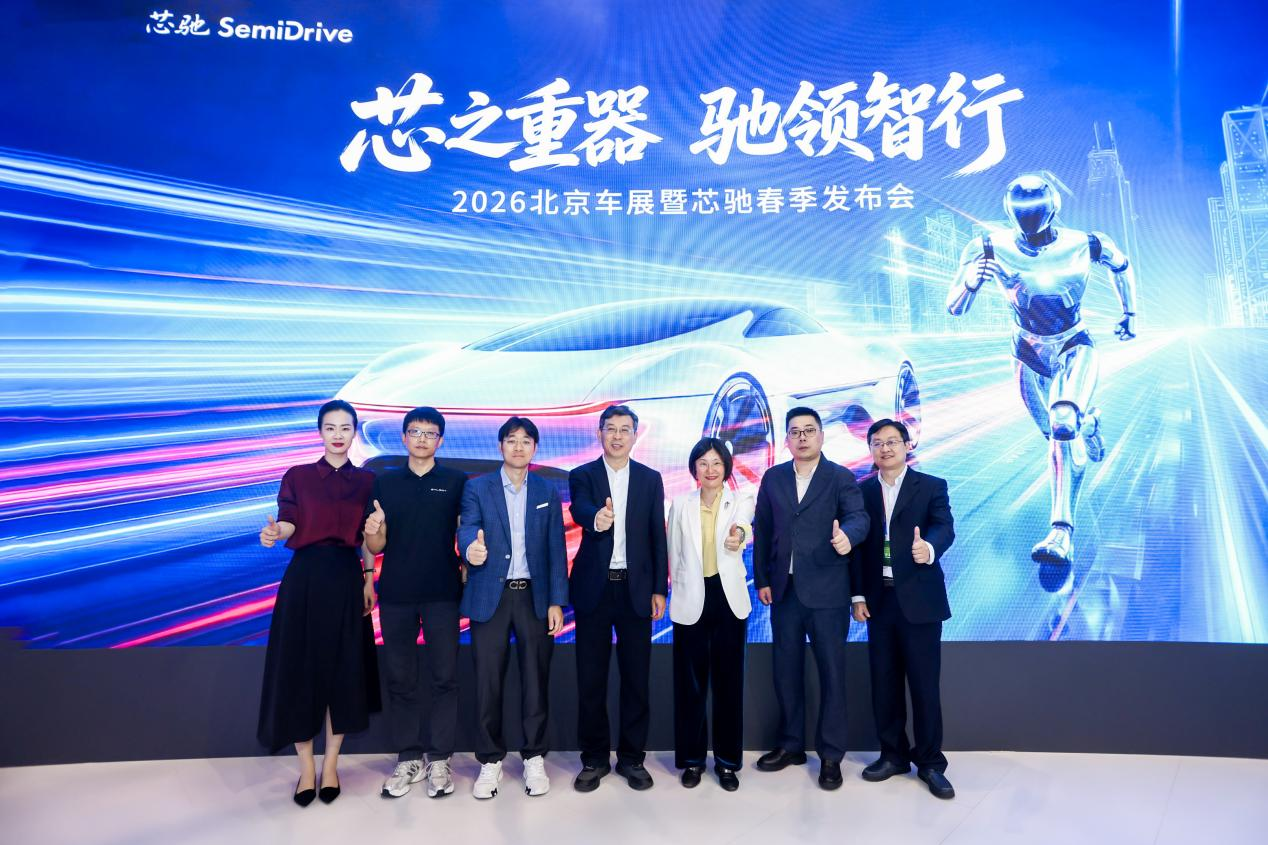
Image source: Xiangchi Technology
From a startup five years ago facing the "three soul questions," to becoming the top Chinese manufacturer in the high-performance automotive-grade MCU market for passenger vehicles, Xinchí Technology's evolution is not an isolated business story, but a testament to the era where China's automotive chip industry has shifted from "following" to "running side by side" and even "leading" in certain areas.
After the “Dual-Core” Summit: The Next Critical Leap
In the automotive chip industry, data is the best passport.
An industry consensus is that the competition in automotive chips, the first round is about "whether they can be made," and the second round is about "whether anyone dares to use them." The only criterion for judging "whether someone dares to use them" is large-scale vehicle validation.
Xiaochi Technology’s achievements are truly impressive.
In the intelligent cockpit domain, X9 series cockpit processors from Xiangxun Semiconductor have become the leading domestic brand, with cumulative shipments exceeding 5 million units and an annual growth rate surpassing 50%. As the only domestic supplier offering comprehensive coverage across all cockpit application scenarios—including digital instrument clusters, infotainment and navigation head units, and cockpit domain controllers—Xiangxun Semiconductor has ranked first in domestic intelligent cockpit chip market share for two consecutive years.
The significance of this achievement lies in the fact that cockpit SoCs are among the most highly integrated and software-stack-complex categories of automotive main control chips, requiring simultaneous support for dual operating systems (Android and QNX), compatibility with a vast array of peripheral interfaces, and the ability to handle heterogeneous computing tasks.
Qiu Yuqing, founder and chairwoman of SemiDrive, stated frankly in an interview with Gasgoo and other media: "The complexity of intelligent cockpit chips is actually very high—they require support for a large number of interfaces, a highly heterogeneous architecture, and an extremely complex software system."
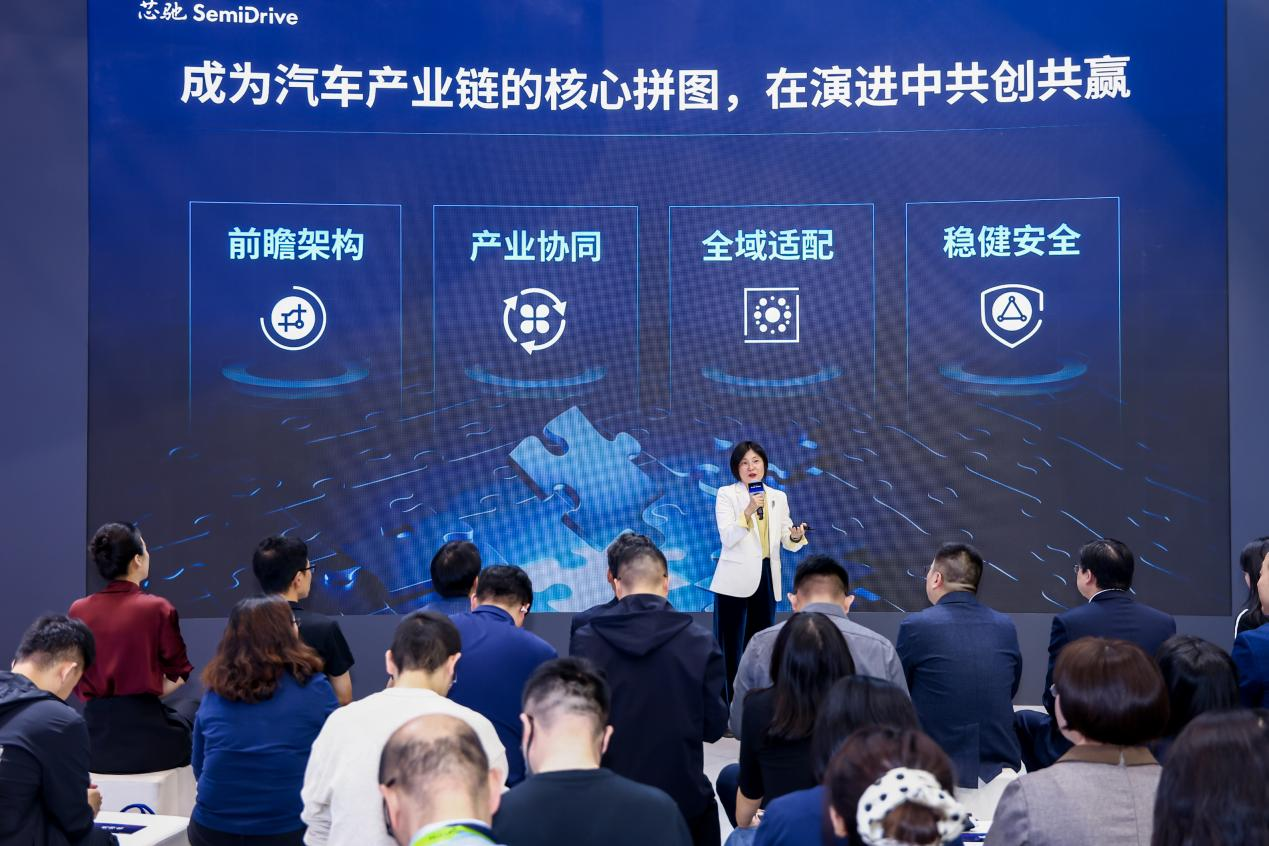
Image source: SemiDrive
A Chinese manufacturer, which has secured the top spot in its domestic market, has emerged in this field—a clear signal that domestically produced chips are no longer merely playing a marginal "substitute" role but are now genuinely penetrating the core of the automotive value chain.
If the cockpit SoC largely determines a vehicle’s “upper limit of user experience,” then high-end vehicle-control MCUs directly define its “safety floor” and architectural evolution capability.
More attention from the industry is being drawn to Xinchí Technology's breakthrough in high-end automotive control MCU.
According to industry authoritative rankings, in 2025, ChipEdge Technology entered the top five in the Chinese passenger car high-performance automotive-grade MCU market, ranking first among Chinese manufacturers. Its E3 series has been mass-produced for three years, with cumulative shipments exceeding 5 million units. The star product E3650 has been selected by 90% of automakers for their next-generation domain control platforms. The E3620, a flagship MCU chip for power domain control, has entered substantive development with multiple leading automakers and Tier 1 suppliers.
It is undeniable that, even today, the high-performance automotive-grade MCU market is still dominated by international giants such as Infineon, Renesas, and NXP, and the domestic localization rate remains to be improved.
Yet, in this landscape, SemiDrive has not only managed to squeeze in but also firmly established itself.
Qiu Yujing recalled the anxiety of being asked the "soul-triple questions" by customers when Semicore Technology was starting from "0 to 1": "Who has used your chips? Are they in mass production? What if there are problems?"
Today, a shipment volume of 12 million units has provided the best answer to these questions.
So far,'s customers cover seven of the top ten global automotive OEMs and all of the top ten Chinese automotive OEM groups, leading the industry in terms of brand coverage and commercial implementation.
If the leadership of cockpit SoCs demonstrates SemiDrive's mastery of "complex systems," and the dominance of its vehicle-control MCUs proves its relentless pursuit of "high real-time performance and high safety," then the combination of these two capabilities is precisely what is most needed in the second half of automotive intelligence.
However, of even greater strategic value is that Xiangxun Technology is currently the only domestic automotive chip company to have achieved mass production across all five core domain controller scenarios: intelligent cockpits, zone controllers, powertrain, chassis, and intelligent driving. This comprehensive mass-production experience across all domains endows Xiangxun Technology with a “holistic domain perspective,” enabling it to better understand system-level coordination and integration than any chip vendor focused on a single domain.
As Zhang Xitong, General Manager of the MCU Product Line at SemiDrive, stated: "Automakers hope that their selected suppliers will have more comprehensive capabilities, enabling faster adoption of new products going forward."
China chip"Leading the Run":"Refactor the 'central cerebellum'"
For a chip manufacturer, what is the practical significance of obtaining stable and continuous "trust"?
It concerns the complete narrative of Changxin Technology's "1 to 100" in domestic chips.
Actually, the competitive pressure faced by domestic chip manufacturers has not decreased, but instead has intensified with the acceleration of localization by international giants. "The speed of support and response is essential for domestic companies, but real success lies in leading the architecture," said Qiu Yujing.
Carefully examining the new products unveiled by ChipX at this auto show reveals that the core logic of its product planning is not a series of scattered function iterations, but rather a clear industrial main line: the centralization of the automotive electronic and electrical architecture.
Currently, the automotive E/E architecture is in a period of rapid change.
This is a strategic high ground that was previously overlooked but is now more critical than ever. This direction aligns closely with the consensus among global Tier 1 suppliers and OEMs: within a central supercomputing architecture, there must exist a system-level security and real-time control unit independent of the application processor.
To seize this high ground, SemiDrive Technology launched the AMU supercomputing base at this auto show, which is essentially a redefinition of the "central intelligent control pons."
Among them, the flagship product E3800 integrates over 10 cores onto a single chip, incorporates aerospace-grade advanced embedded flash memory (delivering performance 10–20 times that of conventional eFlash), and features ultra-high-bandwidth Ethernet, an integrated multi-port switch, and a multi-tier network acceleration engine.
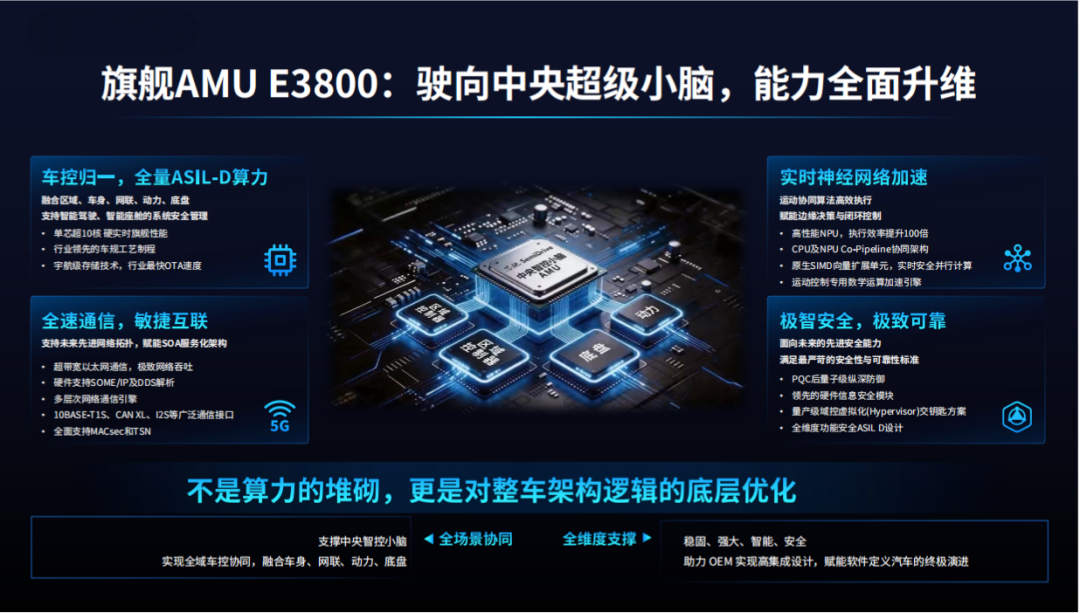
Source: ChipX Technology
More innovatively, the E3800 achieves deep pipeline-level co-optimization between the CPU and NPU through underlying architectural innovations. This breaks the traditional MCU paradigm: future "micro-brains" will not only handle hard real-time control but also undertake lightweight AI inference tasks.
Zhang Xitong's explanation in the interview clarified the logic behind this design: "We believe that the NPU on the MCU is relatively lightweight, because the vehicle's central computing will have a larger AI computing pool." But it is by no means optional. As "X-by-Wire" technologies such as line-controlled chassis and distributed electric drive continue to integrate, vehicle motion coordination control will give rise to new types of algorithms, which inherently require real-time intelligent processing capabilities at the edge.
If E3800 is a single-chip flagship that pushes the "small brain" to the extreme, then "Dual Stars AMU E3650-E" reflects the accurate understanding of industry pain points by CEVA.
The core contradiction that the automakers are facing is that the architecture is undergoing a very rapid iteration and convergence phase, while the demand is still changing dramatically. "Today we need 8 cores, tomorrow we may need 12 or even 16 cores." Several automotive manufacturers have also expressed similar anxieties: the architecture is converging, but functional demands are diverging. Once the chip selection is locked in, the cost of subsequent adjustments is very high. Xinchí's Dual Stars AMU solution can connect two E3650 flagship chips on the same board, leveraging Xinchí's independently developed "SemiLink Jilink" communication optimization technology to reduce cross-chip communication latency to the microsecond level, allowing automakers to flexibly expand from 10 to 16 cores "like building with blocks." Moreover, the code developed during the single-chip phase can be fully reused.
This design also carries two additional layers of significance: first, it addresses the organizational "silo" problem; second, the two chips inherently serve as physical redundancies, thereby providing stronger functional safety assurance.
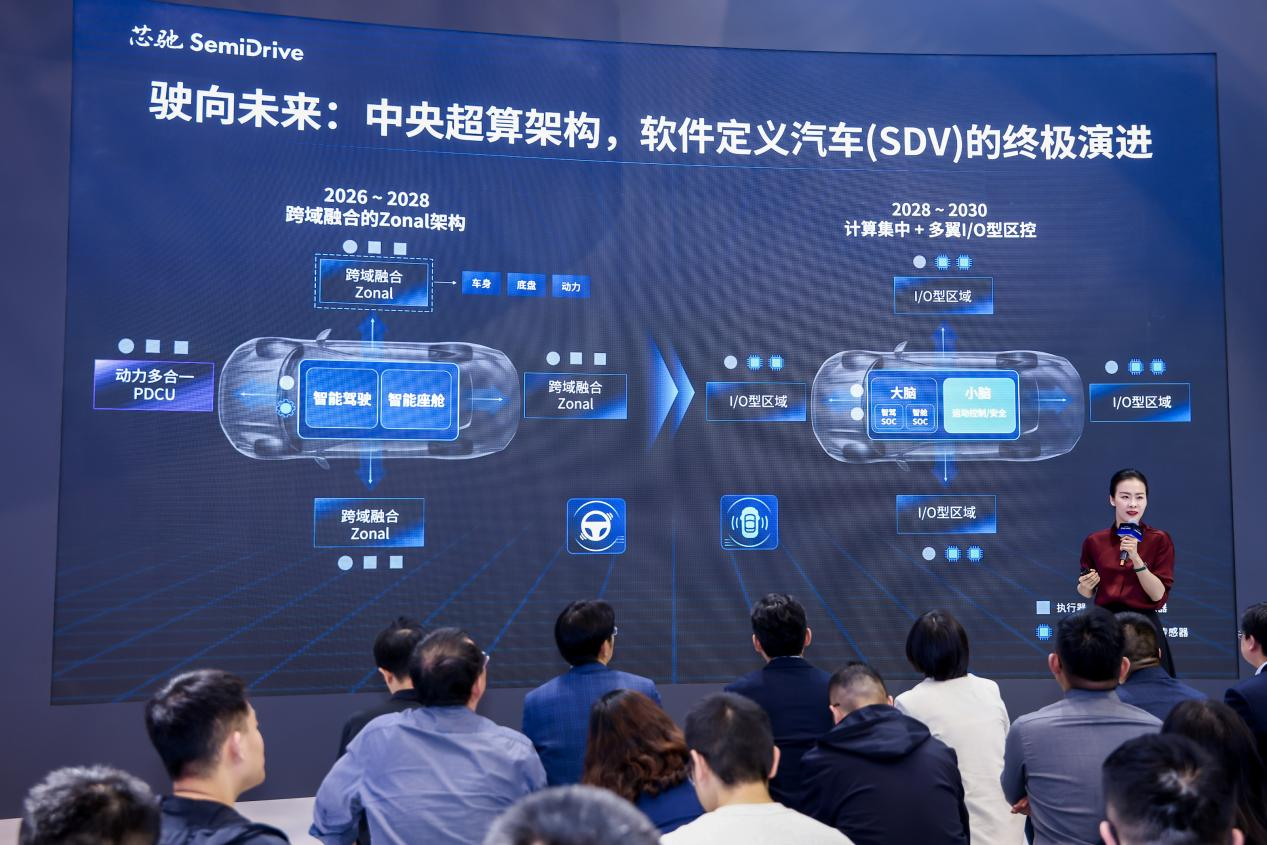
Image source: Xiangchi Technology
This product philosophy reflects Semicore Technology's deep understanding of the actual situation of Chinese automakers: the technical approach should not only pursue theoretical optimality but also serve the real development organizations and rhythms.
Complementing the AMU solution is the E3610 chip simultaneously launched by SemiDrive Technology.
Zhang Xitong stated, "The next-generation central supercomputing architecture isn't as simple as just placing a small MCU there." The E3610 is designed precisely for this purpose: positioned as an I/O-oriented zonal controller, it fully aligns with the next-generation electrical and network architectures. This product completes the vehicle-level product portfolio of SemiDrive Technology within the central supercomputing architecture.
From the flagship E3800 to the Gemini E3650-E and further to the E3610, Xiangchi Technology has established a more comprehensive product portfolio: utilizing the AMU as the computational foundation—the “central cerebellum”—with the E3610 serving as a standardized node for domain controllers, bridging the “central brain” above and managing distributed actuators below.
Qiu Yujing emphasized: “We now require ourselves to empower automakers with new architectures, engage in in-depth discussions with them on the next strategic direction, and design chips based on the architectural requirements for the coming years.”
This "joint definition" development model has created an intergenerational gap compared to the traditional paradigm where chip companies passively followed the demands of original equipment manufacturers.
From Driving Intelligence to General Intelligence: Extending the Second Growth Curve
If the centralization of automotive electronic and electrical architecture is an inevitable evolution, then migrating the entire automotive-grade chip technology system to the field of embodied intelligent robots is a bolder strategic leap.
From a macroeconomic data perspective, the direction of this decision is undoubtedly correct.
2026 is regarded by the industry as a pivotal year for humanoid robots, marking the transition from technological validation to large-scale mass production. According to GGII forecasts, the global market size for humanoid robots will exceed $2 billion by 2026 and is expected to surpass $20 billion by 2030, with the Chinese market size reaching $5 billion.
Such a steep growth curve means that whoever first establishes technological barriers and ecosystem connectivity in this arena will gain the authority to define the underlying architecture of the next generation of smart devices.
However, market size is only a reason for "whether it should be done"; what truly answers "whether it can be done" is the deep-seated capability homology between automotive chips and robotic chips.
"High-performance computing, extreme environmental reliability, nanosecond-level real-time response, multi-bus communication, functional safety and information security, and long-term supply assurance." These six dimensions of high compatibility make automotive-grade chips the ideal technical foundation for embodied intelligence.
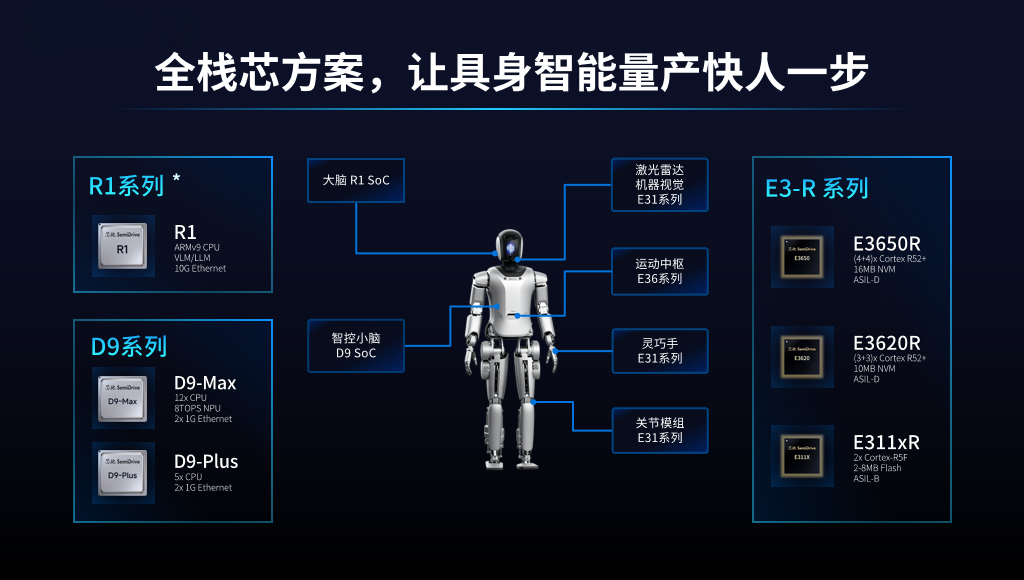
Image source: Xiangchi Technology
Currently, the number of CEVA chips used in a single humanoid robot can reach dozens: from LiDAR sensors, to small controllers in dexterous hands, to joint motor control chips in wrists, arms, hips, and knees. Moreover, robot manufacturers are increasingly demanding that the joint chips meet automotive-grade standards, requiring functional safety and automotive-grade reliability.
【Copyright and Disclaimer】The above information is collected and organized by PlastMatch. The copyright belongs to the original author. This article is reprinted for the purpose of providing more information, and it does not imply that PlastMatch endorses the views expressed in the article or guarantees its accuracy. If there are any errors in the source attribution or if your legitimate rights have been infringed, please contact us, and we will promptly correct or remove the content. If other media, websites, or individuals use the aforementioned content, they must clearly indicate the original source and origin of the work and assume legal responsibility on their own.
Most Popular
-

Continental Plans to Begin Sale of ContiTech in Early 2026
-

$4 Billion! Medtronic Makes Another Acquisition
-

BASF Delivers First Batch of Innovative Cathode Materials for Semi-Solid-State Batteries to Weilan New Energy
-

Why did a century-old european dental instrument giant relocate its manufacturing hub to china?
-
Profit and Revenue Growth Struggle to Conceal Debt Repayment Pressure; Success of Kingfa Sci & Tech's High-End Strategy Yet to Be Seen