Focus On Japan's Asahi Kasei and Mitsubishi Chemical as They Shut Down and Withdraw
On May 12, Japan’s Asahi Kasei and Mitsubishi Chemical simultaneously announced the shutdown or exit of related businesses, involving products such as styrene monomer (SM), polyethylene (PE), acrylonitrile (AN), polycarbonate diol (PCD), and polybutylene succinate (PBS).
Asahi Kasei
Asahi Kasei announced plans to streamline operations at its Mizushima plant by fiscal 2030, as follows:
(1) Discontinue styrene monomer (SM) used in the production of resin raw materials, as well as polyethylene (PE) products used in various films, packaging materials, and miscellaneous goods. This includes high-density polyethylene (HDPE) under the product brands Suntec™-HD and Creolex™, and low-density polyethylene (LDPE) under the product brands Suntec™-LD and Suntec™-EVA.
Shut down the 200,000 tons/year acrylonitrile (AN) production line and convert the 50,000 tons/year methacrylonitrile (MAN) production line to an AN/MAN co-production line. The supply of acrylonitrile will be continuously ensured through Tongsuh Petrochemical in South Korea.
(3) The approximately 3,000-ton-per-year Duranol™ polycarbonate diol (PCD) production line will be shut down, and supply will be maintained by Asahi Kasei Finechem (Nantong) Co., Ltd. and others. This product is mainly used as a polyurethane raw material for synthetic leather, among other applications.
Asahi Kasei stated that stopping the production of the above derivatives and reorganizing the supply chain, in line with the previously announced arrangement for Asahi Kasei Mitsubishi Ethylene Corporation (AMEC) to cease ethylene production at the Mizushima plant, is part of its broader initiative to streamline its materials business portfolio and improve capital efficiency. This adjustment is not expected to have any immediate impact on the supply of the company’s derivative products.
In fiscal 2025, Asahi Kasei recorded net sales of ¥3.07 trillion, up 1.2% year on year; consolidated net profit was ¥158.8 billion (RMB 6.84 billion), up 17.6% year on year; and operating profit for fiscal 2025 was ¥231.2 billion, up 9.1% year on year.
In the future, Asahi Kasei will direct its resources toward its core growth pillars—pharmaceuticals, critical care, overseas housing, and electronic materials. For example, the company recently reached a basic agreement with Mitsui Chemicals and Mitsubishi Chemical on decarbonizing ethylene production in western Japan, with equity in the joint venture to be allocated 45% to Mitsui Chemicals, 45% to Mitsubishi Chemical, and 10% to Asahi Kasei; it also acquired the German biopharmaceutical company AiCuris to strengthen its specialty pharmaceuticals platform in the field of severe infections.
In response to its business transformation, Asahi Kasei will, in fiscal 2025, shut down its methyl methacrylate (MMA) monomer and related businesses; integrate its trading company functions; divest its lead-acid battery separator business; discontinue production of hexamethylene diamine (HMD); decarbonize and optimize capacity at its ethylene manufacturing facilities in western Japan; expand production capacity for Planova virus removal filters; increase production capacity for semiconductor-use Pimel buffer coating/interlayer insulating materials; and expand manufacturing capacity for clean hydrogen system components. These actions demonstrate the rigor of Asahi Kasei’s strategic execution and lay a solid foundation for sustainable, profitable growth.
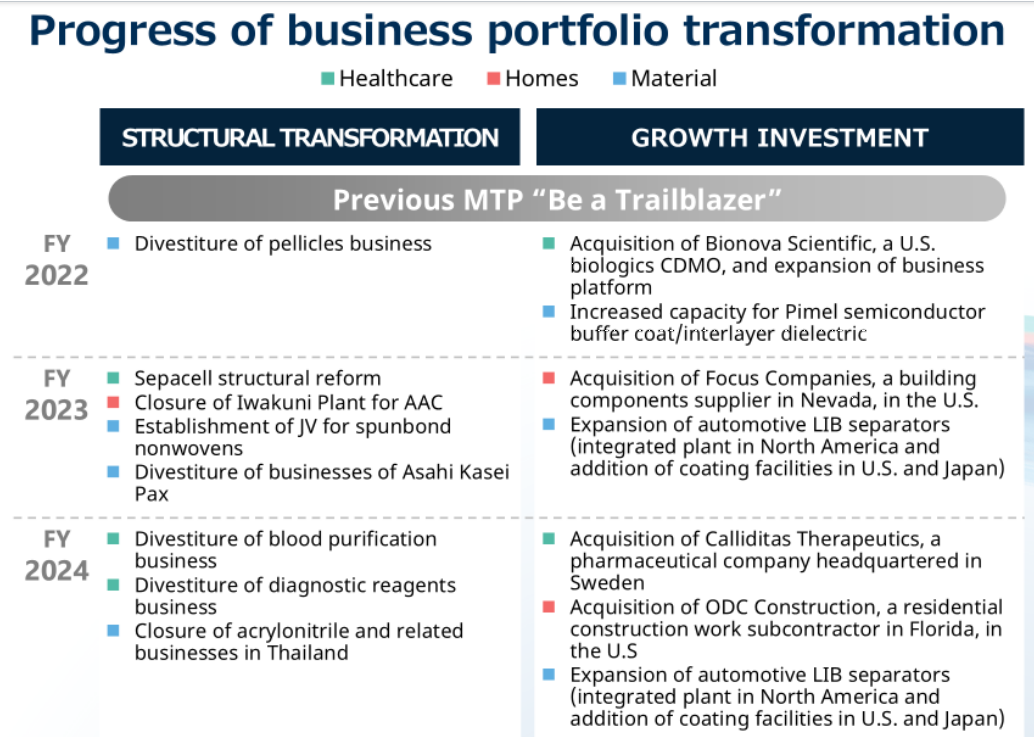
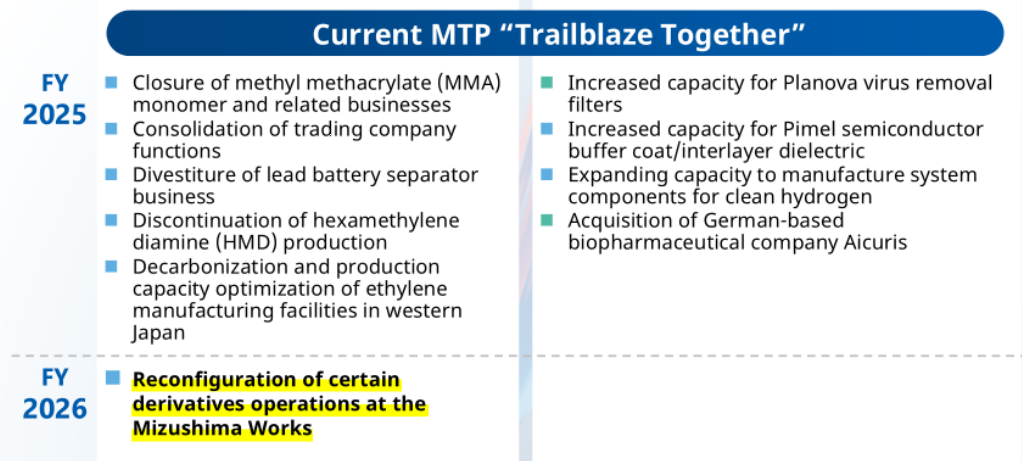
Progress of Asahi Kasei’s Business Transformation
Mitsubishi Chemical
Mitsubishi Chemical has decided to withdraw from the polybutylene succinate (PBS) business of PTT MCC Biochem Co., Ltd. (Bangkok, Thailand; “PTT MCC Biochem”).
It is reported that PTT MCC Biochem Co. is an equity-method affiliate jointly owned by Mitsubishi Chemical and PTT Global Chemical Public Company Limited Corporation (Bangkok, Thailand; “PTT Global Chemical Limited”).
PBS is a biodegradable plastic that can be broken down into water and carbon dioxide through the action of naturally occurring microorganisms. PTT MCC Biochem began commercial production of “BioPBS™” in 2017, and the product has been applied in areas such as coatings for paper cups and coffee capsules.
However, due to various factors such as actual market conditions deviating from initial expectations, the profitability of the PBS business remained persistently low, and Mitsubishi Chemical therefore decided to withdraw from the business. PTT MCC Biochem had already ceased production in December 2025, and after its inventory is sold out, it will discontinue sales. It will then be dissolved and liquidated in accordance with applicable local laws and regulations following the dismantling of its production facilities.
In recent years, Mitsubishi Chemical has accelerated its withdrawal from traditional petrochemical businesses. As early as the end of 2021, it decided to spend several years exiting its oil-based and coal-based chemical operations. Subsequently, Mitsubishi Chemical announced its exit from the PET bottle business and carried out a series of restructuring measures, including the closure of the Onahama Plant of Mitsubishi Chemical and the Shinryo Iwaki Plant.
In March of this year, Mitsubishi Chemical also announced the transfer of all shares in its Taiwanese MMA monomer subsidiary, Kaohsiung Monomer Company (KMC), to China Petrochemical Development Corporation (CPDC).
In February this year, Mitsubishi Chemical Group announced its decision to withdraw from the coke and carbon materials business (including needle coke and pitch coke) operated by the coal division of its consolidated subsidiary Mitsubishi Chemical Corporation. Production in this business is scheduled to cease in the second half of fiscal 2027, and sales will be gradually reduced after production stops. The business employs approximately 600 people.
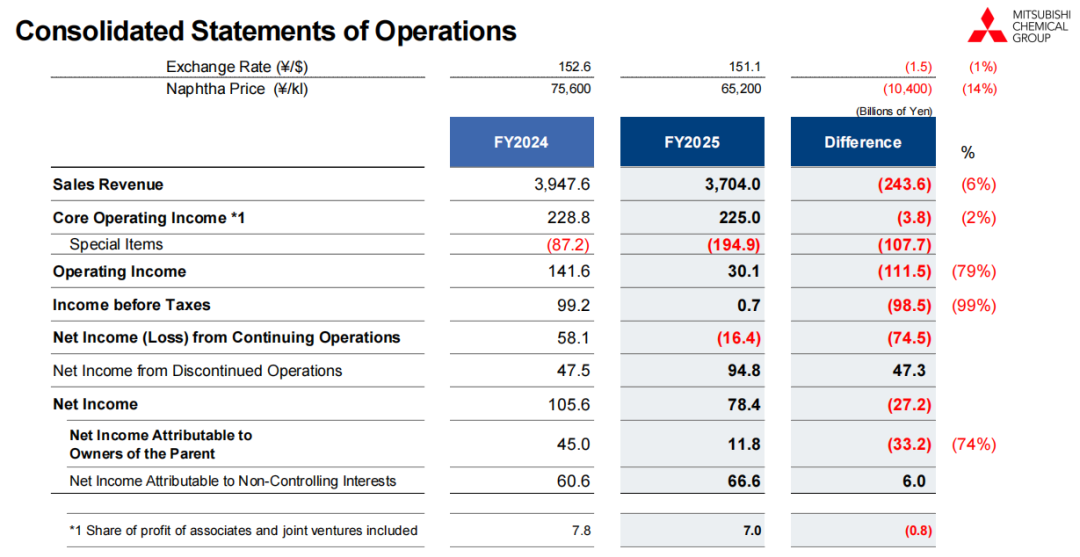
In terms of performance, in fiscal year 2025, Mitsubishi Chemical’s sales revenue was approximately 3.7 trillion yen, down 6% year on year; net profit attributable to owners of the parent was 11.8 billion yen, down 74% year on year. Although the company recognized gains from the transfer of Mitsubishi Tanabe Pharma, net profit declined sharply due to losses arising from its decision to exit the coke and carbon materials businesses, as well as special retirement expenses incurred under Mitsubishi Chemical’s “Next-Stage Support Program.”
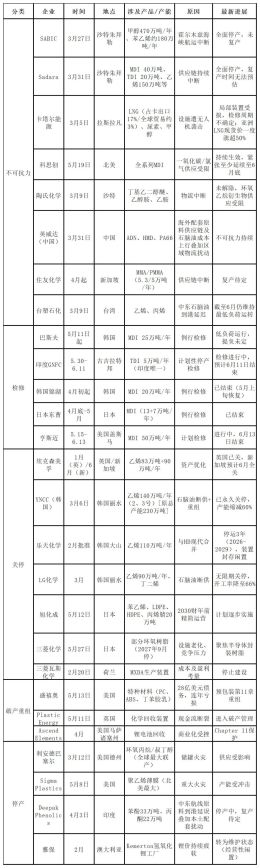
It is worth noting that, in addition to Mitsubishi Chemical and Asahi Kasei, companies such as Celanese, Mitsubishi Gas Chemical, LG Chem, and INVISTA have also announced closures or adjustments to related businesses since the beginning of this year, involving products such as nylon, polycarbonate (PC), and purified terephthalic acid (PTA), as detailed below:
On May 5, Celanese announced a series of strategic actions, including adjustments to its nylon business: the closure of its Sakra plant in Singapore, and the optimization of its North American nylon 66 polymerization facilities in Richmond, Virginia, and Washington, West Virginia, which is expected to reduce its overall polymer production. Celanese expects the Sakra plant to continue operating until the end of July 2026 to ensure a smooth and safe shutdown process.
Mitsubishi Gas Chemical (MGC): On March 31, Mitsubishi Gas Chemical announced plans to cease operations of the polycarbonate (PC) production unit (120,000 tons/year) at its Kashima plant in Japan by March 2028.
LG Chem: According to news on March 25, LG Chem plans to shut down its No. 2 unit at the Yeosu National Industrial Complex this week. LG Chem currently operates two naphtha cracking center (NCC) units in Yeosu: No. 1 with an annual capacity of 1.2 million tons, and No. 2 with an annual capacity of 800,000 tons.
Indorama: On March 2, Indorama Ventures Public Company Limited plans to permanently cease operations at one of the three sites of TPT Petrochemicals located in the Map Ta Phut Industrial Estate in Rayong Province, specifically the purified terephthalic acid (PTA) plant, which has an annual production capacity of 540,000 tons.
Invista: On January 7, Invista announced a series of strategic initiatives, including: closing its precision machining facility in Martinsville, Virginia, USA; ceasing production at its Gloucester plant in the UK; transferring related operations to its facility in Kingston, Canada, which will continue to serve customers in North America and Europe; and continuing to explore various investment opportunities to expand capacity at specific advantageous locations, including the Anlong plant in Shanghai, China.
【Copyright and Disclaimer】The above information is collected and organized by PlastMatch. The copyright belongs to the original author. This article is reprinted for the purpose of providing more information, and it does not imply that PlastMatch endorses the views expressed in the article or guarantees its accuracy. If there are any errors in the source attribution or if your legitimate rights have been infringed, please contact us, and we will promptly correct or remove the content. If other media, websites, or individuals use the aforementioned content, they must clearly indicate the original source and origin of the work and assume legal responsibility on their own.
Most Popular
-
A Look at the Material Suppliers Behind SpaceX
-
Government's Triple Action, Enterprises' Three Arrows in Five Days, Semiconductor Reshuffle! What Signal Does Japan's Chemical Industry Release?
-
Next-generation motors of new energy vehicles: Single-Round Thousand Horsepower, Replacing Brakes, How Powerful Are They?
-
Shutdowns And Production Cuts! Widespread Price Quotes Suspended, Chemical Products May Still Be Easier To Rise Than Fall In June-July!
-
Japan Plans To Sell Lithography Giant JSR! Fujifilm And Mitsubishi Chemical Interested In Taking Over, How Much Time Window Is Left For China?