FDCA Costs Reduced to RMB 5,250–9,500 per Ton! Latest Results from Zhang Yajie’s Team at Ningbo Institute of Materials Technology and Engineering Published
The bio-based aromatic materials team at the Ningbo Institute of Materials Technology and Engineering, Chinese Academy of Sciences, led by Senior Engineer Zhang Yajie, has published in *Bioresource Technology* the results of more than a decade of R&D. They developed an engineered NaClO/KBr/TEMPO oxidation process for converting HMF to FDCA. At an annual production scale of 100,000 tons, the theoretical cost of FDCA can be controlled at approximately RMB 5,250–9,500 per ton, which is close to the cost of petroleum-based terephthalic acid (TPA).
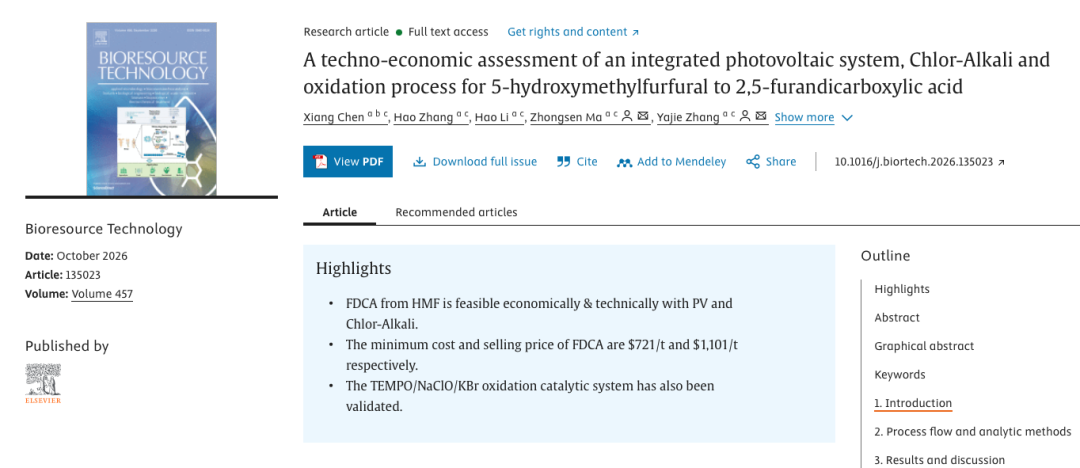
Zhang Yajie’s team conducted a detailed analysis of the oxidation mechanism in their work titled “A techno-economic assessment of an integrated photovoltaic system, Chlor-Alkali and oxidation process for 5-hydroxymethylfurfural to 2,5-furandicarboxylic acid,” successfully validated the process and produced the product in a hundred-ton-scale pilot trial, and performed a detailed techno-economic assessment at the 100,000-ton scale.
This oxidation process uses water as the solvent, and the yield of HMF to FDCA is close to 100%. Based on the characteristics of this process and the upstream and downstream industrial chains, the team proposed a photovoltaic–chlor-alkali–FDCA three-chain coupling strategy, which fully leverages the advantages of the three industries: the photovoltaic industry provides green energy for the chlor-alkali industry and the FDCA oxidation process; the chlor-alkali industry electrolyzes the waste salt NaCl generated from FDCA oxidation to supply the oxidizing material for FDCA oxidation, while also solving the problem of the large amount of solid waste generated during FDCA oxidation.
At an annual production scale of 100,000 tons, the theoretical cost of FDCA is controlled at approximately 5,250 to 9,500 yuan/ton, which is close to the cost of petroleum-based terephthalic acid (TPA). This strategy innovatively couples the production of FDCA with China's advantageous industries—the photovoltaic industry and the chlor-alkali industry—realizing the green transformation of the entire energy process and product. It provides new ideas for the transformation and upgrading of the traditional chlor-alkali industry.
【Copyright and Disclaimer】The above information is collected and organized by PlastMatch. The copyright belongs to the original author. This article is reprinted for the purpose of providing more information, and it does not imply that PlastMatch endorses the views expressed in the article or guarantees its accuracy. If there are any errors in the source attribution or if your legitimate rights have been infringed, please contact us, and we will promptly correct or remove the content. If other media, websites, or individuals use the aforementioned content, they must clearly indicate the original source and origin of the work and assume legal responsibility on their own.
Most Popular
-
Layoffs, Divestments, Plant Closures While Pouring Billions: BASF Undergoes Major Transformation!
-
Ascend Adipic Acid Hit By Force Majeure, Market Expects Supply Resumption In Mid-September
-

Raw Material Supply Shortage! INEOS Phenol Declares Force Majeure on Phenol and Acetone Businesses
-
South Korea initiates anti-dumping investigation against Chinese PVC suspension resin! The target is Tianjin Bohua and Wanhua Chemical. How to break through?
-

Sixth national procurement set to be implemented: A “Reshuffling” Moment for the $10-Billion Medical Device Market