



Did 18 Listed Automakers Achieve the 60-Day Payment Term?

With NIO recently releasing its financial report, the semi-annual reports of major domestic listed automakers have all been disclosed.
Looking back at the first half of the year, "anti-involution" became one of the key phrases in the automotive industry. Relevant departments, industry associations, car companies, and dealers have all voiced their support for "anti-involution." Among them, the most notable was the joint commitment by 17 car companies to shorten the payment terms for suppliers to within 60 days, providing "blood transfusions" to ease the difficulties faced by component manufacturers.
As the mid-year reports conclude, it is the perfect time to assess the effectiveness of commitments. After reviewing the semi-annual reports of 18 listed car companies, a reporter from "Daily Economic News" found that by the end of the first half of the year,The total accounts payable and notes payable amounted to 1,020.903 billion yuan, a decrease of 62.934 billion yuan compared to the end of last year; however, the average turnover days increased to 192.46 days, an increase of 6.17 days compared to the end of last year.The divergence manifests as a decline in total amount and an extension of the payment period.
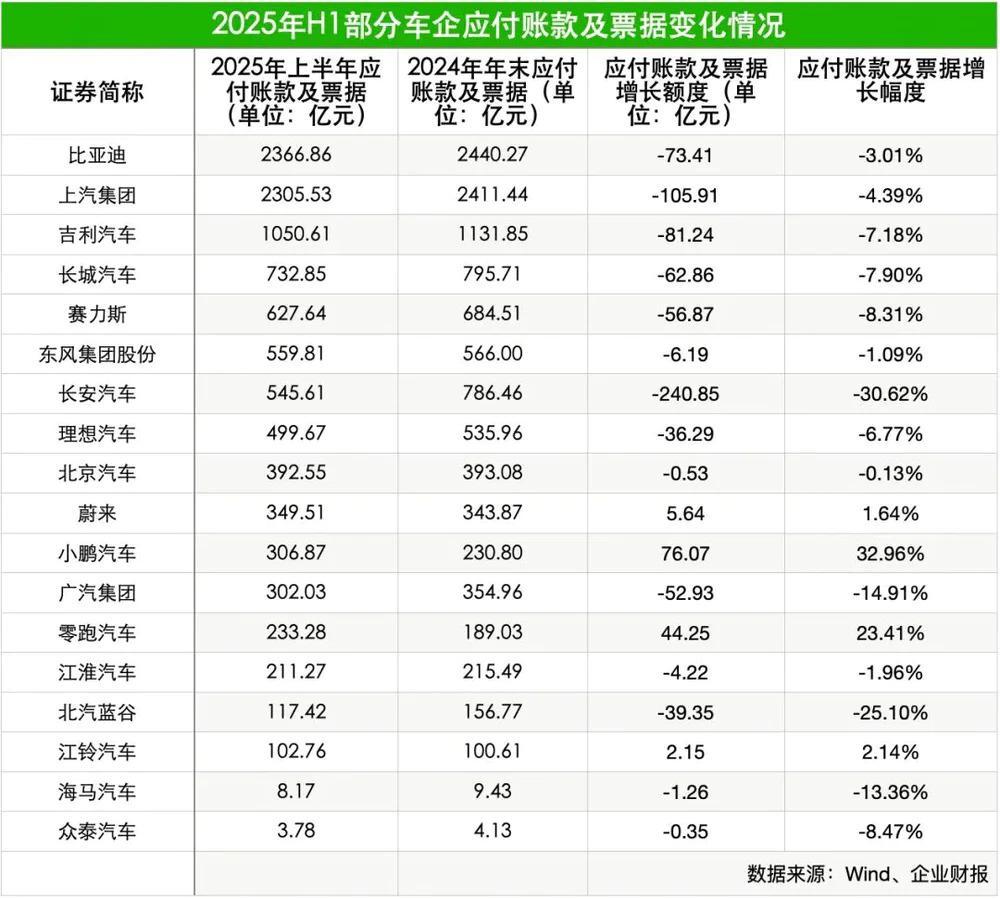
At the individual company level, BYD, SAIC Motor, and Geely Automobile ranked as the "top three in accounts payable," with accounts payable and notes for the first half of the year reaching 236.686 billion yuan, 230.553 billion yuan, and 105.061 billion yuan, respectively—all surpassing the 100-billion-yuan mark. In terms of corresponding turnover days, Zotye Auto, Seres, and Haima Automobile ranked as the "top three with the longest payment periods."
Accounts payable decreased for most, and turnover days increased for most.
In the first half of this year, the accounts payable and notes payable scale of 14 car companies decreased compared to the end of last year. Among them, Changan Automobile, SAIC Motor, and Geely Automobile saw the largest reductions, with decreases of 24.085 billion yuan, 10.591 billion yuan, and 8.124 billion yuan, respectively. In terms of the decline rate, Changan Automobile, BAIC BluePark, and GAC Group lead this indicator.
Compiled by: Sun Lei, National Business Daily Reporter
In contrast,The accounts payable and notes payable of NIO, XPeng Motors, Leapmotor, and Jiangling Motors at the end of the first half of the year have increased compared to the end of last year.In the past six months, XPeng Motors increased by 7.607 billion yuan, a growth of 32.96%; Leapmotor increased by 4.425 billion yuan, a growth of 23.41%.
Some analysts have noted that, as sales increase, these two companies have correspondingly expanded their procurement scale in the upstream supply chain, resulting in a corresponding rise in accounts payable and notes payable. Meanwhile, with the growth in delivery volumes, XPeng Motors and Leapmotor have strengthened their bargaining power within the supply chain, allowing them to more effectively leverage suppliers’ financial support, thereby increasing the scale of accounts payable and notes payable.
Unlike accounts payable and notes payable, from the corresponding...Turnover DaysIn the first half of this year, only six companies showed improvement compared to the end of last year, namelySAIC Motor, Changan Automobile, XPeng Motors, BAIC BluePark, Haima Automobile, and Zotye AutomobileThe accounts payable and notes turnover days for XPeng Motors is 170 days, which is approximately 63 days shorter than at the end of last year, making it the automaker with the largest reduction in payment period.
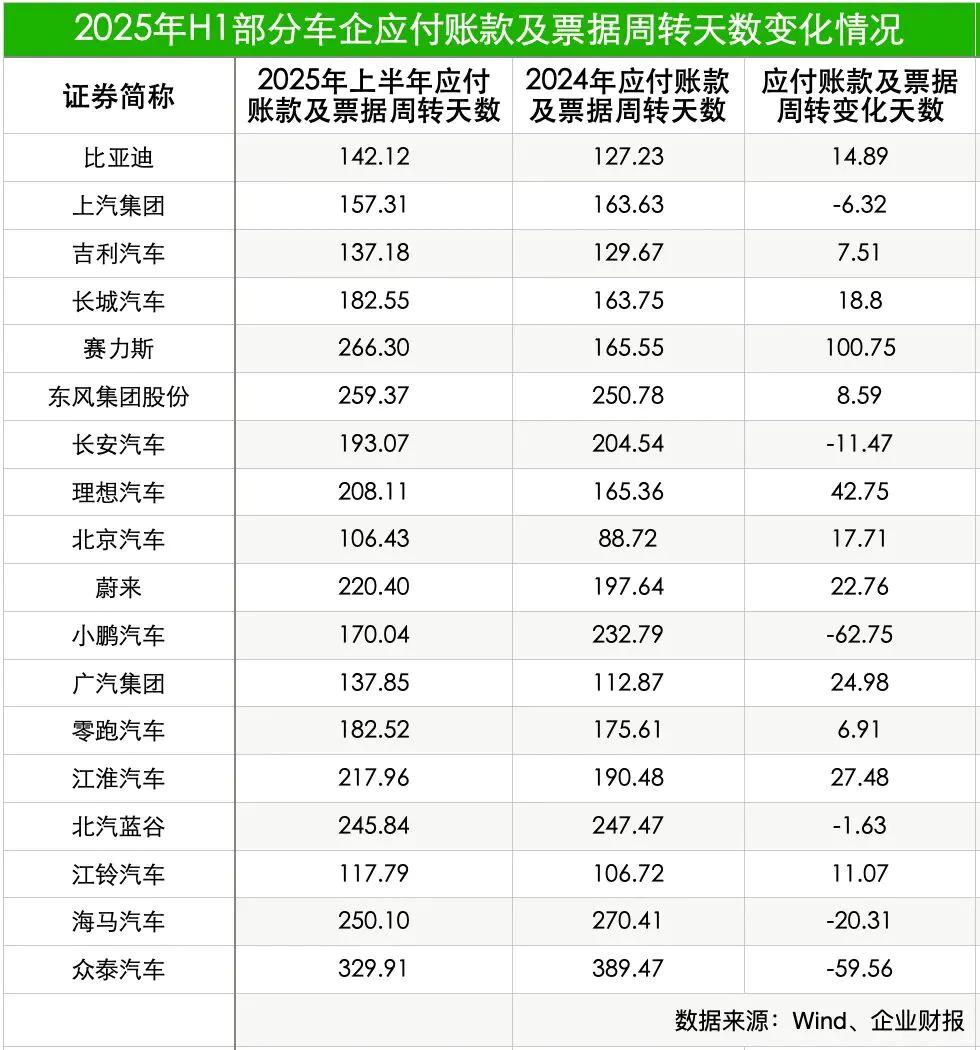
Table: Every Economic Daily Reporter Sun Lei
On July 12, He Xiaopeng, Chairman of XPeng Motors, stated in a post: "After nearly a month of repeated internal discussions, XPeng has formulated steps for adjusting and implementing payment terms, and has begun to push forward." According to sources, some XPeng Motors suppliers received emails in July of this year mentioning that "based on long-term cooperation considerations, the signing of relevant supplementary agreements has been initiated—the payment period will be shortened to within 60 days."
In contrast, the accounts payable and notes turnover days of 11 other companies are still increasing. Among them, Seres' accounts payable and notes turnover days for the first half of this year were 266.3 days, an increase of more than 100 days compared to the end of last year; BYD increased by nearly 15 days to around 142 days, Li Auto increased by about 43 days to 208 days, and JAC Motors increased by more than 27 days to nearly 218 days.
From the above accounts payable and notes and the corresponding turnover days, it can be seen that there is an overall trend of decreasing accounts payable and notes, but an increase in corresponding turnover days. In this regard, some analysts believe that in the first half of the year, car companies generally accelerated their payments and had abundant cash, leading to proactive early payments. However, due to...The "60-day payment term commitment" starts from June 10th to 11th, while the deadline for the semi-annual report is at the end of June, and the changes in the payment terms for car manufacturers have not yet been clearly reflected.
It is worth noting that although the overall accounts payable and notes turnover days have not changed much,However, some companies have already stated in their financial reports that they will take corresponding measures.For example, BYD mentioned in its financial report that in the first half of the year, it further optimized account period management and channel management, and the turnover days for accounts payable and notes payable were at a relatively low level in the automotive industry.
Some companies' cash reserves are insufficient to cover accounts payable and notes payable.
In fact, apart from the statements made by companies in their financial reports,By analyzing changes in corporate cash flow, it is possible to see that automotive companies have begun taking actions to optimize their payment terms.For example, Li Auto's net cash used in operating activities for the second quarter was 3 billion yuan, a significant increase from 430 million yuan in the same period last year. However, its free cash flow was -3.8 billion yuan, which "deteriorated" by more than double year-on-year and further expanded from -2.5 billion yuan in the first quarter.
Li Auto explained that the above change is mainly the company's response to the regulatory requirement of a "60-day payment term," shortening the payment cycle to suppliers from 3 to 4 months to 60 days. Li Auto's Chief Financial Officer, Tie Li, stated during the earnings call that the company's cash flow is expected to improve in the fourth quarter.
Li Auto has informed reporters that the company completed the payment term adjustments for all direct procurement suppliers in mid-July. The contract payment term is 60 days, with payments made on a monthly basis and two unified payment periods each month. In terms of settlement methods, the majority are done via telegraphic transfer, with only a small portion using bank acceptance. A supplier stated, "Li Auto's payment term has changed to 60 days, with direct cash payments, no acceptance."
It is noteworthy that the adjustment of payment terms to suppliers by car companies involves complex processes and cannot be achieved overnight. Reporters have learned that many companies completed this work in July. On August 11, exactly 60 days after the commitment, the Ministry of Industry and Information Technology disclosed research information on the implementation of the commitment by three car companies—FAW Group, GAC Group, and Seres, which have achieved payment of accounts within 60 days.
Implement a 60-day payment term.The biggest obstacle may lie in the financial management capabilities and internal coordination mechanisms of some car companies."For instance, how to adjust cash flow in a short period to ensure timely payment to suppliers is quite a challenge. Additionally, the coordination between the financial, procurement, and production departments within car companies needs to be further strengthened to ensure timely allocation and payment of funds," said Cui Dongshu, Secretary-General of the China Passenger Car Association.
Wang Peng, an associate researcher at the Beijing Academy of Social Sciences, also believes that the automakers' failure to fulfill the "60-day payment period" commitment is due to their own cash flow pressures, forcing them to prioritize the stability of their own financial chains, thereby delaying payments. These views once again prove that shortening the payment period is primarily a "cash battle."Whether the book funds can fully cover accounts payable and notes is the critical point for the "60-day settlement" promise to be truly implemented.
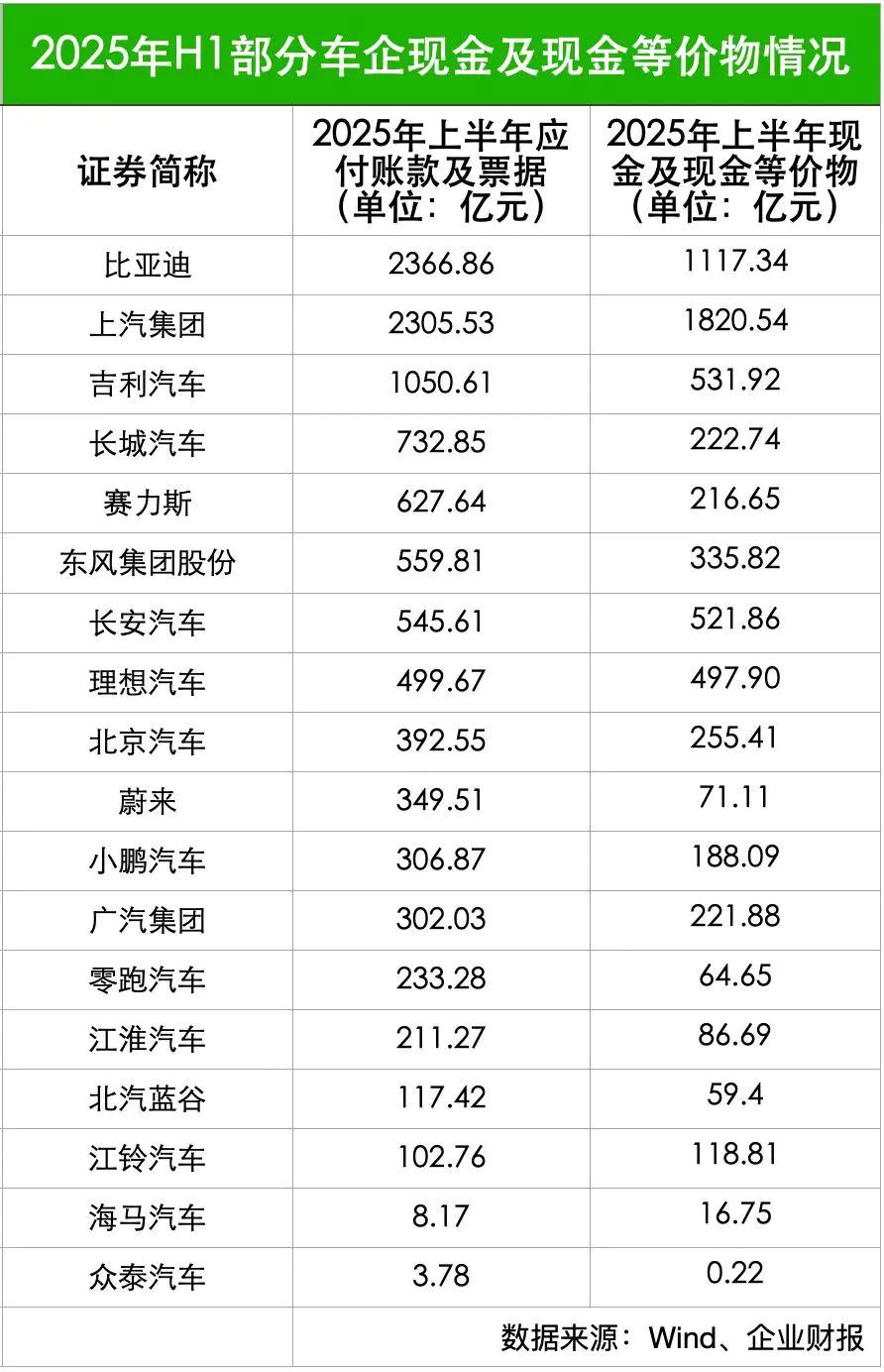
Table: Every Business Daily Reporter Sun Lei
From the perspective of cash and cash equivalents, among the 18 car companies, only Jiangling Motors and Haima Automobile have sufficient book funds to fully cover their accounts payable and notes payable. If short-term investments that can be readily liquidated, along with cash and cash equivalents, are included in the "cash reserves" statistics, then Leapmotor, XPeng Motors, and Li Auto would have cash reserves sufficient to fully cover their accounts payable and notes payable.
However, even when estimated based on cash reserve size, some car companies are still unable to fully cover their accounts payable and notes: companies like BYD, Geely Auto, and NIO have reserve sizes that are still lower than their corresponding accounts payable and notes, putting pressure on their short-term solvency. Looking at the industry as a whole, the "60-day billing period" promise remains an "ultimate cash test" yet to be completed.
Source: NBD Auto
【Copyright and Disclaimer】The above information is collected and organized by PlastMatch. The copyright belongs to the original author. This article is reprinted for the purpose of providing more information, and it does not imply that PlastMatch endorses the views expressed in the article or guarantees its accuracy. If there are any errors in the source attribution or if your legitimate rights have been infringed, please contact us, and we will promptly correct or remove the content. If other media, websites, or individuals use the aforementioned content, they must clearly indicate the original source and origin of the work and assume legal responsibility on their own.
Most Popular
-

Mexico Imposes Tariff Up to 36% on Cross-Border E-Commerce Products, Effective January 1, 2026; Plastic Shows Partial Fluctuation Today
-
4.5 Million Tons! Wanhua Chemical Dominates Globally in MDI, Heavy Investment in Battery Materials Spurs New Storm
-
Trump Delays Tariff Increase on Furniture, Cabinets, and Vanities
-
Wanhua Chemical Invests $27.3 Billion, 2026 Investment Map Revealed, $1.1 Billion Bet on Battery Materials
-
Back-to-back major joker moves! covestro’s 1.32 million ton mdi dual-line expansion and hdi acquisition reshape global polyurethane landscape


