



Comparison of the Three Major Industrialized Chemical Recycling Routes for rPET: BHET, DMT, and Enzymatic Methods
Driven by the global "dual carbon" goals and brand initiatives for recycled material traceability, PET chemical recycling technology is transitioning from laboratory research to large-scale industrial application. Unlike mechanical recycling, which only changes the physical form, chemical recycling employs a process of "depolymerization—purification—repolymerization," effectively removing impurities and restoring virgin-grade performance, achieving true closed-loop recycling, such as "textiles to textiles" and "bottles to bottles."
At present, global chemical recycling of rPET has entered a critical stage characterized by large-scale commercialization, leadership by major enterprises, and diversified technological pathways. Among the many chemical depolymerization technologies, the DMT (dimethyl terephthalate) route and the BHET (bis(2-hydroxyethyl) terephthalate) route are the two mainstream options. Each has its own focus in terms of process flow, product form, economics, and feedstock adaptability, and together they shape the technological landscape of the recycled polyester industry.
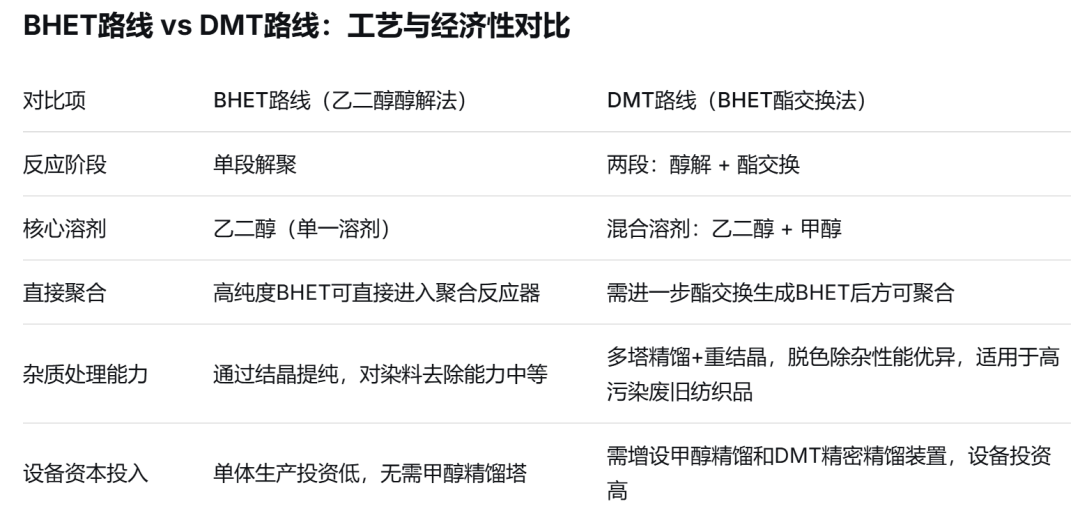
Compared with the DMT route, the BHET route eliminates one transesterification step, offering advantages such as a shorter production process, lower costs and energy consumption, and lower entry barriers. Therefore, it is expected that the BHET route will be more widely adopted in new chemical recycling projects in the future.
— 1 —
Current market pricing: chemically recycled rPET still needs improvement in cost-effectiveness.
Currently, some recycled polyester fiber manufacturers purchase chemically recycled rPET chips at prices ranging from RMB 11,000 to 15,600 per ton for the production of differentiated functional fibers. According to feedback from some buyers, the application results have not been entirely satisfactory: products priced at RMB 15,000–15,600 per ton perform relatively better and appear whiter, while lower-priced products are of average quality and have poorer color tone.
By comparison, data from Huarui Information show that the price of 3A-grade white flakes is about RMB 6,650/ton, recycled PET chips about RMB 7,800/ton, and semi-dull virgin PET chips about RMB 7,200/ton. It is evident that chemically recycled rPET chips are significantly less cost-effective, and without the support of the “textile-to-textile” (T2T) concept, market purchasing willingness remains weak. However, with technological upgrades, the cost of chemical recycling is gradually declining.
— 2 —
Enzymatic Recycling: A Disruptive Technology Under Mild Conditions, Advancing from Lab Scale to Pilot Scale
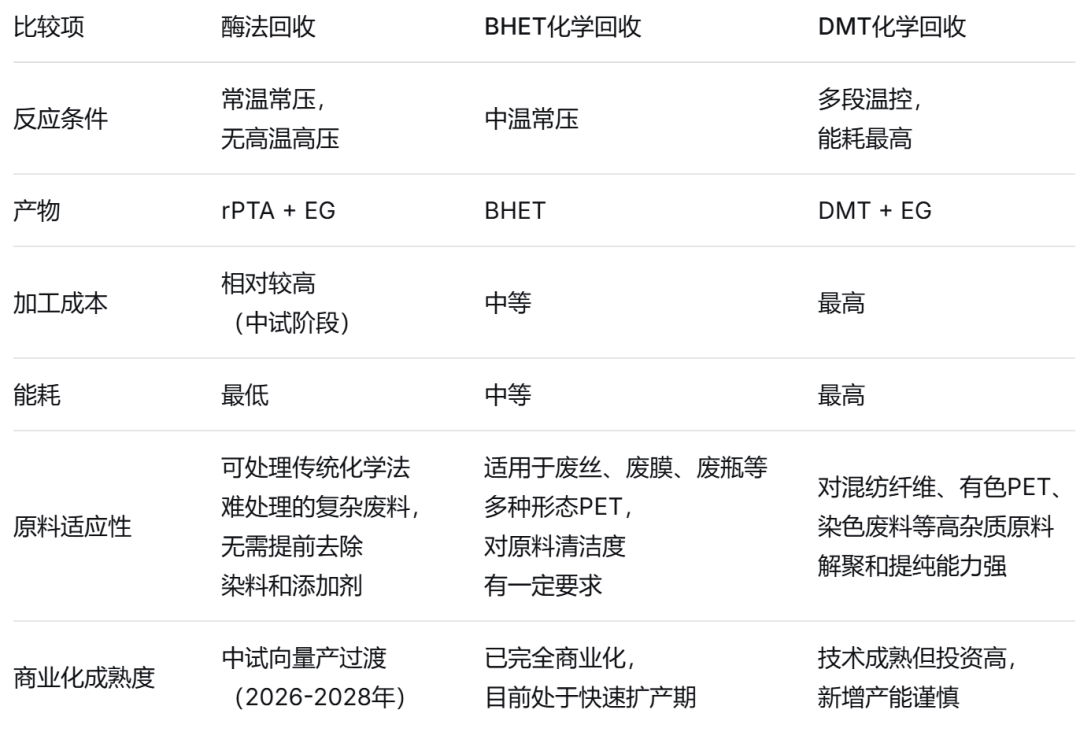
Enzymatic recycling technology uses depolymerizing enzymes as catalysts to break down PET into its monomers, PTA and MEG, under mild conditions (at ambient temperature and pressure or with low- to medium-temperature heating, generally not exceeding 70°C). This technology is currently at the pilot stage and is regarded as a highly promising direction for the recycling industry.
— 3 —
Future Outlook
In the coming years, thanks to its low cost and advantages in integrated processing, the BHET route may become the mainstream choice for new chemical recycling capacity; meanwhile, the DMT route will maintain a differentiated market advantage due to its strong adaptability to mixed waste materials and export premium. The two chemical routes will jointly dominate the domestic chemical recycling capacity landscape. Enzymatic technology, constrained by the relatively high cost of enzyme preparations, is still at the pilot stage, but is rapidly gaining attention in the field of waste textile recycling.
In the long run, continuous technological breakthroughs will simultaneously lower the costs of both chemical and enzymatic recycling, reshaping the cost structure of PET recycling and driving the industry to gradually shift from primarily mechanical recycling to a new stage of fully closed-loop chemical recycling. (Source: CCFGroup)
【Copyright and Disclaimer】The above information is collected and organized by PlastMatch. The copyright belongs to the original author. This article is reprinted for the purpose of providing more information, and it does not imply that PlastMatch endorses the views expressed in the article or guarantees its accuracy. If there are any errors in the source attribution or if your legitimate rights have been infringed, please contact us, and we will promptly correct or remove the content. If other media, websites, or individuals use the aforementioned content, they must clearly indicate the original source and origin of the work and assume legal responsibility on their own.
Most Popular
-

A Look at the Material Suppliers Behind SpaceX
-

Government's Triple Action, Enterprises' Three Arrows in Five Days, Semiconductor Reshuffle! What Signal Does Japan's Chemical Industry Release?
-
Next-generation motors of new energy vehicles: Single-Round Thousand Horsepower, Replacing Brakes, How Powerful Are They?
-
Shutdowns And Production Cuts! Widespread Price Quotes Suspended, Chemical Products May Still Be Easier To Rise Than Fall In June-July!
-
Japan Plans To Sell Lithography Giant JSR! Fujifilm And Mitsubishi Chemical Interested In Taking Over, How Much Time Window Is Left For China?


