Chemical Industry Boom Arrives, but Polyolefins Face the Flood Peak
In early 2026, the buzz around a "banner year for chemicals" quickly intensified within the industry. Futures markets became agitated, and the basic chemicals index staged a strong rebound, with sub-sectors like fluorochemicals, phosphochemicals, and aromatics leading the charge. Market sentiment shifted from dormancy to excitement. This surge was not without reason, but rather a result of policy adjustments, global capacity culling, and the resonance of emerging demand.
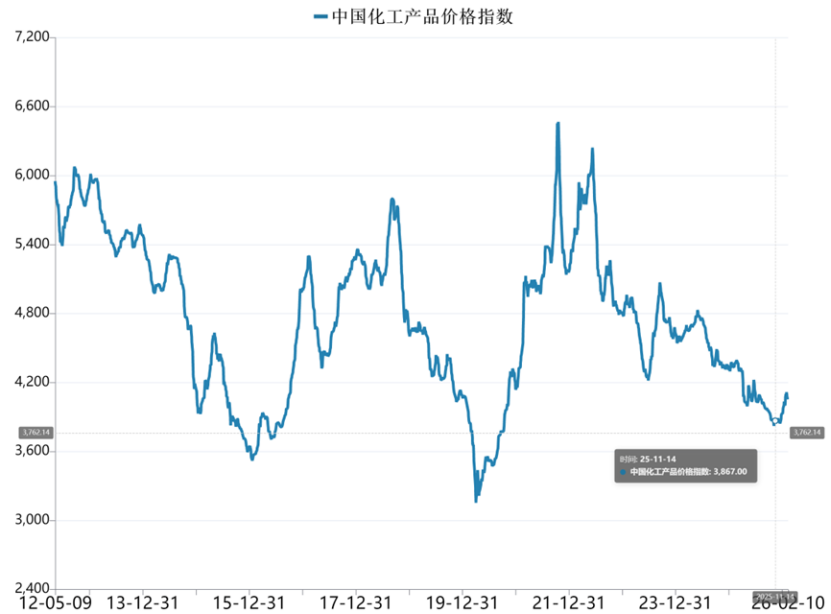
Over the past two years, the chemical industry has been deeply mired in a "race to the bottom" – with unchecked capacity expansion and continuous profit compression. However, since 2025, the tide has subtly turned. The government has introduced a series of regulatory policies, with the "Work Plan for Stabilizing Growth in the Petrochemical and Chemical Industry (2025-2026)" explicitly stating strict control over new production capacity for bulk products such as ethylene, PX, and refining, and curbing the risk of overcapacity in areas like coal-to-methanol. The industry is shifting from "land grabbing" to "high-quality development," and the pace of capital expenditure has significantly slowed down. Concurrently, aging refining and chemical facilities in Europe, Japan, and other regions are accelerating their exit, marginally easing global supply pressure and quietly increasing the market share of leading domestic enterprises.
The demand side is also showing a structural recovery. In 2025, the year-on-year growth rate of finished goods inventory in the chemical manufacturing industry rose to 8.3%, indicating a steady progress in the restocking process. More critically, new growth engines such as electric vehicles, photovoltaics, and semiconductors continue to gain momentum. High-end materials like electronic chemicals and high-performance fibers are in short supply, driving the industry's transition from "aggregate pressure" to "structural differentiation." Against this backdrop, the overall price center of chemical commodities is expected to shift upward moderately. Specifically, the fluorine chemical sector is benefiting from the tightening of refrigerant quotas, aromatics are leveraging demand from electronics and new energy, and high-end specialty chemicals maintain their prosperity.
However, polyolefins are unlikely to benefit from this round of dividends. In 2026, the combined new capacity of PE and PP will be approximately 12 million tons, with a supply growth rate of about 13%, far exceeding the demand growth rate of 5%-8%. The oversupply situation will be further exacerbated. The first half of the year is still digesting the output of existing plants, while the second half will see a peak in production. The large-scale release of HDPE may even squeeze the production conversion space of LLDPE. Although short-term disruptions (such as the US cold wave causing import delays) may bring pulse-like increases, in the medium and long term, the fierce competition for general-purpose materials is unlikely to be reversed, and price ranges will remain low and volatile.
The only bright spot lies in the domestic breakthroughs of high-end polyolefins. POE, UHMWPE, and other specialty materials have achieved mass production, supporting price and volume increases for high-end grades, but the volume is still small, making it difficult to change the overall supply-demand imbalance.
In 2026, the chemical industry is undergoing a profound structural reshaping. Policy dividends and emerging demands have indeed sprouted, but not all tracks can share the spring sunshine. While the narrative of a "boom year" sweeps the market, polyolefins stand beneath a flood of capacity – its spring may have to wait another season.
Author: Zhou Yongle, Senior Market Analyst
【Copyright and Disclaimer】This article is the property of PlastMatch. For business cooperation, media interviews, article reprints, or suggestions, please call the PlastMatch customer service hotline at +86-18030158354 or via email at service@zhuansushijie.com. The information and data provided by PlastMatch are for reference only and do not constitute direct advice for client decision-making. Any decisions made by clients based on such information and data, and all resulting direct or indirect losses and legal consequences, shall be borne by the clients themselves and are unrelated to PlastMatch. Unauthorized reprinting is strictly prohibited.
Most Popular
-

A Look at the Material Suppliers Behind SpaceX
-

Government's Triple Action, Enterprises' Three Arrows in Five Days, Semiconductor Reshuffle! What Signal Does Japan's Chemical Industry Release?
-
Fire breaks out at jiangsu meiside!
-
Name change without tax change: POM Anti-Dumping Duty Rate Inheritance Implemented
-
Ethylene: Production Capacity Accelerates Expansion, Global Industry Landscape Is Being Reshaped