



Carbon Reduction of 9%! Southwest Jiaotong University Transforms Waste PET Into High-Performance Catalysts
Recently, Researcher Wang Xin from the Institute of Frontier Science at Southwest Jiaotong University and Professor Wang Hui from Xi'an Jiaotong University published a research article titled "Upcycling of Waste PET Plastics to Fabricate Cobalt-Nickel Metal–Organic Frameworks and Their Phosphides for Efficient Oxygen Evolution Reaction" in Rare Metals. They proposed a green strategy for the high-value conversion of waste PET plastics into efficient electrocatalytic materials for the oxygen evolution reaction (OER).
This work utilizes waste PET plastic as a source of organic ligands to directly construct a bimetallic cobalt-nickel metal-organic framework Co₄Ni-MOF through a one-step hydrothermal method, which is further processed by phosphorization to obtain the highly active Co₄NiP-400 catalyst. The research results indicate that the phosphorized material exhibits excellent oxygen evolution performance under alkaline conditions, requiring only a 287 mV overpotential at a current density of 10 mA·cm⁻², with a Tafel slope as low as 51 mV·dec⁻¹, while also demonstrating good cycling stability and long-term operational stability. Further theoretical calculations reveal that the phosphorization process effectively tunes the electronic structure of the catalyst, optimizes the adsorption behavior of reaction intermediates, and alters the rate-determining step of the oxygen evolution reaction, thereby significantly reducing the reaction energy barrier. Life cycle assessment (LCA) results further indicate that, compared to the traditional terephthalic acid route, synthesizing such MOF materials using waste PET can lower greenhouse gas emissions and marine eutrophication potential, reflecting good environmental friendliness and resource recycling value. This study provides new insights for the high-value utilization of waste plastics and the design of green electrocatalytic materials.
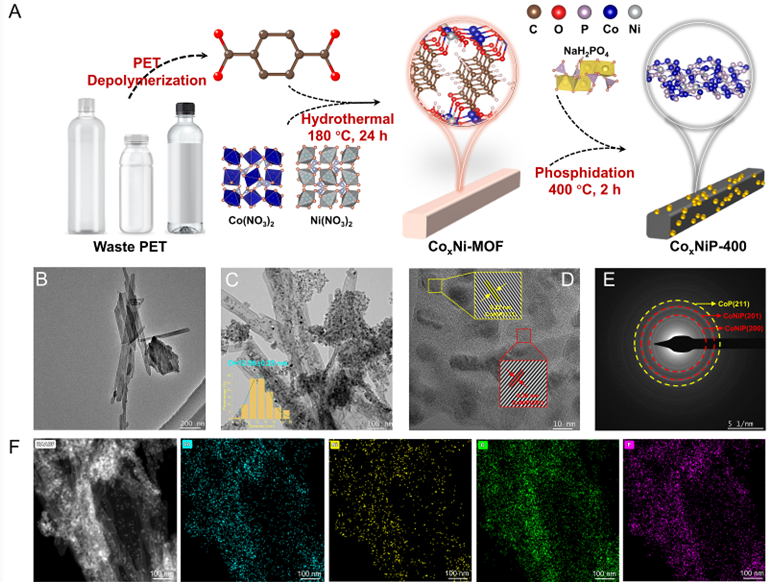
Figure 1 Preparation route and microstructural characterization of waste PET-derived Co₄NiP-400. (A) Schematic illustration of catalyst preparation; (B, C) Co4Ni-MOF and Co4TEM image of NiP-400; (D) Co4HRTEM image of NiP-400; (E) Co4SAED pattern of NiP-400; (F) Co4EDX elemental distribution maps of NiP-400.
【Copyright and Disclaimer】The above information is collected and organized by PlastMatch. The copyright belongs to the original author. This article is reprinted for the purpose of providing more information, and it does not imply that PlastMatch endorses the views expressed in the article or guarantees its accuracy. If there are any errors in the source attribution or if your legitimate rights have been infringed, please contact us, and we will promptly correct or remove the content. If other media, websites, or individuals use the aforementioned content, they must clearly indicate the original source and origin of the work and assume legal responsibility on their own.
Most Popular
-

Layoffs, Divestments, Plant Closures While Pouring Billions: BASF Undergoes Major Transformation!
-
Ascend Adipic Acid Hit By Force Majeure, Market Expects Supply Resumption In Mid-September
-

Raw Material Supply Shortage! INEOS Phenol Declares Force Majeure on Phenol and Acetone Businesses
-
South Korea initiates anti-dumping investigation against Chinese PVC suspension resin! The target is Tianjin Bohua and Wanhua Chemical. How to break through?
-

Sixth national procurement set to be implemented: A “Reshuffling” Moment for the $10-Billion Medical Device Market


