Cabin and Driving Integration Brings the Era of Domestic Chips
The evolution of the vehicle's electronic and electrical architecture is pushing cars into a whole new era of computing.
From distributed ECUs to domain controllers, and then to a central computing platform, the integration of cabin and driving has evolved from a technological vision to an industry consensus, becoming a strategic direction that major automakers are actively pursuing.
This trend is particularly evident at this year’s Beijing Auto Show. More notably, in the race to define the automotive intelligence landscape over the next decade, Chinese chip companies are stepping out from behind the scenes into the spotlight.
Not long ago, constrained by chip performance bottlenecks, the core computing power for cabin-driving integration primarily relied on foreign vendors. Today, with continuous breakthroughs by domestic players such as Horizon Robotics and Black Sesame Technologies, an era of cabin-driving integration powered by Chinese-made chips is rapidly arriving.
Cockpit-Driving Integration: From Concept to Mass Production
One of the core signals of this auto show is that cockpit-and-driving integration has transitioned from technological validation to large-scale mass production.
In the domain of cabin-driving integration, leading new-energy vehicle startups have taken the lead in delivering solutions, while mainstream automakers are closely following suit. A progressive pathway—from “point-wise breakthroughs” to “comprehensive rollout”—has already become clearly defined.
At this auto show, Zeekr’s all-new flagship SUV, the D19, made its highly anticipated debut. One of its key highlights is the industry-first adoption of dual Qualcomm 8797 central domain controllers, enabling a cockpit-and-driving integrated super-cooperative architecture built upon 1,280 TOPS of computing power.
Xpeng Motors has also implemented a cockpit-driving integration architecture on its main vehicle models, unifying the cockpit interaction and ADAS perception and decision-making for coordinated scheduling, significantly reducing system latency and enhancing overall user experience smoothness.
The mass production and market launch of these vehicle models have factually addressed the industry's core concern: cabin and driving integration is both technically feasible and cost-effective.
More automakers are accelerating their follow-up.
During the Beijing Auto Show, Chery signed an agreement with Qualcomm to eliminate data silos between the cockpit and intelligent driving systems based on the Snapdragon Ride Flex SoC. According to the plan, Chery and Qualcomm’s first cockpit-and-driving-integrated vehicle will be launched this year.
BAIC has signed a memorandum of understanding with Qualcomm, building on the global launch and mass production of the Snapdragon 8775 solution, and has initiated exploration of the next-generation solution. Prior to this, BAIC Arcfox Alpha T5 and S5 have already adopted integrated cockpit and driving domain control, completing the first market validation.
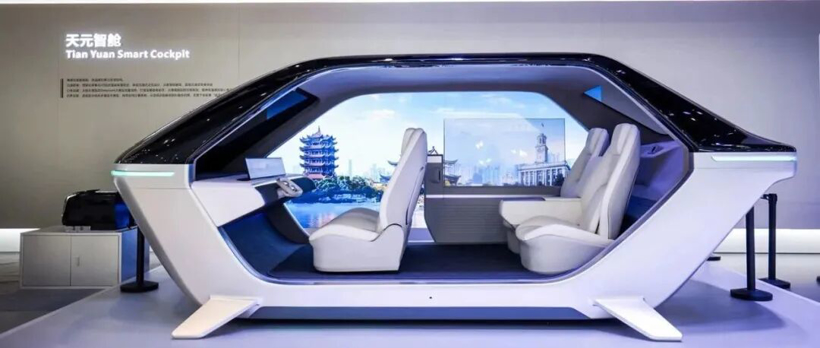
Image source: Huizhima Intelligent
Dongfeng Motor has chosen to form a platform-level partnership with Black Sesame Intelligent to jointly create the first domestic integrated cabin and driving production platform, "Tianyuan Zhitang Plus," which will be first equipped on the Dongfeng Yipai 007, with plans for large-scale coverage across multiple models between 2026 and 2027.
The concept car "S-concept" exhibited by the Hongqi Tian Gong sub-brand also adopts a cabin-driving integration solution, with a central "brain" controlling all vehicle functions. This system not only supports L3/L4 level intelligent driving but can also learn user habits, perceive emotional changes, and shape the cabin into a warm, empathetic, and evolving intelligent "life form."
From new entrants achieving scale deliveries, to established brands rapidly catching up, and to forward-looking technologies setting the direction, automakers’ collective actions have clearly demonstrated that cabin-driving integration is not a solo performance by any single company, but an industry-wide symphony.
Of course, the suppliers of the components behind the scenes also played a crucial role in making this symphony possible.
For example, the cockpit and driving integration platform developed by Bosch based on the Qualcomm SA8775P chip not only supports features that surpass current mainstream cockpit solutions, such as 3D HMI and large model integration with cloud, but also possesses mid-level intelligent driving capabilities like high-speed NOA and urban memory driving.
Cheliangtianxia exhibited a domain controller product matrix covering different tiers: the AL-A1, based on the Snapdragon 8775, has entered mass production on the BAIC Arcfox T5 and S5, representing the world’s first mass-produced single-chip cockpit-and-driving integration solution; the AL-A2, based on the Snapdragon 8797 and designed for the next-generation central computing architecture, simultaneously supports on-device large model deployment and multi-domain collaborative processing.
It is these "behind-the-scenes players" who transform chip computing power into implementable engineering solutions, allowing the integration of cabin and driving to truly move from the laboratory into the hands of consumers.
Domestic chips step up to the table.
As the wave of cockpit and driving integration sweeps through the industry, a new change is quietly taking place: Chinese chip companies are shifting from supporting roles to core participants and drivers.
For example, Heizhima Intelligence is one of the most solid examples in this offensive.
The "Tianyuan ZhiCabin Plus" platform, co-created with Dongfeng, centers around the self-developed Wudang C1296 chip. This chip, utilizing 7nm automotive-grade process technology, achieves hardware-level integration of four major domains—cabin, intelligent driving, gateway, and MCU vehicle control—on a single chip.
Specifically, at the intelligent cockpit level, Tianyuan Zhichang Plus redefines the cockpit interaction experience through 3D immersive interaction, AI intelligent interaction, and full-scene connectivity. At the intelligent driving level, Tianyuan Zhichang Plus, with its multi-modal perception fusion capability, meets the L2+ level full-scenario driving needs. Coupled with FAPA (Fusion Automatic Parking Assistance) and PDC (Parking Distance Control), it achieves comprehensive coverage of core safety scenarios for both driving and parking.
This deep-integrated "platform-level" collaboration marks the first time that domestic large-scale computing chips have upgraded from suppliers to definers within the core architecture of major automakers.
Right behind it, Horizon also unveiled its power to redefine the.
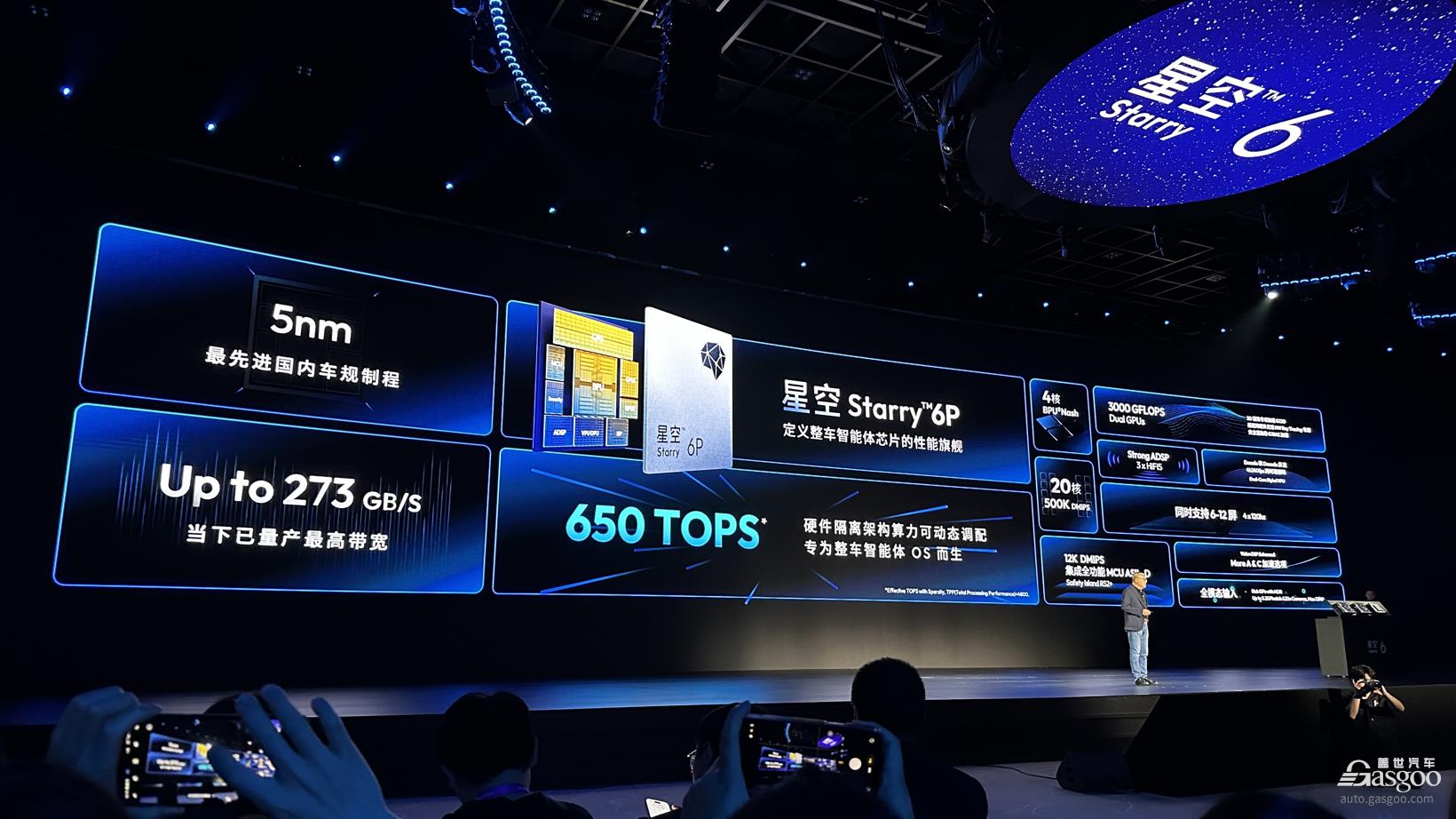
Image source: Gasgoo
On April 22, Horizon announced the launch of its first cabin-drive integrated vehicle intelligence chip, the Horizon Starry® (Horizon Starry®), including two products, Starry 6P and Starry 6H. Among them, the Starry 6P is the flagship version, using 5nm (N5A) automotive-grade process technology, integrating a high-performance CPU (500KDMIPS), GPU (3000 GFLOPS), BPU (650 TOPS), and three HiFi 5 high-performance Audio DSPs. It supports the highest memory configuration currently in mass production, 128GB LPDDR5X (with a maximum bandwidth of 273 GB/s). Additionally, it supports the deployment of large AI models on the device side.
To address the safety isolation challenges of cockpit and driving integration, Horizon has independently developed the Fortress secure physical isolation architecture, achieving physical isolation between the cockpit and the intelligent driving system, enabling independent operation.
On the day of the launch event, Horizon Robotics officially announced that the “StarSky 6” has secured letters of intent for collaboration with over ten leading automakers and Tier 1 suppliers, including BAIC, BYD, Volkswagen, Chery, and Bosch—demonstrating that, in the face of extreme cost pressures and stringent safety requirements, system-level innovation by domestic chipmakers has generated a powerful gravitational pull.
Additionally, Core Engine Technology has also targeted the cockpit and driving integration sector, making product arrangements.
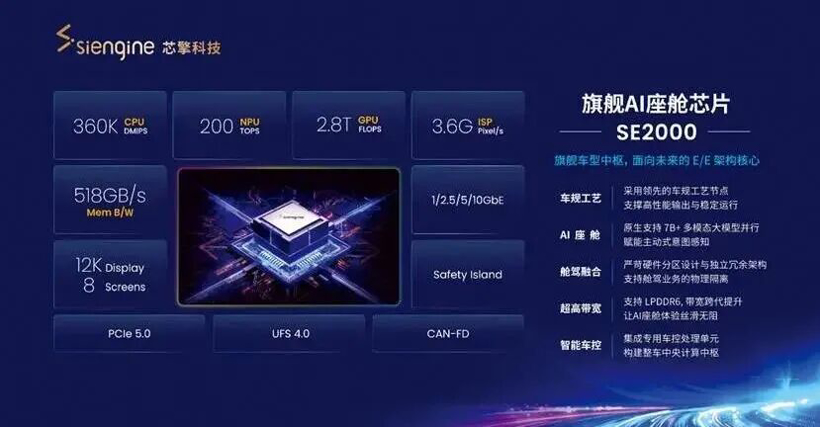
Image source: Core Engine Technology
During the Beijing Auto Show, Xinqing officially announced its 5nm automotive-grade chip "Longying No.2", which is scheduled to start adaptation in 2027. This chip has an AI computing power of 200 TOPS, natively supports a 7B+ multimodal large model, features a bandwidth of up to 518GB/s, and innovatively includes a dedicated vehicle control processing unit and a secure island, enabling physical isolation between cabin and driving functions.
More importantly, "Dragon Eagle No. 2" is not only an AI cockpit chip but also serves as the central computing hub for the entire vehicle.
From Black Sesame Technologies’ deep integration and mass production, to Horizon Robotics’ leadership in defining flagship chips, and to ChipEngine’s forward-looking strategic positioning, a diversified Chinese chip consortium has assembled in the cockpit-and-driving integration sector.
Of course, this does not mean that domestic chips have fully taken the lead. In the high-end market, Qualcomm and NVIDIA still hold a strong position, backed by mature software ecosystems and deep market foundations.
But a pivotal shift has already taken place: on the battlefield of cockpit and chassis integration—a trend reshaping the industry landscape—Chinese chip companies are emerging as a core force that cannot be ignored.
From "being able to use" to "using well," from "alternative" to "preferred," from isolated breakthroughs to architectural definition — this quiet and profound transformation has only just begun.
【Copyright and Disclaimer】The above information is collected and organized by PlastMatch. The copyright belongs to the original author. This article is reprinted for the purpose of providing more information, and it does not imply that PlastMatch endorses the views expressed in the article or guarantees its accuracy. If there are any errors in the source attribution or if your legitimate rights have been infringed, please contact us, and we will promptly correct or remove the content. If other media, websites, or individuals use the aforementioned content, they must clearly indicate the original source and origin of the work and assume legal responsibility on their own.
Most Popular
-

Continental Plans to Begin Sale of ContiTech in Early 2026
-

$4 Billion! Medtronic Makes Another Acquisition
-

BASF Delivers First Batch of Innovative Cathode Materials for Semi-Solid-State Batteries to Weilan New Energy
-

Why did a century-old european dental instrument giant relocate its manufacturing hub to china?
-
Profit and Revenue Growth Struggle to Conceal Debt Repayment Pressure; Success of Kingfa Sci & Tech's High-End Strategy Yet to Be Seen