Brominated flame-retardant abs discolors when exposed to sunlight? here’s your guide to enhancing weather resistance
ABS resin has wide applications, but it has two "drawbacks":First, it is inherently flammable; second, it is highly sensitive to light, heat, and oxygen.。
To solve the first problem, the industry generally adoptsBrominated flame retardants + antimony trioxideA classic formulation with high flame-retardant efficiency and excellent cost performance.
But the second question—Poor weather resistanceBut it became worse because of the addition of brominated flame retardants.
Research data shows that after 336 hours of xenon lamp aging, standard ABS exhibits a color difference (ΔE) of approximately 3.5; whereas brominated flame-retardant ABS under the same conditions shows a color difference (ΔE) exceeding 40, and begins to crack after around 500 hours.Turns color and cracks as soon as it's exposed to sunlight—what should I do?
1.Why does ABS become more sensitive to sunlight after adding bromine-based flame retardants?
To solve the problem, you need to find out the cause.
The root causes have two levels:
Photosensitivity of ABS substrateThe polybutadiene component in ABS contains unsaturated double bonds, which can undergo oxidation reactions under ultraviolet light, generating chromophoric groups such as carbonyl, leading to yellowing.
The "assist" of brominated flame retardantsBrominated flame retardants decompose during processing and use to generate acidic substances such as HBr, as well as free radicals such as R· and Br·. These acidic substances and free radicals accelerate the photo-oxidation of ABS resin, effectively “adding fuel to the fire” for an already sensitive material.
Different brominated flame retardants have different effects on weather resistance. Studies have shown that the tetra-bromobisphenol A (TBBA) system has the worst thermal stability (decomposition temperature is only 285°C in air at 2% weight loss), degrades more easily during processing, leading to the poorest weather resistance of its flame-retarded ABS; while the brominated trisazine (TBM) and brominated epoxy resin (BER) systems have relatively better overall performance.
2.Three Approaches to Enhancing Weather Resistance
Regarding the weather resistance deficiency of brominated flame-retardant ABS, the industry currently mainly adopts three technical approaches.
Path One: Adding UV Absorbers – Highly Effective
UV absorbers can preferentially absorb high-energy ultraviolet light and convert it into harmless thermal energy, thereby inhibiting the initiation stage of polymer degradation.
Experimental data show that adding 3–5‰ of benzotriazole-based UV absorbers to flame-retardant ABS reduces the color difference after 300 hours of xenon lamp aging by approximately 50%. More importantly, samples without weathering stabilizers begin to crack after 300 hours, whereas samples with the UV absorber show no significant cracking even after 672 hours.
Recommended addition rate: 0.3%–0.5%
Path Two: Titanium Dioxide — Both a Pigment and a Protector
Rutile titanium dioxide is an efficient light shielding agent. It can reflect and scatter ultraviolet light, reducing the material's absorption of ultraviolet light. However, it should be noted that titanium dioxide itself has a certain photocatalytic activity. Therefore, titanium dioxide used for weather resistance modification is usually treated with an inorganic coating such as SiO₂, Al₂O₃, to shield its surface photocatalytic active sites.
The experimental results show that:
Adding 2% titanium dioxide reduces the color difference of flame-retardant ABS after 336 hours of xenon lamp aging from over 40 to 17.1.
Adding 4% titanium dioxide further reduced the color difference to 11.8.
In a system compounded with UV absorbers, adding 2% titanium dioxide reduces the color difference after 300 h from 17.3 to 11.0, while adding 4% titanium dioxide reduces it to 8.0, approaching the level of conventional ABS.
Of course, titanium dioxide is not the case where the more you add, the better. It increases the density of the material and reduces its toughness.Considering all factors, around 2% is a relatively ideal balance point.。
Path Three: Hindered Amine Light Stabilizers
Limited effectiveness in bromine-based systems
The reason is that HALS possesses amine characteristics and is weakly basic; the acidic environment generated during the processing of brominated flame retardants causes HALS to undergo protonation, thereby reducing its activity in converting to nitroxyl radicals and leading to deactivation. Consequently, using HALS alone or in combination with UV absorbers in brominated flame-retarded ABS shows no significant synergistic effect.
3.Recommended Approach: Multi-pronged Strategy, Synergistic Enhancement
Based on the above analysis, the following formulation approach is recommended to enhance the weatherability of brominated flame-retardant ABS:
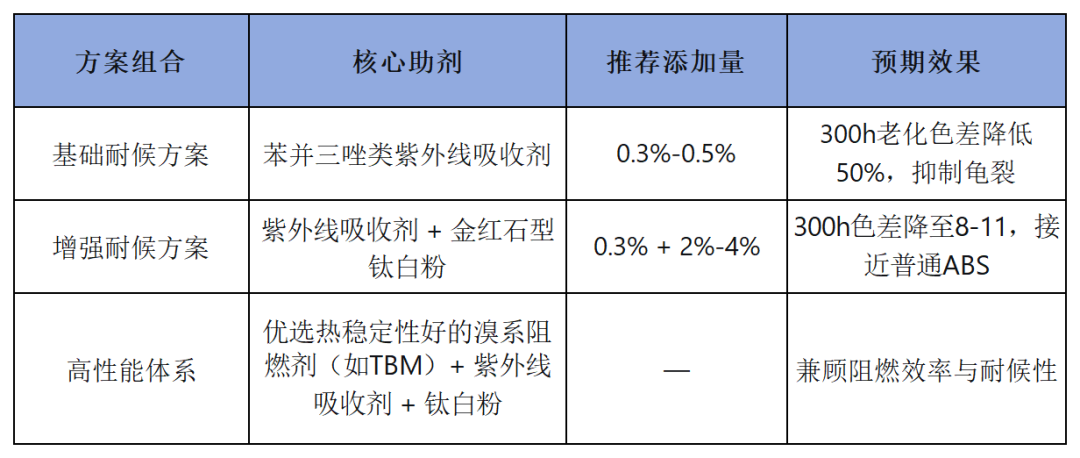
In addition, there are some auxiliary ideas worth noting:
Select bromine-based flame retardants with better thermal stability: Such as tribromoneopentyl alcohol (TBM) and brominated epoxy resin (BER) systems, which are more resistant to high processing temperatures and produce fewer acidic substances upon decomposition than tetrabromobisphenol A (TBBA).
Blend with ASA resinASA resin replaces the butadiene rubber in ABS with acrylic rubber, which contains no unsaturated double bonds, resulting in inherently superior weather resistance. Adding 20-50 parts of ASA to blend with ABS can significantly improve the overall weather resistance of the material.
Add antioxidant Hindered phenol antioxidants and phosphite antioxidants in combination can inhibit thermal oxidative aging during processing and use.
4.Experimental Verification: The Data Speaks
After adjusting the formula, data must be used to support the claims. It is recommended to conduct the following validation:
Xenon lamp aging testTest color difference (ΔE) and appearance changes after 500 h and 1000 h according to ISO 4892-2 or ASTM G155. ΔE < 3 is generally acceptable, and ΔE < 1 is considered excellent.
Mechanical Property Retention RateTest the impact strength and tensile strength retention rate before and after aging.
Flame Retardant Performance Retention RateEnsure that weathering modification does not affect the material's flame retardant rating.
5.
To keep the color of brominated flame-retardant ABS stable outdoors or under long-term light exposure, remember these points:
Prioritize adding UV absorbers (0.3%-0.5%), which is the most cost-effective option.
Add titanium dioxide (2%-4%) as needed, select surface-treated rutile titanium dioxide.
Don’t count on hindered amine; its effectiveness is limited in brominated systems.
Flame retardants also need to be selected, TBM and BER systems are more weather-resistant than TBBA.
If possible, blend in some ASA to enhance weather resistance at the source.
The issue of weather resistance in brominated flame-retardant ABS is essentiallyBromine + double bondThe combination brings systematic challenges. However, as long as the formulation is properly designed, the color difference can be controlled from above 40 to within 10, making the material both fire-resistant and resistant to sunlight.
【Copyright and Disclaimer】The above information is collected and organized by PlastMatch. The copyright belongs to the original author. This article is reprinted for the purpose of providing more information, and it does not imply that PlastMatch endorses the views expressed in the article or guarantees its accuracy. If there are any errors in the source attribution or if your legitimate rights have been infringed, please contact us, and we will promptly correct or remove the content. If other media, websites, or individuals use the aforementioned content, they must clearly indicate the original source and origin of the work and assume legal responsibility on their own.
Most Popular
-
Continental Plans to Begin Sale of ContiTech in Early 2026
-

$4 Billion! Medtronic Makes Another Acquisition
-
BASF Delivers First Batch of Innovative Cathode Materials for Semi-Solid-State Batteries to Weilan New Energy
-
Why did a century-old european dental instrument giant relocate its manufacturing hub to china?
-
Profit and Revenue Growth Struggle to Conceal Debt Repayment Pressure; Success of Kingfa Sci & Tech's High-End Strategy Yet to Be Seen