Annual Exports Reach 560,000 Tons! Import Dependency Plummets from 11% to 5%—Dow Doubles Down on Zhangjiagang?
On April 8, Dow Silicones (Zhangjiagang) Co., Ltd. officially started the expansion project of a 2,500-ton/year batch line for silicone polymers. This move not only marks a new progress in Dow's capacity layout in China but also serves as a significant signal for multinational chemical giants to deepen their presence in the Chinese silicone market and adapt to the new stage of industry development.
Since its official operation in 2002, Dow’s Zhangjiagang manufacturing site has grown over the past two decades into one of Dow’s largest production bases in the Asia-Pacific region, covering an area of nearly 1.1 million square meters. It comprises several entities, including Dow Silicones (Zhangjiagang) Co., Ltd., Dow Siloxanes (Zhangjiagang) Co., Ltd., Dow Chemical (Zhangjiagang) Co., Ltd., and Dow (Zhangjiagang) Investment Co., Ltd., forming a collaborative and highly efficient industrial cluster.
Since its establishment in Zhangjiagang in 1998, Dow has cumulatively invested $3 billion, completing 19 major projects. It has become the largest foreign-invested enterprise in the region and, with its comprehensive production capacity layout, a benchmark organic silicon industrial base in China. Currently, the base has established an all-encompassing production capacity matrix, featuring annual production capacities of 120,000 metric tons of alcohol ethers, 120,000 metric tons of polyether polyols, 210,000 metric tons of siloxanes and fumed silica, a world-class gas-phase polyethylene catalyst plant, and a complete downstream production line covering organic silicon resins, liquid silicone rubber, and silicone sealants—achieving integrated production from basic raw materials to end products.
The expansion of the 2,500-ton-per-year batch line for organosilicon polymers is one of Dow's latest moves to deepen its commitment to China's downstream markets. In 2025, Dow's Zhangjiagang site completed an expansion of downstream organosilicon products, specifically targeting diverse sectors including electronics, transportation, renewable energy, packaging, and construction, precisely aligning with China's industrial upgrading needs. In October of the same year, the construction project planning permit for this expansion was smoothly approved. This series of coordinated actions demonstrates Dow’s strategic resolve to focus on the Chinese market and further develop its downstream organosilicon business. Going forward, Dow plans additional downstream organosilicon investments at Zhangjiagang to further enhance its integrated industrial chain and strengthen localized supply capabilities, closely addressing the specific needs of the Chinese market.
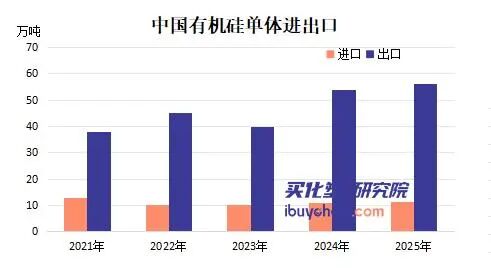
From 2021 to 2025, China’s organic silicon DMC industry experienced a capacity expansion cycle of unprecedented duration and scale.BuyChemistryAccording to the institute's monitoring, new capacity added over five years exceeded 30 million tons. By 2025, the annual production capacity of organic silicon DMC in China has reached 74 million tons. The rapid expansion on the supply side has rewritten the market competition landscape. The most direct change is reflected in international trade. According to customs data, compared to the peak in 2020, China's import volume of organic silicon DMC has decreased by 33,600 tons, and the import dependence rate has dropped sharply from 11.22% to 5.43%. Meanwhile, the export volume continues to grow steadily. In 2025, the export volume of organic silicon DMC reached 5.6 million tons, increasing by 1.8 million tons compared to 2021. This indicates that the growth in domestic capacity has formed a significant import substitution effect, and China's organic silicon industry has significantly enhanced its self-sufficiency capability.
China has become the world's largest producer of silicones, with scale effects bringing a 20%-30% cost advantage. At the same time, domestic silicone production capacity is oversupplied, with demand growth failing to match the expected capacity expansion. Domestic companies, by continuously improving product quality and offering highly competitive prices, have kept the arbitrage window open both domestically and internationally, further driving steady growth in exports.
Dow’s decision to increase its investment at this time confronts a market environment vastly different from that of five years ago. From 2026 to 2030, domestic silicone supply growth is expected to slow to 9.3%, while demand—particularly from traditional downstream sectors such as real estate—remains sluggish, offering limited near-term demand stimulus. This signals a shift in the silicone industry from “incremental competition” to “incremental competition.” Against the backdrop of slowing overall growth, profits will increasingly concentrate in high-value-added, high-technical-barrier niche segments. Dow’s continued investment in Zhangjiagang—especially its focus on high-end downstream products—is a clear response to this trend.
In the future, Dow plans to make more downstream silicone investments in Zhangjiagang, further improving its industrial chain layout and strengthening localized supply capabilities. This will address domestic market demand challenges and leverage China's export advantages in silicones to expand global market share.
【Copyright and Disclaimer】The above information is collected and organized by PlastMatch. The copyright belongs to the original author. This article is reprinted for the purpose of providing more information, and it does not imply that PlastMatch endorses the views expressed in the article or guarantees its accuracy. If there are any errors in the source attribution or if your legitimate rights have been infringed, please contact us, and we will promptly correct or remove the content. If other media, websites, or individuals use the aforementioned content, they must clearly indicate the original source and origin of the work and assume legal responsibility on their own.
Most Popular
-

Continental Plans to Begin Sale of ContiTech in Early 2026
-
$4 Billion! Medtronic Makes Another Acquisition
-
BASF Delivers First Batch of Innovative Cathode Materials for Semi-Solid-State Batteries to Weilan New Energy
-
Profit and Revenue Growth Struggle to Conceal Debt Repayment Pressure; Success of Kingfa Sci & Tech's High-End Strategy Yet to Be Seen
-

Why did a century-old european dental instrument giant relocate its manufacturing hub to china?