



300,000 Dollars Per Day, LNG Ship Rent Surges 650 Percent! Plastic Industry Faces Multiple Chain Impacts
The recent escalation of the situation in the Middle East has triggered severe fluctuations in the global energy market. According to data released by the shipping brokerage company Fearnleys, the daily rental rate for LNG carriers has soared to $300,000, an increase of $260,000 from the previous week, representing a 650% rise. The Joint Maritime Information Centre (JMIC) reported on March 6 that shipping in the Strait of Hormuz has almost completely stalled. Qatar has also warned that the conflict in the Middle East will force the Gulf region to halt energy exports within weeks. As a result, international oil prices surged on March 6, with WTI crude oil rising from a 3% decline to over a 5% increase, reaching a price above $85 per barrel, the highest since July 2024. The plastics industry, as a foundational sector highly dependent on energy and chemical raw materials, is deeply intertwined with the global crude oil and liquefied natural gas (LNG) markets. The energy shock triggered by geopolitical tensions is having a series of chain reactions on the upstream and downstream of the plastics industry, from raw material supply and production costs to market pricing, posing a severe challenge to the industry.
Energy market volatile: LNG and crude oil face pressure, the foundation of plastic raw material costs is shaken.
As the global epicenter of energy production, the Middle East's geopolitical instability directly disrupts energy supply and transportation systems. LNG and crude oil, serving as core feedstocks and energy sources for the plastics and petrochemical industry, are immediately impacted by price and supply fluctuations, making them critical variables affecting the sector.
The LNG market has been extremely volatile. With the escalation of supply disruptions in the Middle East, the freight rates for LNG tankers have surged to historic levels. According to the LNG Weekly Report released by the shipping broker Fearnleys on March 4, the spot freight rates for 174,000 cubic meter LNG carriers on the routes from the US Gulf Coast to Europe and from the US Gulf Coast to Asia have both soared to 300,000 USD per day. The rate for the US Gulf Coast to Asia route has jumped from 4.2 million USD per day the previous week. Freight rates for the Australia to Asia route have also risen to about 25.5 million USD per day. More notably, this surge in freight rates has set a historical record, with a rise of about 26 million USD, an increase of 650% (Fearnleys, LNG Weekly Report, March 4, 2026). Data from Spark Commodities on the same day also confirmed the market's frenzy, with the spot daily freight rate for a 174,000 cubic meter LNG carrier equipped with a two-stroke engine reaching 278,300 USD, the highest level since December 2022. The rate increased by 116,500 USD in a single day, breaking the previous record for the largest daily increase.
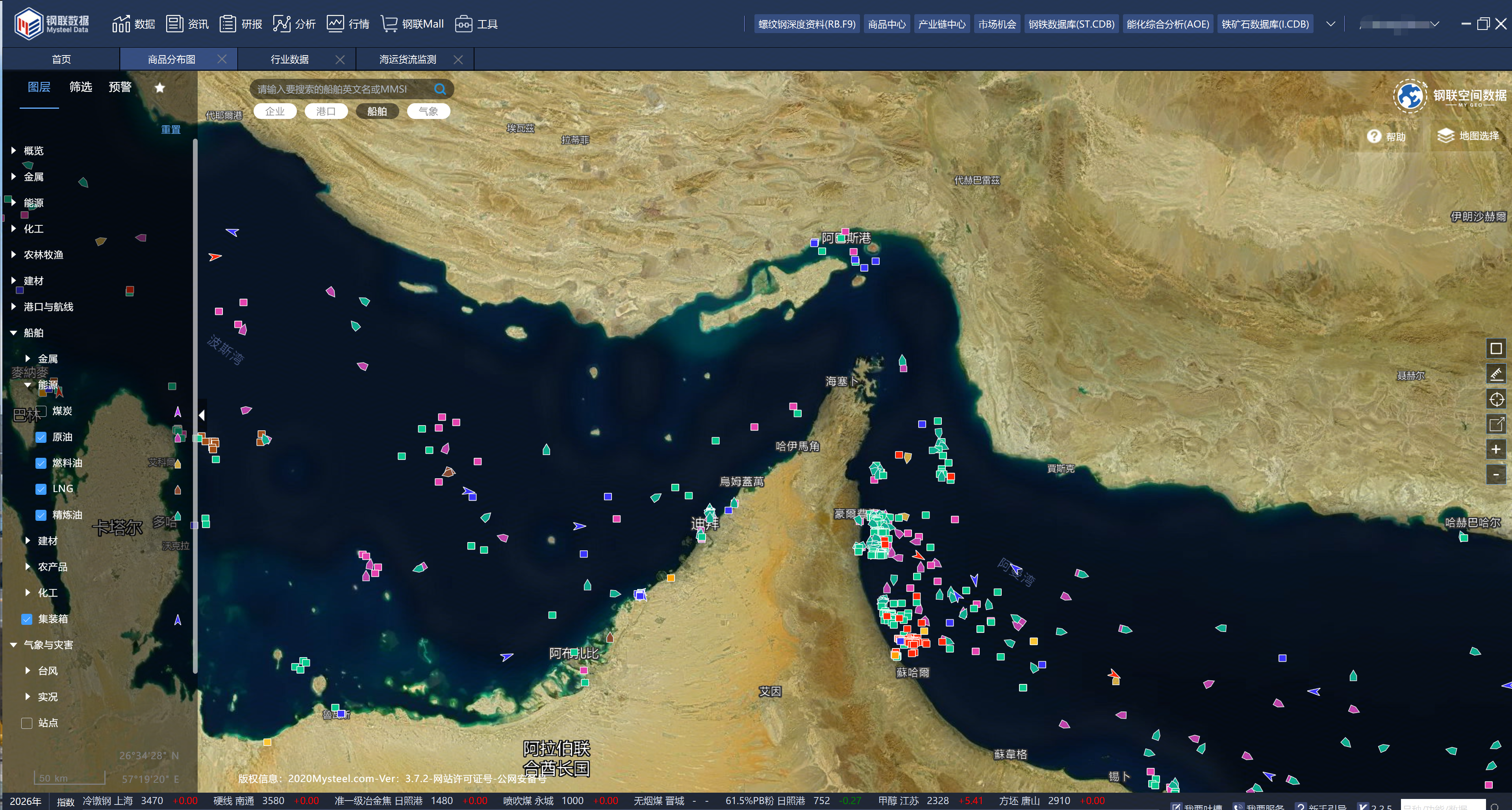
Data source: Steelhome Data - Marine Cargo Flow Monitoring System
Bloomberg reports that the sharp rise in LNG freight rates is driven by severe disruptions in Middle Eastern LNG supply and blocked transportation routes. Qatar, a major global LNG exporter, has suspended LNG production and declared force majeure to some buyers. Together, Qatar and the UAE account for 20% of global LNG supply, and their supply disruption has directly tightened the global natural gas market. At the same time, a report from the Joint Maritime Information Center (JMIC) released on March 6 stated that shipping in the Strait of Hormuz has almost completely halted, with only two confirmed commercial passages observed in the past 24 hours, both of which were cargo ships, while oil tanker transportation has nearly come to a standstill (JMIC, March 6, 2026 report). Shipping brokers noted that the Strait of Hormuz, as the "chokepoint" for global energy transportation, the shipping blockage has not only caused a sharp rise in LNG transportation costs, but also forced traders to adjust their procurement routes—LNG originally transported from the Gulf region to Asia over short distances now has to be sourced from the U.S., Australia, or West Africa, with the extended journey further increasing transportation demand and costs.
Fluctuations in the crude oil market have also directly impacted the plastics and chemical industry. According to data from JMIC and international crude oil trading markets, on March 6, spurred by news of Qatar’s production halt and shipping disruptions in the Strait of Hormuz, international oil prices surged sharply during trading—WTI crude reversed from a 3% decline to a gain of over 5%, briefly surpassing USD 85 per barrel, the highest level since July 2024. Goldman Sachs noted that market confidence in the feasibility of U.S. naval escort operations for oil and gas tankers transiting the Strait of Hormuz remains weak, with investors concerned that such escort measures would be insufficient to counter drone attacks—further heightening expectations of volatility in the crude oil market.
For the plastic industry, the dual fluctuations of LNG and crude oil directly shake the foundation of industry costs. LNG is not only a core energy source for the production of some plastic raw materials (such as methanol), but its price fluctuations also spread to the natural gas chemical industry chain; while crude oil, as the most critical source of raw materials for the plastic industry, sees its price increase directly raising the production costs of basic chemical raw materials like ethylene and propylene, thereby affecting the pricing of major plastic products such as polyethylene (PE), polypropylene (PP), and polyvinyl chloride (PVC).
Chain reaction highlighted: Plasticizer raw material supply is tight, enterprises face sharp increase in cost pressure.
The energy turmoil triggered by the Middle East situation is rippling through the industrial chain to the upstream and downstream sectors of the plastics and chemicals industry, leading to tight raw material supplies and soaring production costs—the main challenges currently facing the industry—with some companies already operating at reduced loads.
The volatility in the polypropylene (PP) market vividly reflects the impact of energy market fluctuations. According to data from ZouChuang Information, driven by the Middle East situation in early March, PP futures surged first: on March 2, the main contract PP2605 opened with a gap-up and hit the daily trading limit, closing at RMB 6,998 per ton—up RMB 396 per ton, or 6%, from the previous close. On March 3, the same contract again hit the daily limit, closing at RMB 7,223 per ton, a further increase of 5.99%. This strength in the futures market drove spot prices upward in tandem; by noon on March 3, the mainstream quotation for homopolymer PP (fiber-grade) in the East China region stood at RMB 7,050–7,200 per ton, up RMB 410 per ton—or over 6%—from RMB 6,715 per ton on February 28, resulting in a “simultaneous increase in both price and volume.”
In addition to methanol and PP, the situation in the Middle East also affects the supply of bromine, potash, and other plastic-related raw materials. According to data released by the General Administration of Customs, in 2025, China will import 35,000 tons of bromine from Israel and 14,000 tons from Jordan, which together account for 64.7% of the total import volume. China Galaxy Securities analysis points out that the escalation of conflicts in the Middle East may lead to a temporary reduction or shutdown of some bromine production facilities in Israel. At the same time, the logistics costs for bromine exports from Israel and Jordan will significantly increase, and the transportation cycle will face considerable uncertainty. This is expected to raise the price center of bromine. Bromine is widely used in the production of plastic flame retardants, plasticizers, and other products. Fluctuations in its supply will further exacerbate the raw material pressure on the plastic industry.
Supply chain disruptions intensify: Shipping interruptions combined with high costs, the industry faces dual challenges.
The Middle East situation not only affects raw material supply and production costs but also directly disrupts the global supply chain of the plastic processing industry; shipping disruptions and rising logistics costs further exacerbate the industry’s difficulties.
The stagnation of shipping through the Strait of Hormuz has become a core bottleneck disrupting global supply chains. As one of the world’s most critical energy transportation corridors, the Strait handles substantial volumes of LNG and crude oil, as well as serves as a vital conduit for plastic raw materials and finished products. With shipping nearly at a standstill, import disruptions of plastic raw materials and export constraints on finished goods have become increasingly pronounced. Maersk, a leading global shipping company, has taken proactive measures, announcing the suspension of its FM1 service linking Far East and the Middle East, its ME11 service connecting the Middle East and Europe, and its local short-haul transport services in the Gulf region—effective immediately and until further notice. Maersk’s actions are merely a microcosm of the broader supply chain disruptions unfolding globally; as the situation continues to escalate, additional shipping companies are likely to reroute vessels or suspend services, further intensifying logistical pressures on the plastics industry.
The surge in logistics costs has further worsened the situation for plasticization companies. LNG shipping rates have surged by 650%, not only increasing the transportation costs of natural gas and related raw materials, but also driving up overall global shipping costs, leading to a significant rise in the maritime transportation costs of plastic raw materials and finished products. Meanwhile, geopolitical conflicts have caused a sharp increase in war insurance premiums, further intensifying the pressure on logistics costs. Some plasticization companies are even facing the dilemma of "being unable to afford shipping or being unable to transport goods"—either bearing the high transportation costs, or being unable to obtain raw materials or deliver finished products in time due to disrupted shipping routes, resulting in a passive situation in their production and operation.
In addition, the uncertainty of the situation in the Middle East has also led to confusion in the plastics market expectations. According to market analysis data from shipping brokers, although the current spot price of LNG in Asia has dropped slightly from $25.40 per million British thermal units to $23.80, it is still about twice as high as before the escalation of the conflict; international oil prices, although fluctuating, remain in a high and volatile state. The instability of energy prices makes it difficult for plastic companies to accurately predict cost trends, and they dare not blindly expand production or sign long-term orders. Some companies choose to reduce capacity and control inventory to cope with potential risks. The demand side of the downstream industries is also showing a wait-and-see attitude due to the increase in costs, further affecting the market circulation of plastic products, forming a vicious cycle of "cost increase—demand wait-and-see—capacity reduction."
Industry Response: Mitigate Risks in the Short Term, Pursue Transformation in the Long Term
In response to the multiple shocks triggered by the Middle East situation, the plastics and chemicals industry must focus on short-term risk prevention and control while keeping long-term structural optimization in mind, and proactively respond to market volatility.
In the short term, plastic manufacturing companies should focus on cost control and inventory management. On one hand, optimizing the raw material procurement channels, reducing over-reliance on Middle Eastern raw materials, and actively expanding procurement sources from the United States, Australia, and other regions to reduce the risk of supply disruption; on the other hand, reasonably controlling inventory levels to avoid losses caused by significant fluctuations in raw material prices, while flexibly adjusting production plans, optimizing capacity allocation according to cost and demand changes, and alleviating profit pressure. For downstream enterprises, they can reduce the impact of raw material price fluctuations by locking in long-term supply agreements, bulk purchasing, and other methods.
In the long term, the plasticizers industry must accelerate its transformation and upgrading to reduce dependence on traditional energy sources. On one hand, it should promote technological innovation, optimize production processes, improve energy utilization efficiency, and reduce energy consumption per unit of product. On the other hand, it should proactively deploy new and renewable energy alternatives and explore integrated utilization of diverse energy sources—such as natural gas and coal—to mitigate cost pressures arising from price volatility in crude oil and LNG. Meanwhile, the industry should strengthen industrial chain collaboration, establishing long-term, stable cooperative relationships between upstream raw material suppliers and downstream plasticizers producers to jointly address external risks—including geopolitical tensions and energy price fluctuations—and enhance the industry’s overall resilience.
In addition, the uncertainty of geopolitics also reminds the plastic industry to further improve the global supply chain layout and enhance the resilience and flexibility of the supply chain. Enterprises can reduce the supply chain risks caused by turbulence in a single region and ensure the stability of production and operation by setting up production bases in different regions and establishing diversified logistics channels.
In summary, the escalation of the Middle East situation has triggered volatility in the LNG and crude oil markets, profoundly impacting the plastics and petrochemical industry across multiple dimensions—including raw material supply, production costs, and supply chain stability. The industry is currently at a critical juncture, simultaneously coping with short-term shocks and planning for long-term development. Only by accurately grasping market dynamics, strengthening risk prevention and control, and accelerating transformation and upgrading can the industry achieve stable growth amid this complex external environment. Going forward, industry trends will remain closely tied to the evolution of the Middle East situation and fluctuations in global energy markets. Zhuan Su Shi Jie will continue to closely monitor these developments.
【Copyright and Disclaimer】This article is the property of PlastMatch. For business cooperation, media interviews, article reprints, or suggestions, please call the PlastMatch customer service hotline at +86-18030158354 or via email at service@zhuansushijie.com. The information and data provided by PlastMatch are for reference only and do not constitute direct advice for client decision-making. Any decisions made by clients based on such information and data, and all resulting direct or indirect losses and legal consequences, shall be borne by the clients themselves and are unrelated to PlastMatch. Unauthorized reprinting is strictly prohibited.
Most Popular
-

A Look at the Material Suppliers Behind SpaceX
-
Government's Triple Action, Enterprises' Three Arrows in Five Days, Semiconductor Reshuffle! What Signal Does Japan's Chemical Industry Release?
-
Fire breaks out at jiangsu meiside!
-
Name change without tax change: POM Anti-Dumping Duty Rate Inheritance Implemented
-
Ethylene: Production Capacity Accelerates Expansion, Global Industry Landscape Is Being Reshaped


