



2026 Government Work Report Sets Tone: Plastic Industry Enters Era of Refined Development
Although the 2026 Government Work Report did not explicitly mention "plastics" or "polyolefins," its comprehensive directives on upgrading traditional industries, boosting domestic demand, and advancing green transformation have clearly outlined a development pathway for this foundational materials sector. The report’s key signals indicate that the plastics industry is formally transitioning from an era of extensive, scale-driven expansion into a refined phase centered on efficiency, structural optimization, and sustainability.
The clearest signal is the ongoing crackdown on "involutionary" competition. The report explicitly states that "comprehensive rectification of 'involutionary' competition has yielded visible results" and includes "advancing capacity governance in key industries" among the tasks for the "Fifteenth Five-Year Plan." Over the past two years, domestic polyolefin capacity has been rapidly expanded, leading to severe product homogenization in commodity-grade materials, prolonged price pressure, and enterprises trapped in a cycle of "the more they produce, the greater their losses." Now, policymakers no longer encourage blind capacity expansion; instead, they emphasize orderly regulation to shift the industry from focusing on "whether it exists" to "how good it is." This implies that new upstream projects, such as ethylene and propylene facilities, will face stricter approval processes, and the peak period of disorderly capacity additions is coming to an end.
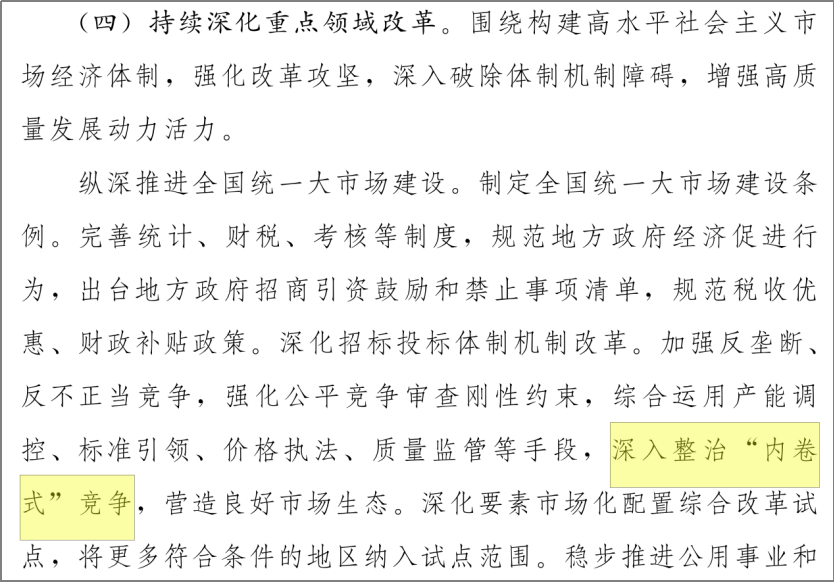
(Government Work Report: 2026 Government Work Tasks)
At the same time, the report identifies "significantly boosting consumption" as a key driver for stabilizing growth, and arranges ultra-long-term special treasury bonds to support the replacement of old with new for durable consumer goods such as automobiles and home appliances. This provides substantial support to the plastics industry. Although the market is keen on discussing new materials and new applications, the reality is that traditional sectors such as lightweight automotive parts, appliance casings, food packaging, and agricultural films still account for over 70% of polyolefin consumption. If domestic demand policies can effectively stimulate end-user consumption, it will directly lead to a recovery in midstream plastic processing orders, alleviating the current conflict between high inventory and weak demand.
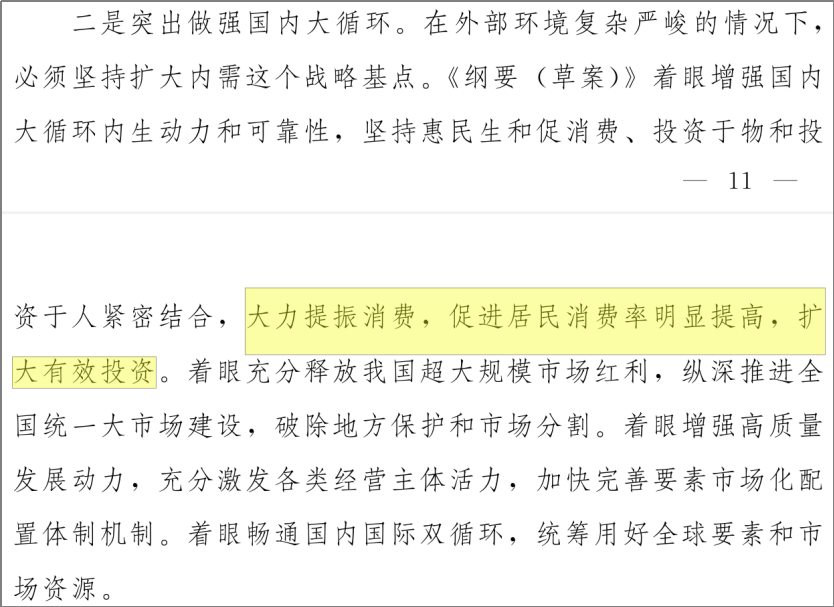
(Major Strategic Tasks in the Government Work Report)
Green and low-carbon development is another irreversible main theme. The report sets a target of reducing carbon dioxide emissions per unit of GDP by 3.8% by 2026, and requires "accelerating the green and low-carbon transition of key industries." In this context, the coal-to-olefins route with high carbon emissions will face greater cost pressures, while integrated companies with advantages in light hydrocarbon feedstocks, green power support, or carbon capture, utilization, and storage (CCUS) technology reserves will gain a competitive edge in resource access and long-term competitiveness.
In summary, the policy environment in 2026 has set new boundaries for the plastic industry: controlling the total volume, stabilizing demand, and promoting transformation. The industry is no longer pursuing "rapid development," but rather seeking new support points for high-quality development through refined operations, optimization of product structure, and green technology upgrades, based on existing production capacity.
【Copyright and Disclaimer】This article is the property of PlastMatch. For business cooperation, media interviews, article reprints, or suggestions, please call the PlastMatch customer service hotline at +86-18030158354 or via email at service@zhuansushijie.com. The information and data provided by PlastMatch are for reference only and do not constitute direct advice for client decision-making. Any decisions made by clients based on such information and data, and all resulting direct or indirect losses and legal consequences, shall be borne by the clients themselves and are unrelated to PlastMatch. Unauthorized reprinting is strictly prohibited.
Most Popular
-

Layoffs, Divestments, Plant Closures While Pouring Billions: BASF Undergoes Major Transformation!
-
Ascend Adipic Acid Hit By Force Majeure, Market Expects Supply Resumption In Mid-September
-

Raw Material Supply Shortage! INEOS Phenol Declares Force Majeure on Phenol and Acetone Businesses
-
South Korea initiates anti-dumping investigation against Chinese PVC suspension resin! The target is Tianjin Bohua and Wanhua Chemical. How to break through?
-

Sixth national procurement set to be implemented: A “Reshuffling” Moment for the $10-Billion Medical Device Market


