$133 Spot Oil vs. $99 Futures: The "Can't Buy" and "Dare Not Buy" in the Oil Market
Recently, something rather strange has happened in the oil market: if you check the international oil price on a quotation software, the Brent crude futures are around $99 per barrel; but if you are an oil refinery in urgent need of oil and want to take away a real barrel of crude oil immediately, you might have to pay $133. The difference of more than $30 is unprecedented in the history of oil trade. As an industry expert put it, this serious disconnection between reality and expectations is something our generation may have never seen before.
Brent Crude Oil Futures and Spot Price Trend Comparison
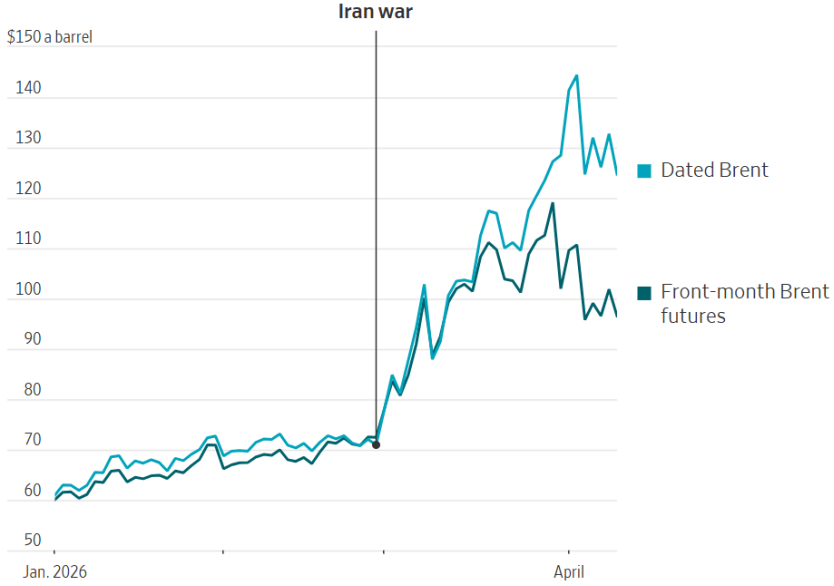
The reason why "physical goods" and "futures" diverge so much is directly due to an extreme shortage at the physical level. Currently, the situation in the Middle East is in chaos, with shipping in the Strait of Hormuz being intermittent. The spot market reflects "emergency needs," where buyers in urgent need are willing to pay a huge premium, commonly known as "strong backwardation," to get immediate access to oil. On the other hand, the futures market reflects expectations for the future, with the main contracts typically being about two months out. This time difference makes it difficult for the financial market to immediately reflect the real-world "dire urgency."
The deeper reason lies in the fact that the current oil market has become too "hot to handle." Due to extremely high volatility, professional traders have grown cautious. In the past, everyone assumed speculators would jump in during turbulent times to push prices higher, but the reality now is that even if you firmly believe oil prices will keep rising, you still dare not place heavy bets. The swings are so violent that even a minor pullback can trigger a margin call, wiping you out before dawn. As the saying goes, "No matter how right you are, if you run out of capital halfway, you're still dead." This fear has eroded liquidity in financial markets, as everyone is cutting positions and waiting on the sidelines, resulting in futures prices failing to fully keep pace with the frantic surge seen in the spot market.
Interestingly, political factors have also fanned the flames. Some remarkably “precise” trades have emerged in the market—for instance, hundreds of millions of dollars exited the market just 15 minutes before certain key figures announced on social media a temporary suspension of military operations. Such uncannily accurate timing has unsettled ordinary traders, making them even more reluctant to act in financial markets for fear of becoming victims of insider information.
Moreover, sellers' actions have widened the price gap. The spot market is flooded with buyers scrambling for cargoes, while the actual oil remains stuck in the strait. In contrast, the futures market is far more balanced: oil producers are rushing to sell forward contracts at high prices to hedge their positions, and traders who borrowed oil from strategic reserves are frantically selling nearby contracts to repay their obligations. These opposing forces intertwine, effectively keeping the futures market in check.

【Copyright and Disclaimer】This article is the property of PlastMatch. For business cooperation, media interviews, article reprints, or suggestions, please call the PlastMatch customer service hotline at +86-18030158354 or via email at service@zhuansushijie.com. The information and data provided by PlastMatch are for reference only and do not constitute direct advice for client decision-making. Any decisions made by clients based on such information and data, and all resulting direct or indirect losses and legal consequences, shall be borne by the clients themselves and are unrelated to PlastMatch. Unauthorized reprinting is strictly prohibited.
Most Popular
-

Continental Plans to Begin Sale of ContiTech in Early 2026
-

$4 Billion! Medtronic Makes Another Acquisition
-

BASF Delivers First Batch of Innovative Cathode Materials for Semi-Solid-State Batteries to Weilan New Energy
-

Why did a century-old european dental instrument giant relocate its manufacturing hub to china?
-
Profit and Revenue Growth Struggle to Conceal Debt Repayment Pressure; Success of Kingfa Sci & Tech's High-End Strategy Yet to Be Seen