



1% electrification rate alarm: Toyota's $104 Billion Acquisition of Toyota Industries, Is It a Breakthrough or a Desperate Gamble?
In October 2025, Toyota Motor Corporation announced approximately2.2Trillion yenAcquired all shares of the group-related company Toyota Industries Corporation for approximately RMB 104 billion in cash and facilitated its delisting.

Source of image: Auto Business Review
Toyota's acquisition of Toyota Industries this time has set a record in Toyota's internal consolidation history and is also an ambitious privatization case in the Japanese corporate world. More significantly, this acquisition constitutes a dramatic reversal: Toyota Industries, as the "parent" and major shareholder of Toyota, has ultimately been fully integrated by the "subsidiary" it spun off.
This event marks a profound transformation in Japan's traditional corporate governance model and reveals Toyota's strategic self-reinvention driven by the dual forces of electrification transition and capital market demands.
Cross-shareholding becomes a "burden," deeply trapped in a profit dilemma and unable to extricate itself.
The history of Toyota Industries can be traced back to 1926, when Sakichi Toyoda founded the "Toyoda Automatic Loom Works" in Aichi Prefecture, primarily engaged in the manufacture of textile machinery.
In 1933, his son Kiichiro Toyoda established the automobile department within Toyoda Automatic Loom Works, marking the beginning of Toyota's automotive business. For a long time, Toyota Industries has been a key upstream supplier for Toyota Motor Corporation, producing engines, air conditioning compressors, drive motors, forklifts, and textile machinery.
As of the fiscal year 2024, Toyota Motor holds approximately...24% stakeToyota Industries, on the other hand, holds about 9% of the shares of Toyota Motor Corporation.
This cross-shareholding relationship was once a symbol of the "Toyota Group" and is also typical of Japan's "Keiretsu" system: using family ties to build a stable network through mutual shareholding, resisting external capital invasion, and maintaining long-term stability of the supply chain.
However, this former advantage is increasingly seen as an "inefficient legacy" in today's rapidly changing automotive industry. The reason is that cross-shareholdings occupy a large amount of capital, resulting in generally low returns for corporate shareholders, and also weaken the independence of the board of directors and the function of market supervision.
Behind Toyota's aggressive reforms this time is a harsh financial reality. In the 2025 fiscal year, Toyota's net profit is expected to plummet by 44% to 2.66 trillion yen. This is no longer a slide, but a vertical dive.
Toyota attributes its difficulties to external factors: tariffs imposed by the U.S. government on Japanese cars have reduced Toyota's operating profit by 1.4 trillion yen this fiscal year, and the appreciation of the yen has further decreased its profit by 725 billion yen. However, these explanations hardly conceal deeper issues: Toyota's sluggish transition to electrification has severely undermined its competitiveness.
Market data shows that in the fiscal year 2024, Toyota's electric vehicle sales accounted for only 1% globally, far below competitors like Volkswagen and General Motors, which have electrification rates exceeding 15%. While Tesla and BYD are making rapid progress in the electric vehicle sector, Toyota is still lingering in the comfort zone of hybrid technology.
Toyota's predicament represents the general challenges faced by the Japanese automotive industry. Japan was the first major automotive country to be shocked by Tesla. In 2020, after engineers organized by Nikkei Inc. disassembled a Tesla Model 3, they marveled, "We cannot do it."
02 Accelerate upstream! Toyota's electric vehicles break through and speed up.
Toyota's acquisition this time is not merely an equity transaction; it is essentially a strategic adaptation under the pressure of industrial transformation.
In the era of traditional fuel vehicles, a loose supply system could ensure cost and stability; however, in the era of electric vehicles, core technologies are concentrated in areas such as electric drive, batteries, inverters, and control chips.Vertical integration becomes the key to efficiency.Toyota Industries holds mastery over these critical segments. Its electric drive and compressor systems are applied in Toyota's hybrid and hydrogen fuel cell vehicles, serving as the core of thermal management and energy efficiency; its semiconductors and electronic control components provide chips and control modules for Toyota's onboard systems.
After the acquisition, Toyota will directly control the upstream manufacturing segment, enhancing supply chain transparency and production efficiency. A person close to Toyota's supply chain stated, "During the electric vehicle transition period, Toyota can no longer allow these core technologies to remain in the hands of a 'relatively independent' subsidiary. Integrating Toyota Industries is a necessary step for the group to maintain its competitiveness."
Facing rapid integration in electrification and intelligence by competitors such as Tesla and BYD, Toyota is reshaping its own industry chain with a similar vertical integration model. This acquisition will further streamline the processes of technology research and development, manufacturing, and resource allocation, forming a full-chain collaborative mechanism from chips to complete vehicles.
03 Global Automakers' Diverse Transformation Paths: China's Overseas Expansion, Europe's Acceleration, Japan's Quest for Change
Toyota's radical restructuring is just a microcosm of the global automotive industry's transformation wave. Different countries and companies are choosing different transformation paths based on their own circumstances.
Chinese car companies Choose to accelerate transformation through "going abroad," evolving from an early single trade model to a new stage of building factories overseas, joint ventures and cooperation, and reverse technology export. Southeast Asia is the most concentrated region, with Thailand being particularly prominent.
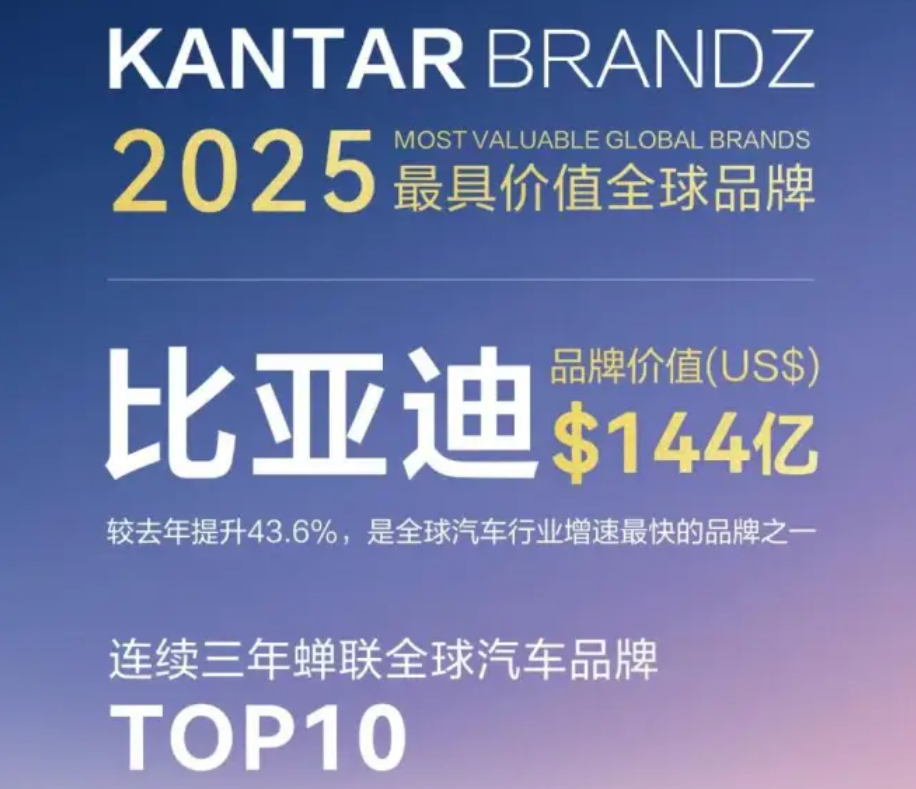
On one hand, mainstream car manufacturers such as BYD, Chery, and Changan are investing in building factories in multiple locations worldwide, advancing from mere vehicle exports to a new stage of "localized production + globalized service." On the other hand, Chinese car companies are continuously enhancing their brand value. For instance, BYD's performance in the global automotive market has become increasingly impressive. Not only has it ranked among the top ten global automotive brands for three consecutive years, but it also ranked sixth on the "2025 Kantar BrandZ Most Valuable Global Brands" list released on May 15, 2025, with a brand value of $14.4 billion.
Source: Y Car Entertainment
The first half of 2025,European carsThe electrification transformation of the market is showing strong momentum. According to mid-year reports released by mainstream automakers such as Volkswagen, Renault, and BMW, sales of battery electric vehicles (BEVs) have continued the high growth trend from the first quarter. Behind the sales growth is the intensive new product launch plans by major automakers. From 2025 to 2026, the European market will witness a wave of pure electric models being launched. For example, Renault plans to introduce four pure electric models in 2025, including the Renault 4 launched at the end of the second quarter, the Alpine A390 released in May, the Renault Kwid for international markets, and the Mobilize Duo/Bento that redefines urban mobility. Volkswagen Group's deliveries of pure electric vehicles in the European market surged by 89% year-on-year, with 190,000 units delivered in the second quarter alone, a year-on-year increase of 73%. In the Western European market (Germany, France, the UK, Italy, Spain), Volkswagen's pure electric penetration rate has increased to 20%, up 10 percentage points from the same period last year.
With the rise of new-generation car companies like Tesla and BYD, the global automotive industry is undergoing a power shift. There was a time when car manufacturers from around the world flocked to Japan to learn the "Toyota Production System"; now, Toyota is also beginning to learn from other car companies in the context of electrification.
An official from Japan's Ministry of Economy, Trade and Industry noted: "Toyota's actions will have a demonstrative effect on large conglomerates such as Mitsubishi, Mitsui, and Sumitomo. Unwinding cross-shareholdings and restructuring capital efficiency will become the core themes of the next stage of corporate governance in Japan."
Editor: Lily
Source of Materials: Public reports from Automotive Industry Review Magazine, Sina Finance, Tencent News, Toutiao, and National Business Daily.
【Copyright and Disclaimer】This article is the property of PlastMatch. For business cooperation, media interviews, article reprints, or suggestions, please call the PlastMatch customer service hotline at +86-18030158354 or via email at service@zhuansushijie.com. The information and data provided by PlastMatch are for reference only and do not constitute direct advice for client decision-making. Any decisions made by clients based on such information and data, and all resulting direct or indirect losses and legal consequences, shall be borne by the clients themselves and are unrelated to PlastMatch. Unauthorized reprinting is strictly prohibited.
Most Popular
-

Mexico Imposes Tariff Up to 36% on Cross-Border E-Commerce Products, Effective January 1, 2026; Plastic Shows Partial Fluctuation Today
-

Trump Delays Tariff Increase on Furniture, Cabinets, and Vanities
-
4.5 Million Tons! Wanhua Chemical Dominates Globally in MDI, Heavy Investment in Battery Materials Spurs New Storm
-
Wanhua Chemical Invests $27.3 Billion, 2026 Investment Map Revealed, $1.1 Billion Bet on Battery Materials
-
Back-to-back major joker moves! covestro’s 1.32 million ton mdi dual-line expansion and hdi acquisition reshape global polyurethane landscape


