



Xiaomi's cold-weather test vehicle shows up, pmma wins as xpeng and lynk & co. already apply it
According to ZhuanSu Vision News on February 2nd, this morning, Shunwei Capital's Investment Partner, Hu Zhengnan, posted a set of real car pictures of a disguised test vehicle on Weibo, saying it was "the car everyone is waiting for." Xiaomi Group Vice President, Chairman of the Procurement Committee, and General Manager of the Asset and Engineering Management Department, Zhang Jianhui, also revealed the progress of the new car on Weibo today, saying that she participated in the new car's high-altitude cold test and would be driving along the national border for a section today. The pictures she shared showed the dynamic situation of the car. Blue light on, let's go! 。

Source: IT Home
Referring to earlier reports today, the vehicles showcased are 4 SUVs clad in camouflage. Judging from the vehicle silhouettes, they are expected to be multiple different models, potentially including Xiaomi's first range-extended SUV. Likely for Xiaomi YU9 The message says the car may be equipped with an 80-degree battery, with a pure electric range expected to exceed 400km.
In terms of body size, the Xiaomi YU9 is expected to be over 5.2 meters in length and around 1.8 meters in height. According to a previous research report released by Deutsche Bank, Xiaomi Auto plans to launch a large D-class hybrid SUV in 2026, with a possible release date in 2026. Xiaomi initially plans to launch 4 new car models this year. , namely, SU7 facelift, SU7 Executive Edition, an EREV five-seater SUV, and an EREV seven-seater SUV.
Current Development Status of Lantern
"The 'Little Blue Light' is an external indicator for the operation of an intelligent driving assistance system. When the vehicle's intelligent driving functions (such as highway navigation assist, city intelligent driving, etc.) are activated, this light will automatically illuminate, clearly conveying the information 'the vehicle is in intelligent assisted driving mode' to other road users, in order to enhance traffic transparency and safety."
Although assistant driving system indicator lights are not yet widespread in China, Level 2+ autonomous driving functions are widely used, and some users have become accustomed to operating them similarly to Level 3 systems, which poses safety hazards. Real-world examples show that assistant driving vehicles lacking indicator lights can lead to misjudgment by other drivers, potentially causing accidents. However, with indicator lights, clearly indicating the vehicle's status can effectively reduce misjudgment, increase the vigilance of road users, and lower the risk of accidents. The experience with "probationary driver" stickers shows that clear prompts can effectively encourage other road users to maintain a safe distance.
Recently, multiple brands of vehicles have been successively equipped with "little blue lights".
On February 2, 2026, Xiaomi's new SUV (likely to be named YU9) made its public debut in extreme cold conditions during high-altitude testing. The "little blue light" on the exterior of the car was lit and the boarding operation was completed, marking the entry of Xiaomi Auto's intelligent driving system into the real vehicle verification stage.
The new Blue Mountain Intelligent Advanced Edition, launched on December 22, 2025, features Great Wall Motor's self-developed VLA large model and CP Master assisted driving system, making it the first model from a traditional automaker to be equipped with the "Little Blue Light."
MONA M03 MAX vehicles have been spotted with illuminated blue lights during road tests, and Xpeng has previously launched crowdfunding plans to upgrade older models like the P7, G6, and G9 with "blue light" hardware.
The third-generation Lynk & Co 03 features a "small blue light" added to the rear, indicating that its Qianli Haohan H3 assisted driving system is active.
It is worth noting that, despite online articles claiming "all new cars must be equipped with blue lights from January 1, 2025," this statement lacks official regulatory basis. Currently, the "blue light" remains a voluntary auxiliary reminder device configured by car manufacturers, and is not a mandatory national standard.
Plastic entry point for the autonomous driving system indicator light.
In the era of internal combustion engines, we judged and predicted the driving paths of cars on the road by their headlights, turn signals, and the turn signals and taillights of the vehicles in front of us. With the popularization of assisted driving, the same is true for vehicle lights. When a vehicle activates assisted driving, the external autonomous driving indicator lights up in teal, informing other vehicles on the road that the car is in autonomous/assisted driving mode. This system usually requires to be equipped with [missing information]. At least 4 Teal-colored auxiliary driving indicator light. The autonomous driving indicator light should have two luminous intensities, with the daytime luminous intensity requirement being roughly the same as the brake light, and the nighttime luminous intensity being the same as the high-mounted brake light.
Whether it's headlights, turn signals, taillights, or indicator lights for advanced driver-assistance systems, all are designed to be more easily noticed. External transparent plastic Play a vital role, and indicator lights have higher requirements for the light transmittance of materials. Furthermore, current automotive lighting trends are towards integration, especially in taillight components, which often adopt a through-type structure, with rear-assisted driving system indicator lights often integrated within them.
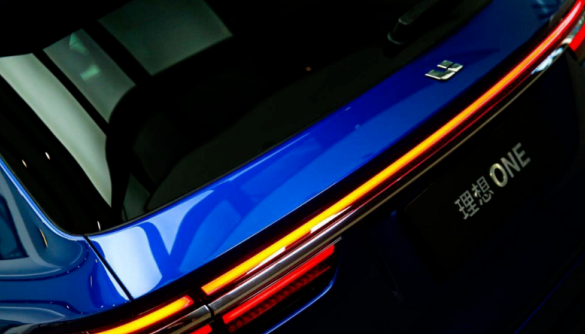
Full-width taillights made of PLEXIGLAS® PMMA molding compound, source: Li Auto.
Through its understanding, Special Plastic Vision learned that the Li ONE used [something] in the key area of the taillights (equipped with a small blue light). ROHM's PLEXIGLAS® Resist High-Impact PMMA Grades This specification ensures good light transmission and excellent weather resistance, typical of traditional PMMA materials, while significantly improving the material's impact resistance and resistance to environmental stress cracking, providing a solid performance guarantee for the Li ONE's integrated taillight.
Positive implications of autonomous driving system indicator lights for PMMA.
Automotive lighting, an important component featuring plastic applications, consists of reflectors, lenses, housings/light sources, electronic circuits, and mounting accessories. According to CPRJ, commonly used plastics for automotive lights and related components in China mainly include: PC、PP、PS、ABS、PBT/PET、PMMAEngineering plastics compounded/modified plastics.
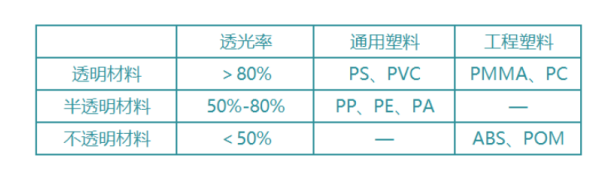
PMMA and PS As non-crystalline transparent plastics, both PS and PMMA possess high transparency, but Special Plastic Vision discovered through comparison of the two highly transparent plastics that... PSThough its light transmittance is second only to that of acrylic glass and it has good colorability, it is brittle and hard, not impact-resistant, has low heat resistance (80°C), and poor resistance to organic solvents. It is mainly used for high-frequency insulation parts, transparent parts, decorative parts, and corrosion-resistant parts, and is not suitable for automotive lighting applications.
PMMAPossessing a high light transmittance of up to 93%, excellent weather resistance, and a wide temperature range of -60 to 100℃. PMMA plastic products Maximize light transmittance and present the original color of the LED. More suitable materials for "Little Blue Lamp" 。
Source: Automotive Lighting and Lamps
PC products It also boasts high transparency, along with superior heat resistance and impact resistance, making it a "popular choice" for automotive lighting materials. However, its light transmission is slightly inferior to PMMA and PS. While the indicator light illuminates during the activation of advanced driver-assistance systems (ADAS), its power is low, and the heat generated is far less than that of automotive headlights. Therefore, considering cost and overall performance, PMMA remains the best choice for ADAS indicator lights.
Epilogue:
With the development of intelligent driving technology, automotive headlights are gradually shifting from safety functions to intelligent interactive functions. According to QYResearch, the global intelligent headlight market size is projected to reach \$[Amount] billion by 2027. $11.3 billion , with a compound annual growth rate of 5.4%.
With a market of nearly 100 billion RMB poised for takeoff, if auxiliary driving marker lights, poised to be the new blue ocean for automotive lighting, become widespread, and assuming each vehicle is equipped with a minimum of 4 units, the single market size will exceed 10 billion RMB, with PMMA emerging as the "biggest winner" among plastics for this component.
【Copyright and Disclaimer】This article is the property of PlastMatch. For business cooperation, media interviews, article reprints, or suggestions, please call the PlastMatch customer service hotline at +86-18030158354 or via email at service@zhuansushijie.com. The information and data provided by PlastMatch are for reference only and do not constitute direct advice for client decision-making. Any decisions made by clients based on such information and data, and all resulting direct or indirect losses and legal consequences, shall be borne by the clients themselves and are unrelated to PlastMatch. Unauthorized reprinting is strictly prohibited.
Most Popular
-
Key Players: The 10 Most Critical Publicly Listed Companies in Solid-State Battery Raw Materials
-
Vioneo Abandons €1.5 Billion Antwerp Project, First Commercial Green Polyolefin Plant Relocates to China
-
Clariant's CATOFIN™ Catalyst and CLARITY™ Platform Drive Dual-Engine Performance
-
EU Changes ELV Regulation Again: Recycled Plastic Content Dispute and Exclusion of Bio-Based Plastics
-
Goldhair Technology Stock Soars, Operating Quality Gradually Improves

