



World's First 80,000-Ton CCUS Polyether Project Officially Starts Production!
On March 22, 2026, in the chemical industry base of Xuyi New District, Lianyungang City, Jiangsu Province, the 80,000-ton-per-year industrial production facility for carbon dioxide-based polyether (Carnol®) of Changhua Chemical Technology Co., Ltd. was officially put into operation, as the real-time feeding data of the control system ran steadily.
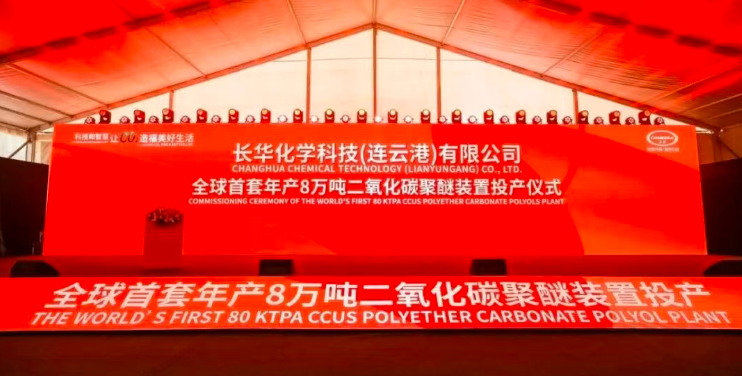
This milestone event marks the commercialization of China's first carbon dioxide-based polyether production line with the capability for continuous and stable supply at a ten-thousand-ton scale. It also signifies that, in the global polyurethane industry's green and low-carbon transformation, China has for the first time provided a "industrial solution" that can be scaled up and replicated.
The 80,000-ton carbon dioxide polyether project is an important part of Changhua Chemical's total investment of about 6 billion yuan. The latter project is planned to be constructed in phases, with the carbon dioxide polyether project's total annual capacity planned at 1.06 million tons. If the total investment is smoothly achieved, it is expected to utilize 320,000 tons of carbon dioxide annually, and the carbon footprint of the entire product life cycle can be reduced by up to 30%.
The significance of this project extends far beyond capacity expansion; it represents an industrial-scale breakthrough in the "utilization" component of CCUS (Carbon Capture, Utilization, and Storage) technology. The traditional polyether industry chain follows a linear model: "oil extraction → petrochemical feedstocks → polyethers → polyurethane products → waste." The industrialization of CO₂-based polyethers marks the first time carbon is cyclically reused at the core feedstock stage, reintegrating industrial waste gas into the production chain and ushering the polyurethane industry into an era of circular economy.
The project employs an advanced low-pressure, low-temperature synthesis process to convert CO₂—previously regarded as a greenhouse gas—into high-performance poly(propylene carbonate) polyol (PCE), enabling carbon resources to transition in value from the "emission end" to the "manufacturing end." For the first time, carbon elements enter the mainstream supply chain of bulk chemical materials as a "basic feedstock."
After the first phase of the project goes into production, the company's total designed production capacity for the polyether series will increase from 440,000 tons per year to 720,000 tons per year.
Established in 2010, Changhua Chemical is a domestic professional large-scale manufacturer of polyether polyol products. Its main business includes flexible foam polyether (POP, flexible foam PPG), CASE polyether, and special polyether. After 15 years of technological innovation and in-depth development, the company has built an integrated technical system from basic research, pilot verification to industrialization. Its products have core competitiveness such as low odor, low VOC (volatile organic compounds), low aldehyde content (formaldehyde, acetaldehyde, acrolein), and low aromatic hydrocarbon content. The company has established long-term and in-depth cooperation with many well-known brands in fields such as automotive, soft furnishings, and footwear, and its main products have maintained a top three market share in China.
Carnol® has passed formula verification by several leading home and automotive enterprises, and its application scenarios cover new energy vehicle seats, soft furniture, eco-friendly coatings, and apparel, among other fields.
As China continues to advance its "dual carbon" goals (peaking carbon emissions by 2030 and achieving carbon neutrality by 2060), and as international policies such as the EU's Carbon Border Adjustment Mechanism (CBAM) become increasingly stringent, low-carbon materials are becoming a key variable in global industrial chain competition.
In the future, PUDaily will continue to track the industrialization progress of the project and its profound impact on the global supply chain, jointly witnessing the Chinese chemical industry move towards a new stage of greener and more sustainable development.
【Copyright and Disclaimer】The above information is collected and organized by PlastMatch. The copyright belongs to the original author. This article is reprinted for the purpose of providing more information, and it does not imply that PlastMatch endorses the views expressed in the article or guarantees its accuracy. If there are any errors in the source attribution or if your legitimate rights have been infringed, please contact us, and we will promptly correct or remove the content. If other media, websites, or individuals use the aforementioned content, they must clearly indicate the original source and origin of the work and assume legal responsibility on their own.
Most Popular
-

Middle East Triggers Widespread Force Majeure In Global Chemical Industry
-
Not Just MDI! Huntsman and BASF Impose “War Surcharge” Across Europe
-

Nike technology innovation and material application
-
BASF Delivers First Batch of Innovative Cathode Materials for Semi-Solid-State Batteries to Weilan New Energy
-
Deadly Impact: Hormuz Strait Blockade Sparks Shortage of Plastic Raw Materials, Threatening Shutdowns at Japanese and Korean Chemical Plants


