



Ultra-Wide Temperature Battery "Goes to Heaven and Earth", Commercial Aerospace Becomes Core Growth Pole
The 2025–2026 winter automotive testing is currently in full swing. In Yakushi, Inner Mongolia, amid the freezing -30°C air, new test vehicles draped in black-and-white camouflage are hitting the ice. They perform high-speed runs, emergency braking, and sharp turns on circular tracks, as the roar of engines echoes across the snowy plains.
As the "touchstone" for a vehicle's ultimate performance, extreme cold testing is a crucial and necessary step before a new car is launched. As of now, during this testing season, the number of vehicles tested in Yakeshi has exceeded 1,000, covering well-known brands such as BMW, Audi, Porsche, Li Auto, BYD, Voyah, Deepal, and Leapmotor. Among these, new energy vehicles account for over 90%.
Behind this "ice and fire" extreme challenge, battery technology innovation is the key to breaking the deadlock – the breakthrough of ultra-wide temperature range batteries solves the problem of extreme temperature adaptation for new energy vehicles and many other fields.
Recently, the case titled "Deeply Implementing Patent Achievement Revitalization to Boost the Industrialization of Ultra-Wide Temperature Range Battery Patent Technology" by the Shenzhen Institute of Advanced Technology (SIAT), Chinese Academy of Sciences, was successfully selected as one of the third batch of excellent cases for patent transformation and utilization in 2024 by the China National Intellectual Property Administration (CNIPA).
It is reported that in 2023, the energy storage technology team of the Shenzhen Institutes of Advanced Technology (SIAT) had already developed China's first battery cell product with a wide temperature range, low cost, and long lifespan. Its minimum operating temperature reaches -70℃ and its maximum operating temperature reaches +80℃, and it can be normally charged at a low temperature of -30℃, enabling wide temperature range application scenarios in extreme cold and heat.
From Lab to Mass Production
Limited by battery materials, traditional lithium-ion batteries operate at temperatures between 0-40℃, and their discharge performance significantly declines below 0℃.
However, due to China's vast territory, temperatures vary significantly across regions and seasons. In winter, temperatures in northern regions can drop below -40°C, while in summer, surface temperatures in southern regions can exceed 50°C. Traditional lithium-ion batteries cannot adapt to such extreme temperature conditions. This leads to several critical issues: on one hand, the abundant clean energy sources in the north, such as solar and wind power, are difficult to integrate directly into the power grid; on the other hand, it results in troublesome situations such as electric vehicles failing to start and smartphones automatically shutting down in winter, as well as frequent instances of electric vehicle spontaneous combustion in summer.
To address these pain points, as early as 2013, Tang Yongbing, a researcher at the Shenzhen Institute of Advanced Technology, proposed a research project to develop lithium-ion batteries with higher energy density and a wider operating temperature range by utilizing alloyed metal materials. The goal was to develop lithium-ion batteries capable of maintaining over 70% of their range at temperatures as low as -30°C.
After nearly a decade of research and development, the team has successfully developed a new wide-temperature lithium-ion battery technology based on aluminum-based anodes. The operating temperature range of the product has been expanded to -70°C to 80°C, and it is now widely applied in fields such as outdoor energy storage, outdoor monitoring, and photovoltaic energy storage.
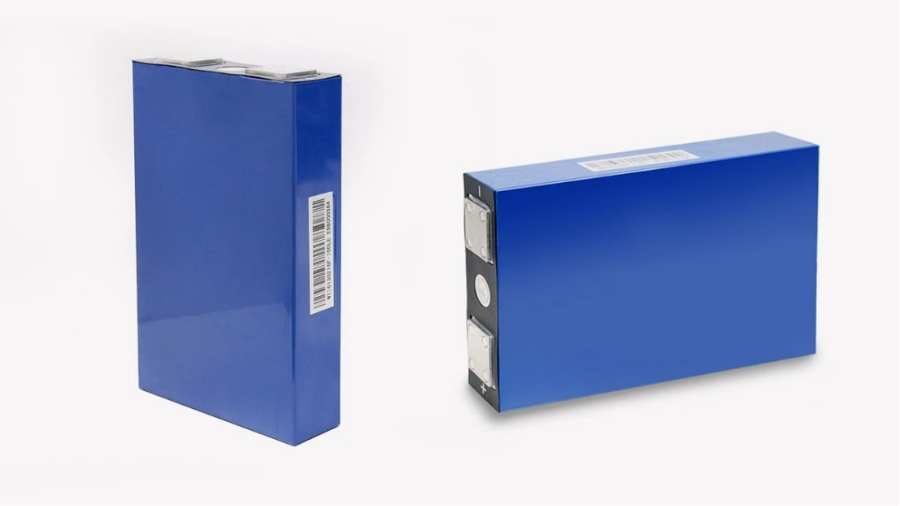
Aluminum-based ultra-wide temperature range battery, Shenzhen Institute of Advanced Technology provided the image.
Researchers at the Shenzhen Institutes of Advanced Technology told Southern Finance reporters that the new aluminum-based ultra-wide temperature range battery product has been promoted and applied in major national demand areas such as smart grid monitoring and large-scale storage of clean energy in northern China. For example, the megawatt-hour wide-temperature-range energy storage system developed in cooperation with the State Power Investment Corporation has been applied in the Daqing photovoltaic energy storage project, reducing the energy consumption of auxiliary equipment such as industrial air conditioners by 89.3%.
Beyond energy storage, the ultra-wide temperature range characteristics also bring key technological breakthroughs to the new energy vehicle industry. Researchers at the Shenzhen Institute of Advanced Technology stated that optimizing battery performance in low-temperature environments is a major direction in the current development of electric vehicles, and the ultra-wide temperature range performance of this new type of battery can effectively alleviate the range anxiety of new energy vehicles, helping them to become popular in all climates and all scenarios.
On December 26, 2024, a team from the Shenzhen Institute of Advanced Technology (SIAT) conducted the first vehicle-mounted verification of wide-temperature range batteries on a new energy vehicle, with comprehensive testing carried out at the National Automobile Quality Supervision and Test Center. Test data indicated that, without a heating module, the battery achieved a range retention rate of 67.3% under the CLTC (China Light-duty Vehicle Test Cycle) at -30°C.
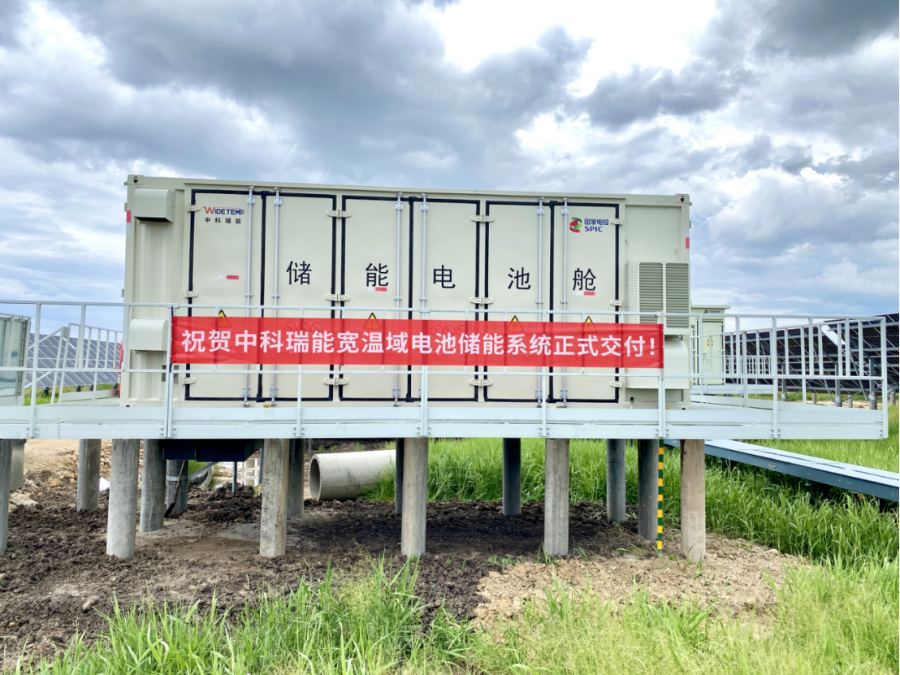
Wide-temperature-range energy storage battery system, photo courtesy of SIAT
Fueled by capital, the industrialization of ultra-wide temperature range battery patent technology is accelerating. According to Wu Xiaoli, Director of the Transformation Department of the Shenzhen Institutes of Advanced Technology (SIAT), based on the new battery technology, the team's 23 related patents, relying on SIAT, successfully achieved technology transfer and transformation with intellectual property valued at 65 million yuan, and established Shenzhen Zhongke Ruineng Industrial Co., Ltd. in March 2017. Currently, it has started the construction of an ultra-wide temperature range battery cell and PACK (battery module) manufacturing base in Guangyuan, Sichuan, covering an area of 200 mu, with an initial investment scale of 1.27 billion yuan.
Accelerating large-scale application
Currently, the wide-temperature battery industry is experiencing a boom in large-scale applications, and the market size will continue to climb. According to Boyan Consulting data, the market size of high and low temperature batteries in China will reach 18.73 billion yuan in 2025, a year-on-year increase of 24.6%, a growth rate significantly higher than the average growth rate of domestic lithium-ion batteries during the same period. Its market size is expected to increase to 22.98 billion yuan in 2026, a year-on-year increase of 22.7%.
From the perspective of application scenarios, wide-temperature-range batteries are gradually extending from the two core areas of energy storage and new energy vehicles to emerging fields such as the low-altitude economy, robotics, and commercial aerospace, accelerating the realization of "full-scenario coverage."
Among them, the commercial space industry is expected to become the core driving force for the growth of demand for wide temperature range batteries. With the accelerated networking of low-Earth orbit (LEO) satellite constellations, the market demand for space energy storage batteries continues to expand. By the end of 2025, the number of commercial satellites in orbit in China had reached approximately 800, and 50 commercial space launches were completed throughout 2025, successfully sending 311 commercial satellites into orbit. At the same time, China has declared more than 200,000 LEO satellite constellation resources to the International Telecommunication Union. The future exponential growth in the number of satellites will directly drive an explosive increase in demand for wide temperature range batteries.
It is worth noting that the commercial aerospace sector imposes extremely stringent performance requirements on new energy batteries. The complex challenges of the space environment, such as extreme temperature fluctuations, high vacuum, and intense high-energy particle radiation, demand that batteries possess exceptional wide-temperature adaptability, with an ideal operating range spanning from -120°C to +120°C. With their outstanding advantages in adapting to extreme environments, ultra-wide-temperature batteries are expected to capture a core share of the commercial aerospace battery market.
Researchers at SIAT told Southern Finance reporters that the research team is currently focusing on application requirements in extreme environments such as aerospace and Antarctic expeditions, and is fully committed to the research and development of related technologies and products.
The iterative development of technology and the demands of various applications are mutually reinforcing, with expanding application scenarios continuously driving the upgrade of wide-temperature-range battery technology. Researchers at the Shenzhen Advanced Institute state that future wide-temperature-range batteries will aim to further increase energy density. By developing new solid-state battery electrolytes and electrode materials, they will not only overcome range limitations in extreme temperatures but also adapt to scenarios with higher demands for endurance and stability, such as the low-altitude economy, high-end electronic products, and commercial aerospace.
【Copyright and Disclaimer】The above information is collected and organized by PlastMatch. The copyright belongs to the original author. This article is reprinted for the purpose of providing more information, and it does not imply that PlastMatch endorses the views expressed in the article or guarantees its accuracy. If there are any errors in the source attribution or if your legitimate rights have been infringed, please contact us, and we will promptly correct or remove the content. If other media, websites, or individuals use the aforementioned content, they must clearly indicate the original source and origin of the work and assume legal responsibility on their own.
Most Popular
-

Key Players: The 10 Most Critical Publicly Listed Companies in Solid-State Battery Raw Materials
-

Vioneo Abandons €1.5 Billion Antwerp Project, First Commercial Green Polyolefin Plant Relocates to China
-
Clariant's CATOFIN™ Catalyst and CLARITY™ Platform Drive Dual-Engine Performance
-
Multifaceted Collaboration: PA Prices Rebound Against Trend to Break Through
-
European Supermarket Shelves Full of "Misleading" Recycled Plastic Packaging Claims

