



Trump May Cancel Iran Strike! Oil Prices Hit A More Than One-Month Low! Plastic Market Bull-Bear Tug-Of-War Continues
1. Overnight Crude Oil Market Developments
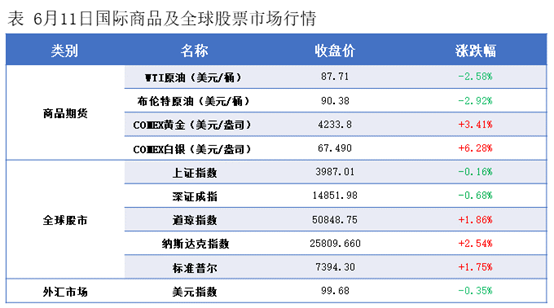
There are reports that the US and Iran are close to reaching a peace agreement, which has eased market concerns and caused international oil prices to decline.Crude oil futuresWTI crude oil futures Jul contract fell by USD 2.32/bbl to USD 87.71/bbl, down 2.58% from the previous period; ICE Brent crude futures Aug contract fell by USD 2.72/bbl to USD 90.38/bbl, down 2.92% from the previous period. China’s INE crude oil futures Jul 2026 contract rose by RMB 12.9 to RMB 586/bbl, and fell by RMB 21.3 to RMB 564.7/bbl in night trading.
Post-market forecast
The supply and demand aspects of the crude oil market still have significant support. Recent data shows that OPEC production has further declined, primarily due to a 19% drop in Iranian oil production in May following lockdowns, with a substantial decrease of 546,000 barrels per day. Other Gulf countries like Saudi Arabia, Iraq, and Kuwait have seen slight production increases. Additionally, the ongoing reduction in crude oil market inventories will continue for some time; U.S. crude oil total inventories are already very close to the lowest levels seen in decades. The EIA's June Short-Term Energy Outlook projects that by December 2026, total oil inventories in OECD countries will drop below 2.3 billion barrels, marking the lowest level since records began in 2003. This figure is significantly lower than the average inventory level of 2.8 billion barrels over the past five years, highlighting a notable inventory gap. Overall, the recent anxiety over supply shortages has clearly cooled, which can also be confirmed by the declining discounts in the physical market. As Trump announces a forthcoming agreement, the Iranian Foreign Ministry still emphasizes that the Strait remains closed. If a U.S.-Iran agreement is successfully reached, the market will next focus on the navigation status of the Strait of Hormuz and the subsequent consumption of oil market inventories.
It appears that Trump is now very close to achieving his goal of extricating himself from the Iran conflict, and he is extremely eager to reach an agreement. Going forward, the market will closely watch Iran’s official response to the deal, as well as the contents of the memorandum of understanding. Since late May, oil prices have been locked in a roughly $10 sideways range, with resistance above and support below. If the U.S.-Iran negotiations—the biggest source of uncertainty—can be settled, geopolitical tensions would ease, while progress in reopening navigation through the Strait of Hormuz would also loosen crude supply conditions. This would cool bullish expectations for oil prices. However, the continued decline in crude inventories, especially with U.S. crude inventories at historically low levels, will limit the downside for oil prices. At present, prices remain near the lower end of the high-level range, and it is expected that bulls and bears will continue to struggle around this area. Moreover, before the “other shoe” clearly drops, geopolitical factors may still see repeated twists and turns, and oil prices could still experience sharp fluctuations at any time. Pay attention to timing and participate cautiously.
2. Macroeconomic Trends
On June 11, Premier Li Qiang presided over a State Council executive meeting. The meeting heard a report on the implementation of the spirit of the National Science and Technology Conference. It pointed out the need to anchor the goal of building a strong science and technology nation, efficiently organize and implement major national science and technology tasks, promote the efficient utilization of major facilities, strengthen the systematic collaborative efforts of national strategic scientific and technological forces, and fully leverage the strategic support role of scientific and technological innovation in the construction of Chinese-style modernization.
According to the official website of the Ministry of Foreign Affairs, Philippine Defense Secretary Gilberto Teodoro has repeatedly made erroneous remarks concerning China, undermining China’s legitimate interests and damaging China-Philippines relations. To safeguard China’s national sovereignty, security, and development interests, China has decided to prohibit Teodoro and his spouse and children from entering the Chinese mainland, Hong Kong, and Macao, and to prohibit organizations and individuals within China from engaging in any transactions, cooperation, or other activities with Teodoro and his spouse and children.
Foreign Ministry spokesperson Lin Jian chaired a regular press conference. A reporter asked, according to reports, China has canceled a high-level meeting with the EU this month due to escalating trade tensions. Lin Jian said that, as far as he understands, China and the EU are maintaining communication on the relevant dialogue.
U.S. President Donald Trump said in a post on the social media platform Truth Social that, since the talks with Iran had been submitted to Iran’s highest leadership and approved, he had canceled the strikes and bombing operations against Iran originally scheduled for that night. A spokesperson for Iran’s Foreign Ministry said that, so far, Iran has not reached a final conclusion on an Iran-U.S. agreement.
The European Central Bank announced a 25-basis-point interest rate hike, its first since September 2023 and the first by a major global central bank in response to the Middle East conflict. The ECB made no pre-commitment to a specific interest rate path, but noted that if energy prices remain elevated and trigger second-round effects, it could further tighten policy. The ECB also lowered its 2026 eurozone economic growth forecast to 0.8% and raised its inflation forecast to 3%.
Driven by a sharp rise in energy prices, the U.S. Producer Price Index (PPI) increased by 6.5% year-on-year in May, reaching the highest level since November 2022 and exceeding the market expectation of 6.4%. However, the core PPI, which excludes food and energy, rose by 4.9% year-on-year, lower than the market expectation of 5.4%.
III. Futures Market Trends in the Plastics Market
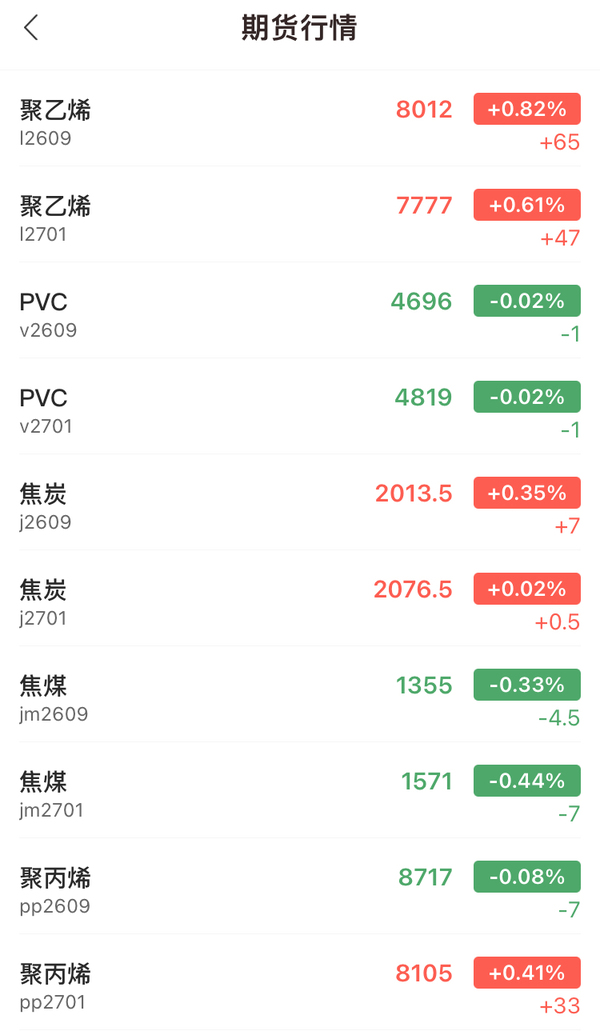
Oil prices plunged, hitting their lowest level in more than a month! The main domestic plastics futures contractslight fluctuations:
The plastic 2609 contract was quoted at 8,012 yuan/ton, up 0.82% from the previous trading day.
The PP2609 contract was quoted at 8,717 yuan/ton, down 0.08% from the previous trading day.
The PVC2609 contract was quoted at 4,696 yuan/ton, down 0.02% from the previous trading day.
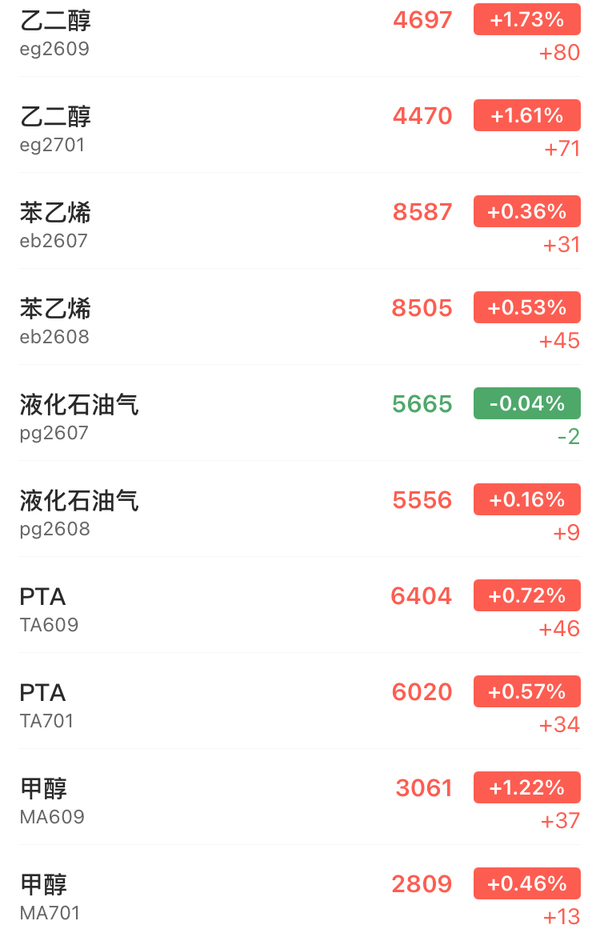
The styrene 2607 contract was quoted at 8,587 yuan/ton, up 0.36% from the previous trading day.
4. Market Forecast
PE: At the current stage, the polyethylene market is characterized by a balance of bullish and bearish forces, with the pace of market fluctuations tending to stabilize. The industry is facing dual pressures from both operational constraints and supportive factors. The traditional off-season for consumption has deeply dragged down the pace of production and sales in the downstream processing industry. The destocking of end products has encountered obstacles, and the rate of raw material consumption by enterprises continues to slow down, with weak demand support becoming a core constraint on upward market movement. On the geopolitical front, positive factors are continuously developing, as conflicts in the Middle East escalate, leading to a steady increase in support from crude oil raw material costs, reshaping the cost base of the industry chain and effectively repairing negative trading sentiment in the market. The trading mindset among market participants is marginally warming as traders cautiously test the waters by raising spot prices based on cost advantages. Downstream processing plants are constrained by insufficient orders and high finished product inventories, resulting in overall weak stocking intentions and extremely restrained purchasing behavior. They are only relying on low prices in the futures market and low-priced spot goods for sporadic essential replenishment. While transactions for low-priced goods have seen a slight recovery, overall market activity still struggles to gain momentum. On the policy front, positive measures are being released simultaneously. On June 10, the National Development and Reform Commission held a special economic symposium, clearly outlining the implementation of intelligent upgrades in the industry, improving the nationwide unified market, and addressing vicious internal competition. They are also preparing a toolbox of economic control policies to stabilize the economy, optimize the supply-demand ecology and competitive landscape of the polyolefin industry in the long term, and boost medium- to long-term development expectations for the industry. Considering various factors such as fundamentals, costs, and policies, the downturn in demand during the off-season is difficult to reverse in the short term. Coupled with insufficient resilience in downstream procurement, the room for market price increases is limited. However, the support from geopolitical costs and positive policy sentiment firmly locks down the downside potential. It is expected that the polyethylene market will maintain a strong sideways fluctuation trend in the short term, with limited price movements, as the market operates steadily based on cost support, making it unlikely to experience unilateral price increases or decreases.
PP: The current polypropylene market is characterized by a complex interplay of multiple factors, with escalating geopolitical conflicts resonating with favorable policies, while seasonal demand weakness and macroeconomic pressures create a balancing effect. Overall, it presents features of "cost support, tight supply, weak demand, and range-bound fluctuations." On the cost side, the significant production cuts by Middle Eastern oil-producing countries, combined with disruptions in the navigation of the Strait of Hormuz, have heightened expectations of tight crude oil supply, providing strong support for PP. Additionally, the U.S. military's continuous strikes on key Iranian facilities have further raised geopolitical risk premiums, leading to a noticeable reluctance among traders to sell, with reduced willingness to unload at low prices, resulting in a tightening of spot circulation supplies. On the policy front, the National Development and Reform Commission clarified on June 10 the promotion of the "Artificial Intelligence +" initiative, the construction of a unified market, and the rectification of industry "involution," which temporarily boosts market confidence and benefits long-term industry upgrading and order regulation. However, bearish factors continue to exert pressure, as the ceasefire framework between the U.S. and Iran remains in place, Asian refineries are operating at low capacity, and expectations of further interest rate hikes by the Federal Reserve have strengthened, contributing to a bearish macro atmosphere. Downstream terminals are in a traditional off-season, with low operating rates in sectors such as plastic weaving and injection molding, leading to weak order follow-up and cautious purchasing, making it difficult to form effective support. In terms of market performance, futures rose sharply on the back of geopolitical and policy positives, with spot prices also showing strength, resulting in a slight upward shift in the low-end price level. In conclusion, the polypropylene market is expected to maintain a high-level narrow fluctuation pattern in the short term, with limited downside support from geopolitical factors and low inventory, but soft demand in the off-season will limit the extent of any upward movement. The core of market volatility still depends on the evolution of the situation in the Middle East and crude oil trends, while continuous attention should be paid to the implementation of subsequent growth stabilization policies.
PVC: The spot market has shown some downside resilience. Most ex-works prices have started to stabilize at low levels and have not continued to decline further. In various regional spot markets, merchants have adjusted quotes flexibly, but low-end prices have also begun to show signs of bottoming out. High-end all-in prices in the spot market remain difficult to conclude, while some downstream buyers are replenishing inventories on dips, leaving spot transactions average. At present, there are still no strong support factors on the PVC supply-demand side. As time passes, maintenance shutdowns on the supply side may decrease, and PVC supply is expected to increase. Meanwhile, domestic demand remains weak, with the seasonal off-season for demand approaching, and external trade is also about to face the closure of India’s tariff window. Overall, in the short term, PVC spot prices are still likely to remain in a narrow range of fluctuations.
【Copyright and Disclaimer】This article is the property of PlastMatch. For business cooperation, media interviews, article reprints, or suggestions, please call the PlastMatch customer service hotline at +86-18030158354 or via email at service@zhuansushijie.com. The information and data provided by PlastMatch are for reference only and do not constitute direct advice for client decision-making. Any decisions made by clients based on such information and data, and all resulting direct or indirect losses and legal consequences, shall be borne by the clients themselves and are unrelated to PlastMatch. Unauthorized reprinting is strictly prohibited.
Most Popular
-

A Look at the Material Suppliers Behind SpaceX
-
Global Chemical Giants Accelerate Production Capacity Restructuring, Dow and Celanese Optimize Global Industry Layout
-

Government's Triple Action, Enterprises' Three Arrows in Five Days, Semiconductor Reshuffle! What Signal Does Japan's Chemical Industry Release?
-
Name change without tax change: POM Anti-Dumping Duty Rate Inheritance Implemented
-
Fire breaks out at jiangsu meiside!


