



Three Major Engines Work Together, Modified Materials Welcome Leap Forward
Currently, the plastic industry is facing the practical challenges of long cycles and high costs in the development of high-end new materials, while the downstream market continues to upgrade its requirements for material performance. In this context, the development of modified/composite materials has become an important pathway to enhance material performance and reduce overall costs, and is a key approach to meet the dual demands of low cost and high performance in the market.
Modified plastics and composite materials are important branches of materials science. They differ in definition, processing, and application logic, but also have areas of overlap and integration.
Modified plastics refer to plastic products in which specific additives are introduced by physical or chemical means based on general-purpose, engineering, or special engineering plastics to enhance properties such as flame retardancy, strength, impact resistance, and toughness. They remain essentially plastics, with a macroscopic form primarily consisting of uniform granules.
Composite materials are new materials formed by combining two or more materials with different properties at the macroscopic level through physical or chemical means, typically consisting of a matrix (such as resin, metal, or ceramic) and a reinforcement (such as carbon fiber, glass fiber, or aramid).
It is worth noting that materials such as fiber-reinforced resins can be classified both as modified plastics and as composite materials, and the boundary between the two has become increasingly blurred in practice. This report focuses on modified plastics while also taking into account key applications of composite materials.
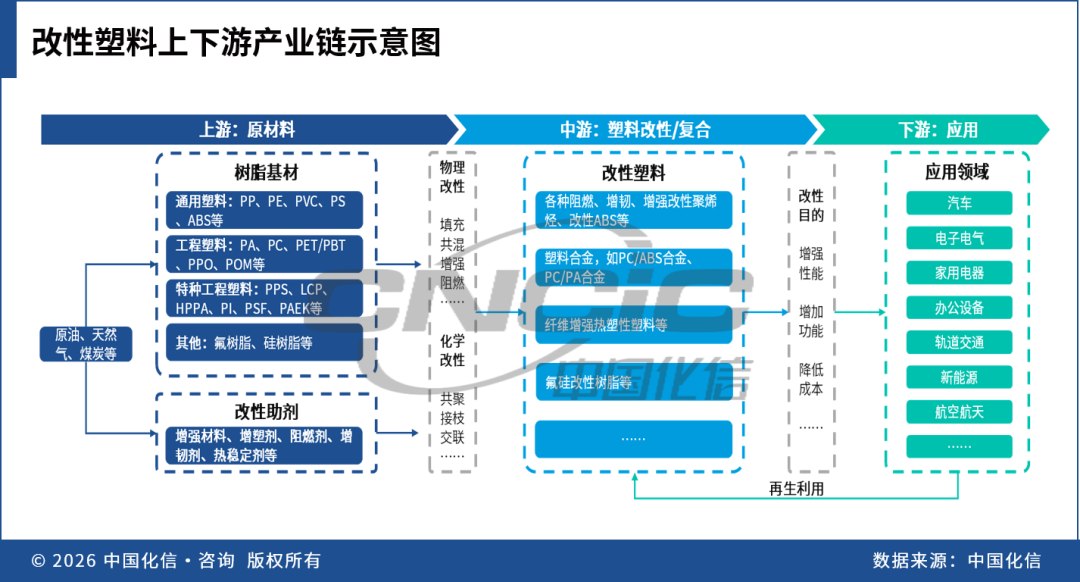
The modified plastics and composites industry is at a critical juncture, transitioning from "scale expansion" to "value enhancement." The coordinated efforts of three major engines—policy independence, supply chain restructuring, and demand leap—are accelerating the optimization of industrial structure and the of capability levels.
Policy autonomy provides solid strategic support for the industry. National-level policy guidance, such as "trade-in for new," not only stimulates terminal consumption of new energy vehicles and home appliances but also lays a foundational demand for modified plastics and composite materials, while raising higher quality requirements for products. The continuous release of policy dividends is compelling enterprises to increase R&D investment and enhance technological capabilities.
Supply chain restructuring, in turn, is essential to ensuring industrial resilience. Amid growing global geopolitical complexity and rising supply chain uncertainty, building a stable, efficient, and controllable production capacity system has become a fundamental capability for enterprises competing in the global market. Domestic companies are enhancing the autonomy and controllability of their supply chains by integrating upstream raw materials and adopting regionalized production capacity layouts.
The shift in demand has become the core engine of industrial development. The home appliance sector is evolving towards safety, health, environmental protection, lightweight design, and intelligence, which raises higher quality requirements for modified plastics. The continuous growth of new energy vehicles and the trend towards lightweight design have driven the widespread application of high-performance modified plastics. Meanwhile, the rise of emerging industries such as humanoid robots and the low-altitude economy has posed new challenges for materials, including lightweight, high strength, corrosion resistance, and electromagnetic shielding.
China has become the world’s largest market for modified plastics and the main engine of global demand growth. Between 2021 and 2025, China’s demand for modified plastics increased from 25.59 million tons to about 34.5 million tons, with market size surpassing RMB 400 billion and a compound annual growth rate of 7.7%. This growth has been driven not only by the “trade-in” policy in traditional industries, but also by the continuous expansion of emerging application scenarios.
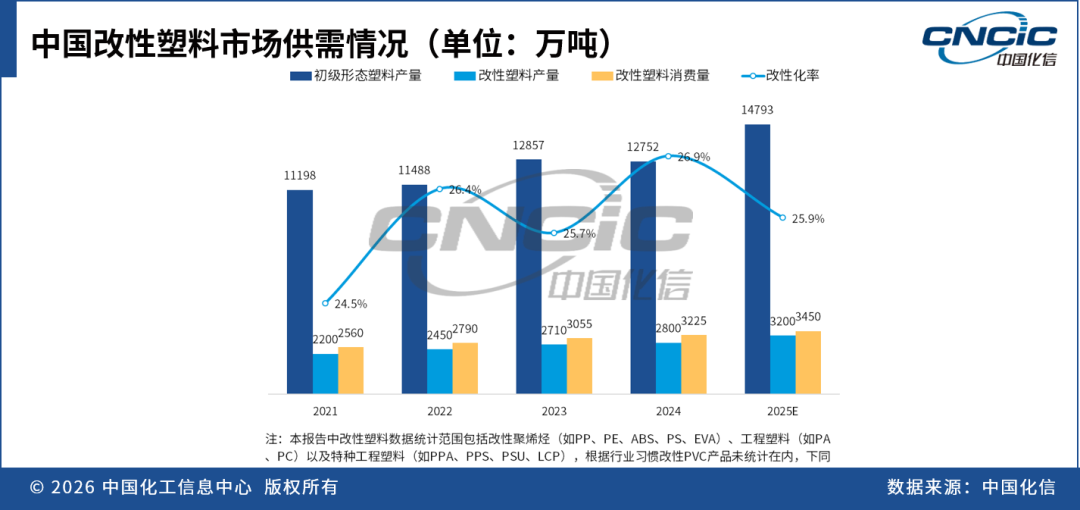
From the perspective of the competitive landscape, industry concentration remains relatively low. At present, there are more than 3,000 modified plastics manufacturers in China, including over 30 listed companies. In 2024, the total production capacity of the top 10 leading companies is approximately 6.75 million tons per year, accounting for only 15% of the country’s total capacity. However, it is worth noting that, as industry competition intensifies, outdated capacity is being gradually phased out, and market concentration is on an upward trend. In the future, as the structure of downstream applications continues to upgrade, companies with core technologies, cost control capabilities, and innovation capabilities will stand out at an accelerated pace.
From the perspective of profitability, the industry’s earning capacity has improved significantly. In the first three quarters of 2025, the 10 representative leading modified plastics companies in China recorded combined operating revenue of RMB 90.08 billion, up 16.8% year on year; their net profit reached RMB 2.06 billion, up 45.1% year on year. Profit growth significantly outpaced revenue growth, reflecting a substantial improvement in corporate profitability. This was mainly attributable to the decline in raw material prices, the implementation of the “trade-in” policy, rising demand from emerging sectors, and the accelerated overseas expansion and localized deployment of domestic enterprises. Meanwhile, judging from changes in the revenue and profit shares of the 10 representative leading modified plastics companies in China in recent years, the concentration of China’s modified plastics industry has continued to increase, with profits further converging toward leading enterprises.
In terms of market participants, domestic enterprises and foreign-invested companies each have their own strengths and weaknesses. Leveraging cost advantages and flexible customization capabilities, domestic enterprises have established a solid customer base in the mid- to low-end market, but they still face technical shortcomings in high-end modification applications. Foreign-invested companies, on the other hand, mainly focus on mid- to high-end products, with strong technological reserves and outstanding service capabilities, but they are under greater cost pressure. As awareness of supply chain autonomy and controllability continues to grow, domestic enterprises are accelerating their transition toward high-end R&D and manufacturing, and are expected to further reduce dependence on foreign sources for high-end modified plastics.
The expansion of emerging application scenarios is becoming a core driver of innovation and development in the modified/composite materials industry. Under the combined effects of policy guidance, capital investment, and technological breakthroughs, demand for high-performance materials in emerging fields such as low-altitude aircraft and humanoid robots is accelerating.
The low-altitude economy is transitioning from a "pilot demonstration" phase to a "scaled commercial" phase. According to the Civil Aviation Administration of China, the market scale is expected to exceed 3.5 trillion yuan by 2035. The growth momentum mainly comes from four aspects: first, top-level strategies continue to intensify, with low-altitude economy being included in the government work report for three consecutive years, evolving its positioning from a "new growth engine" to an "emerging pillar industry"; second, application scenarios are constantly expanding, extending from early drone performances and aerial photography to low-altitude logistics, emergency rescue, agricultural protection, and urban air mobility; third, the technological system is becoming increasingly mature, with breakthroughs in 5G/6G, digital twins, AI algorithms, and eVTOL technology significantly improving operational efficiency and safety; fourth, capital and enterprises are accelerating their entry, with over 160,000 companies related to the low-altitude economy in China by early 2026, and the industrial cluster effects in regions such as the Yangtze River Delta, Greater Bay Area, and Beijing-Tianjin-Hebei are significant.
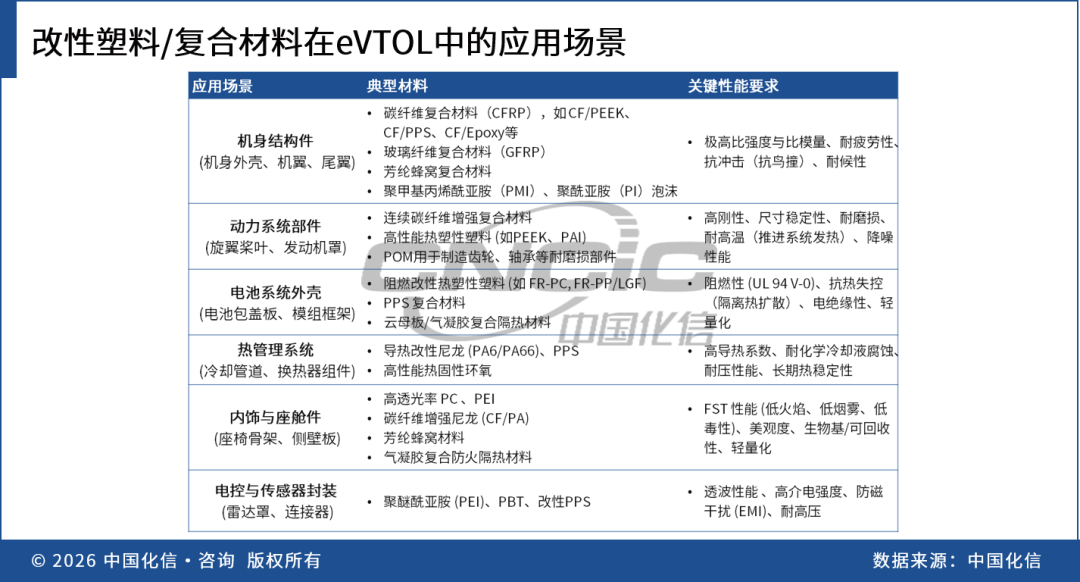
Low-altitude aircraft are the main carriers of the low-altitude economy, and they include helicopters, drones, and electric vertical takeoff and landing aircraft (eVTOLs). Taking eVTOLs as an example, they have extremely stringent requirements for material performance, especially in terms of lightweight design and safety. Composite/modified materials stand out due to their excellent properties. Their low density and high strength enable them to effectively reduce aircraft weight while ensuring structural strength; their outstanding fatigue resistance and impact resistance allow them to withstand various stresses and external forces during flight, providing a solid guarantee for the safe operation of eVTOLs.
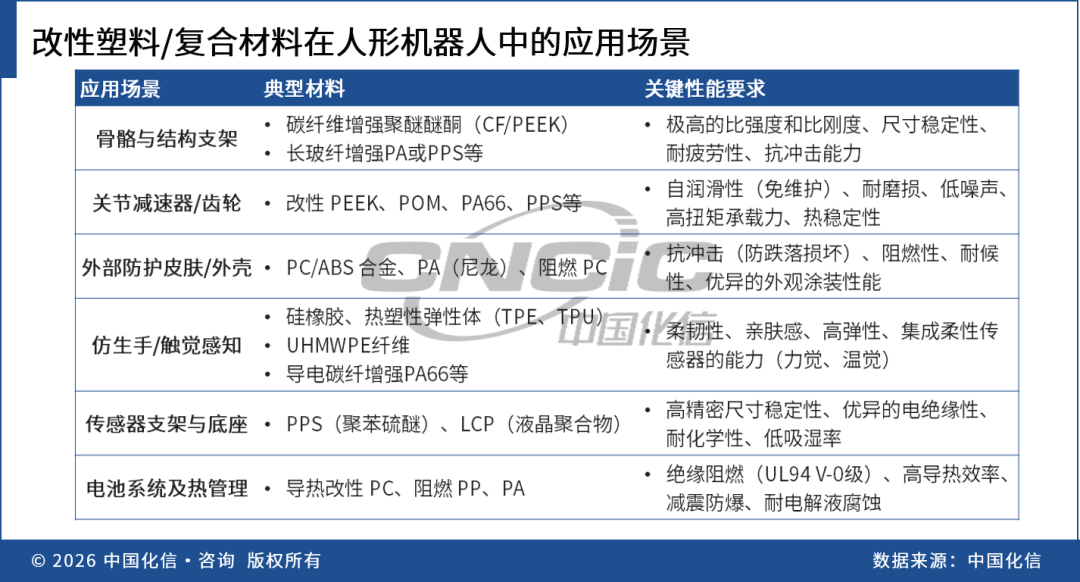
As an integrative embodiment of artificial intelligence, advanced manufacturing, new materials, and other technologies, humanoid robots are being regarded as the next disruptive product after computers, smartphones, and new energy vehicles. By 2035, the global market size is expected to exceed RMB 400 billion, with China’s market reaching RMB 140 billion. Technological breakthroughs, a maturing supply chain, and support from policies and capital are all providing strong momentum for the development of humanoid robots. Humanoid robots impose extremely stringent requirements on materials, with core needs centered on lightweighting, high strength, high rigidity, wear and fatigue resistance, as well as special functions such as electromagnetic shielding and bionic touch. The application of modified polyether ether ketone (PEEK), carbon fiber–reinforced composite materials, thermoplastic elastomers, and other materials will provide a solid foundation for the development of humanoid robots.
The modified/composite materials industry is rapidly evolving from traditional home appliance and automotive applications toward emerging fields such as low-altitude aircraft and humanoid robots. Material requirements have also progressed from the early goal of “replacing steel with plastics” to an integrated performance system that deeply combines lightweighting, high strength, high rigidity, and specialized functionality.
At the same time, the logic of industry competition is undergoing a fundamental shift. In the past, companies competed on scale and production capacity; today, however, the industry is rapidly entering a “capability differentiation stage.” At this stage, a company’s technological R&D capabilities, product differentiation, service responsiveness, and cost control will become the key variables determining its market position.
Based on the above judgments, the following development suggestions are proposed for enterprises of different sizes:
1. Small and medium-sized enterprises: It is recommended to follow the “specialized, refined, distinctive, and innovative” development path, focusing on a specific niche scenario or material system, concentrating resources to build technological barriers, and striving to become a hidden champion in a niche field. Rather than pursuing being “large and comprehensive,” they should aim to be “deep and specialized.”
2. Large enterprises: They can accelerate the increase in industry concentration through mergers, acquisitions, and integration; build a complete industrial chain ecosystem; create platform-based groups; and enhance their overall risk resilience and global competitiveness.
【Copyright and Disclaimer】The above information is collected and organized by PlastMatch. The copyright belongs to the original author. This article is reprinted for the purpose of providing more information, and it does not imply that PlastMatch endorses the views expressed in the article or guarantees its accuracy. If there are any errors in the source attribution or if your legitimate rights have been infringed, please contact us, and we will promptly correct or remove the content. If other media, websites, or individuals use the aforementioned content, they must clearly indicate the original source and origin of the work and assume legal responsibility on their own.
Most Popular
-

A Look at the Material Suppliers Behind SpaceX
-

Government's Triple Action, Enterprises' Three Arrows in Five Days, Semiconductor Reshuffle! What Signal Does Japan's Chemical Industry Release?
-

Global Chemical Giants Accelerate Production Capacity Restructuring, Dow and Celanese Optimize Global Industry Layout
-
Name change without tax change: POM Anti-Dumping Duty Rate Inheritance Implemented
-
Fire breaks out at jiangsu meiside!


