The UAE's Declaration of Independence: A Long-Planned Breakthrough for Interests
Yesterday, the UAE announced its withdrawal from OPEC, effective May 1. Although this decision appears sudden amid the current turmoil, viewed over a longer timeframe, it is the inevitable outcome of the UAE’s multi-year “production-increase strategy.” During recent OPEC production-cut cycles, the UAE repeatedly voiced dissatisfaction; however, it previously opted for compromise because the risks of acting unilaterally during periods of low oil prices were too high. Now, however, geopolitical conflicts have fundamentally altered the underlying logic of this strategic calculus.
The Reality Ledger Behind the Exit
The UAE’s decision to fully reveal its position at this moment is primarily driven by the need to alleviate its current fiscal anxiety. Due to the ongoing blockade of the Strait of Hormuz, the UAE’s physical crude oil exports have been severely disrupted, causing a sharp decline in oil revenue. During the closure of the Strait, the UAE has accumulated substantial losses. Under its plan, once the situation eases, it must rapidly ramp up production and output to the maximum extent, leveraging the economies of scale from high output to recoup its deficits.
However, OPEC’s collective decision-making mechanism typically aims for a measured, quota-based, gradual increase in production to prevent a price collapse caused by oversupply. Such slow-motion coordination clearly does not align with the UAE’s desire for a “rapid rebound.” Leaving the organization would allow it to bypass Saudi-imposed restrictions and immediately flood the market with its idle capacity the moment the Strait reopens.
Strategic direction after exit
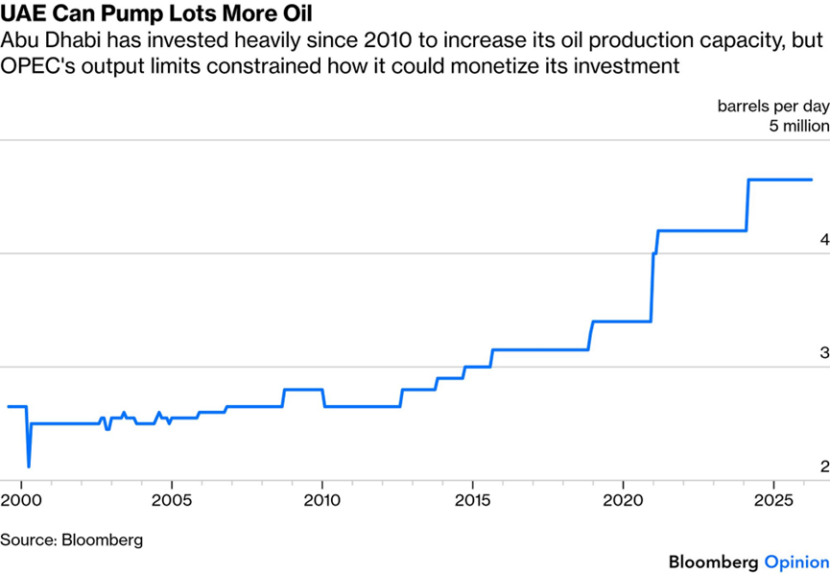
After exiting, the UAE will have full autonomy over pricing and production decisions. Currently, the UAE has over 1 million barrels per day of idle capacity, and it has been investing heavily in expanding production, with a target of reaching a total capacity of 5 million barrels per day. Post-OPEC, the UAE can leverage its low production costs and advanced shipping infrastructure (such as the Fujairah pipeline that bypasses the straits) to sign exclusive long-term contracts directly with major global customers, using more flexible pricing strategies to capture market share that previously belonged to OPEC.
This behavior will undoubtedly weaken Saudi Arabia's leadership and may trigger a chain reaction within OPEC+. If other members see that "going it alone" can secure greater benefits, the entire organization's supply management mechanism will face a systemic collapse.
The UAE continues to increase investment to enhance oil production capacity.
The Pivot of Logic: When Will the Strait Reopen?
It must be clearly understood that the UAE's ambition to increase production remains trapped within a geographical siege. As long as the Strait of Hormuz is not substantially opened, all of the UAE's production-increase plans will remain confined to paper. As long as the strait remains closed, the logic of physical supply disruption will outweigh any "production-increase expectations."
Therefore, the UAE's exit event's impact on the market is actually a preview of future supply surplus. It indicates that once the Strait resumes operations, the global oil market will immediately shift from "geopolitical scarcity" to "share war."
【Copyright and Disclaimer】This article is the property of PlastMatch. For business cooperation, media interviews, article reprints, or suggestions, please call the PlastMatch customer service hotline at +86-18030158354 or via email at service@zhuansushijie.com. The information and data provided by PlastMatch are for reference only and do not constitute direct advice for client decision-making. Any decisions made by clients based on such information and data, and all resulting direct or indirect losses and legal consequences, shall be borne by the clients themselves and are unrelated to PlastMatch. Unauthorized reprinting is strictly prohibited.
Most Popular
-

Continental Plans to Begin Sale of ContiTech in Early 2026
-
$4 Billion! Medtronic Makes Another Acquisition
-
Profit and Revenue Growth Struggle to Conceal Debt Repayment Pressure; Success of Kingfa Sci & Tech's High-End Strategy Yet to Be Seen
-

BASF Delivers First Batch of Innovative Cathode Materials for Semi-Solid-State Batteries to Weilan New Energy
-

Why did a century-old european dental instrument giant relocate its manufacturing hub to china?