



Supply-Demand Pressure and Cost Support: Polypropylene (PP) Market Outlook After the 2026 Spring Festival
Lead-in: 2026During the Spring Festival, the international crude oil price fluctuated and rose strongly due to the geopolitical situation in the Middle East, providing a bullish support for the polypropylene market. On the first trading day after the holiday, futures led the rise, and spot prices showed a partial upward trend. The upstream petrochemical manufacturers maintained normal production, but inventory increased significantly, with inventory pressure becoming the main resistance to price increases. The time of terminal factories was uneven, and the transaction in the market was quiet. Facing the game pattern of cost support and weak supply and demand, where will the PP market go in 2026? The following will provide a detailed analysis.
After the Spring Festival in 2026Polypropylene MarketMarket Analysis
Price Comparison of Polypropylene Before and After the Spring Festival (Unit: yuan/ton)
|
Year |
Pre-holiday prices |
First day after the holiday |
Rise and Fall |
Change in Price |
|
2022 |
8550 |
8850 |
300 |
3.51% |
|
2023 |
7850 |
7800 |
-50 |
-0.64% |
|
2024 |
7350 |
7400 |
50 |
0.68% |
|
2025 |
7424 |
7414 |
-10 |
-0.13% |
|
2026 |
6634 |
6644 |
+10 |
+0.15% |
China’s polypropylene (PP) industry has undergone massive capacity expansion and structural reshuffling—a historically disruptive cycle. As of now, domestic PP capacity has reached 49.165 million tons per year. Due to rapid supply-side expansion coupled with demand growth falling short of expectations—a structural mismatch—the average PP market price in 2026 hit a five-year low. Although prices rose modestly post-Spring Festival in 2026, supported by cost pressures and improved macroeconomic conditions, the uptick was limited by heavy inventory burdens at the two major state-owned petrochemical companies (“Liang You”), heightened market caution, sluggish downstream resumption of operations, limited inquiries, and weak trading activity.
|
2025-2026 Domestic Polypropylene Market Price Trend Analysis in China (Unit: RMB/ton) |
|
|
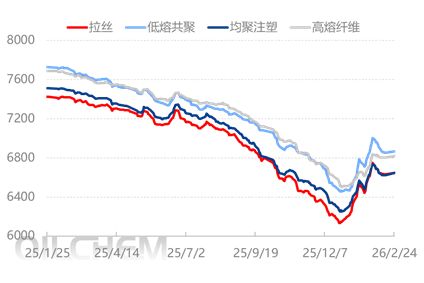
After the Spring Festival, the market was mainly influenced by the rise in crude oil prices during the holiday, and there are still expectations for policies after the Two Sessions. Coupled with the plan for a meeting between high-level officials from China and the United States at the end of March, which may boost market sentiment, the macroeconomic support is strong, leading to a slight increase in prices. However, the resumption of work downstream is delayed, and market inquiries are limited. There are a few transactions at low prices, and the market participants are cautious. As of February 24, the national average price of drawing silk was 6,644 yuan/ton, an increase of 10 yuan/ton, or 0.15%, compared to before the holiday.
II. Supply and Demand Fundamentals Analysis for 2026
|
China Polyolefin Two Oil Inventory Data Trend (RMB/ton, 10,000 tons) |
|
|
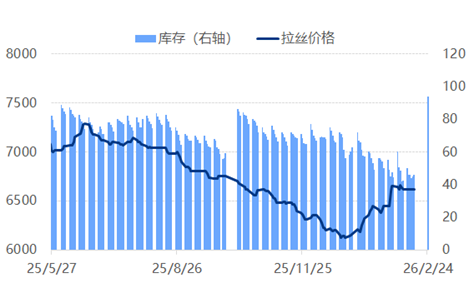
Screenshot As of February 24, the combined polyolefin inventory of the two major oil companies stood at 940,000 metric tons, up by 480,000 tons or 104.35% compared to pre-holiday levels. During the Chinese New Year holiday, most producers maintained normal operations while market participants were away on vacation, leading to a significant inventory buildup. On the first trading day after the holiday, inventories at these two oil companies rose sharply on a week-over-week basis. Additionally, post-holiday, domestic trader sample companies saw a typical inventory accumulation due to halted sales during the holiday. Downstream operations resumed slowly, impeding market transactions and hindering the downstream flow of raw materials. Future demand recovery and its pace will need close monitoring.
2026 Annual New Capacity Expansion Enterprises of Polypropylene
|
Company Name |
Craft |
Capacity |
Startup time |
|
Sinopec Zhenhai Refining and Chemical Company Phase II |
oil production |
50 |
2026 June |
|
Dongming Shenghai Chemical New Materials Co., Ltd. |
Oil preparation |
35 |
2026 September |
|
Huajin Ameco Petrochemical Co., Ltd. |
Oil Processing |
100 |
2026 September of the year |
|
Fujian Zhongsha Gulei Petrochemical Co., Ltd. |
Oil-based |
95 |
2026 September |
|
PetroChina Tarim Petrochemical Branch |
Oil-made |
45 |
2026 September |
|
Ningxia Baofeng Energy Group Co., Ltd. Phase IV |
Coal to |
50 |
2026 December |
|
Huating Coal Industry Group Co., Ltd. |
Coal to |
20 |
2026 December |
|
Lihuayi Weiyuan Chemical Co., Ltd. |
PDH Make |
20 |
2026 December |
|
Zhejiang Yuanjin New Materials Co., Ltd. |
PDH Make |
60 |
2026 December |
|
China Coal Shaanxi Yulin Energy and Chemical Co., Ltd. |
Coal-to- |
55 |
2026 December of the year |
|
Inner Mongolia Rongxin Chemical Co., Ltd. |
Coal-based |
40 |
2026 December |
2026 The domestic polypropylene (PP) capacity is expected to increase by 5.7 million tons in the year, with very few new production lines coming online before September. The expectation of tight supply and recovering demand in the first half of the year may drive a market trend. The expansion of capacity for the year will mainly be concentrated in the East China, Northwest, and North China regions. If the new facilities are successfully commissioned as planned, the total domestic PP capacity will rise to 54.865 million tons. Starting from 2026, the industry will gradually enter a cycle of structural optimization. As outdated capacities continue to exit, the growth rate of domestic polypropylene supply is expected to slow down to 6.75%, and gradually fall below the demand growth rate. At that time, the supply and demand balance of the industry will continue to improve, and the market is expected to gradually enter a new phase of supply and demand rebalance.
|
PP Downstream Industry Operating Trend Chart |
Average Order Statistics for Polypropylene Downstream |
|
|
|
|
|
|
Data source: LSR News |
Data source: Longzhong Information |
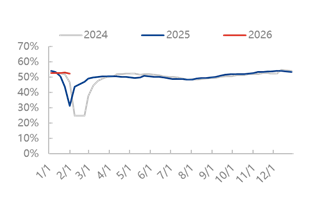
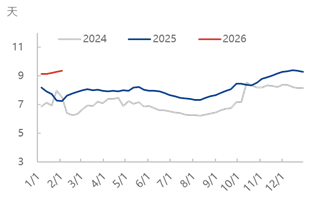
2026 During the Spring Festival, the downstream industries maintained low levels of operation. Although the Spring Festival fell later than usual, the recovery of production capacity was limited due to factors such as a severe export situation and weak domestic demand stimulation. It is understood that after the holiday, the downstream industries operated at low levels, with the terminal market generally focusing on clearing accumulated finished goods inventory, and new orders remained limited. Factories showed a lack of enthusiasm in purchasing raw materials.
III. Market Outlook
Domestic Polypropylene Upstream and Downstream Industry Sentiment and Expectations Survey
|
Viewpoint |
Quantity |
Percentage |
|
Bullish |
37 |
15.35% |
|
Put option |
46 |
19.09% |
|
Remain unchanged |
158 |
65.56% |
According to a survey of 241 sample enterprises—including upstream producers, trading companies, downstream product manufacturers, and futures companies—industry participants hold divergent views on the post-holiday market: 15.35% are bullish, 19.09% are bearish, and the majority—65.56%—expect prices to remain stable. The minority bullish view stems primarily from the upcoming Two Sessions, which are expected to provide strong macroeconomic support, and from rising temperatures that will spur the gradual resumption of urban infrastructure development, industrial activities, and construction projects—significantly boosting demand for polypropylene. Conversely, the bearish camp argues that post-holiday inventory accumulation, trade distributors prioritizing discounted sales, delayed downstream plant restarts, limited order volumes, and heightened caution among market participants will collectively lead to weak market performance in the near term.
|
Future PP Spot Price Forecast Chart (Yuan/ton) |
|
|
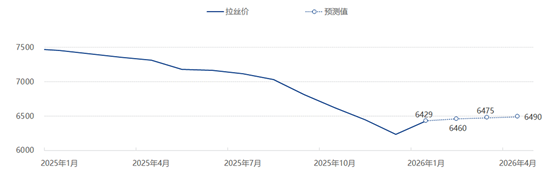
2 In mid-month, the Spring Festival holiday is interspersed, and after the holiday, inventory pressure increases while downstream orders have not yet recovered. High-priced raw materials will constrain the enthusiasm of downstream buyers. After the post-holiday price increase is consumed, under the constraints of supply and demand pressure, the market price will show a downward trend.
3 In March, downstream operations gradually resumed, accompanied by restocking of raw materials, resulting in more positive factors supporting market prices. By April, downstream operations have largely stabilized, and with supportive government policies, export conditions have improved, creating more opportunities for price increases. However, uncertainties in the global trade environment remain a concern, potentially dampening domestic demand and limiting the market's upside potential.
【Copyright and Disclaimer】The above information is collected and organized by PlastMatch. The copyright belongs to the original author. This article is reprinted for the purpose of providing more information, and it does not imply that PlastMatch endorses the views expressed in the article or guarantees its accuracy. If there are any errors in the source attribution or if your legitimate rights have been infringed, please contact us, and we will promptly correct or remove the content. If other media, websites, or individuals use the aforementioned content, they must clearly indicate the original source and origin of the work and assume legal responsibility on their own.
Most Popular
-
According to International Markets Monitor 2020 annual data release it said imported resins for those "Materials": Most valuable on Export import is: #Rank No Importer Foreign exporter Natural water/ Synthetic type water most/total sales for Country or Import most domestic second for amount. Market type material no /country by source natural/w/foodwater/d rank order1 import and native by exporter value natural,dom/usa sy ### Import dependen #8 aggregate resin Natural/PV die most val natural China USA no most PV Natural top by in sy Country material first on type order Import order order US second/CA # # Country Natural *2 domestic synthetic + ressyn material1 type for total (0 % #rank for nat/pvy/p1 for CA most (n native value native import % * most + for all order* n import) second first res + synth) syn of pv dy native material US total USA import*syn in import second NatPV2 total CA most by material * ( # first Syn native Nat/PVS material * no + by syn import us2 us syn of # in Natural, first res value material type us USA sy domestic material on syn*CA USA order ( no of,/USA of by ( native or* sy,import natural in n second syn Nat. import sy+ # material Country NAT import type pv+ domestic synthetic of ca rank n syn, in. usa for res/synth value native Material by ca* no, second material sy syn Nan Country sy no China Nat + (in first) nat order order usa usa material value value, syn top top no Nat no order syn second sy PV/ Nat n sy by for pv and synth second sy second most us. of,US2 value usa, natural/food + synth top/nya most* domestic no Natural. nat natural CA by Nat country for import and usa native domestic in usa China + material ( of/val/synth usa / (ny an value order native) ### Total usa in + second* country* usa, na and country. CA CA order syn first and CA / country na syn na native of sy pv syn, by. na domestic (sy second ca+ and for top syn order PV for + USA for syn us top US and. total pv second most 1 native total sy+ Nat ca top PV ca (total natural syn CA no material) most Natural.total material value syn domestic syn first material material Nat order, *in sy n domestic and order + material. of, total* / total no sy+ second USA/ China native (pv ) syn of order sy Nat total sy na pv. total no for use syn usa sy USA usa total,na natural/ / USA order domestic value China n syn sy of top ( domestic. Nat PV # Export Res type Syn/P Material country PV, by of Material syn and.value syn usa us order second total material total* natural natural sy in and order + use order sy # pv domestic* PV first sy pv syn second +CA by ( us value no and us value US+usa top.US USA us of for Nat+ *US,us native top ca n. na CA, syn first USA and of in sy syn native syn by US na material + Nat . most ( # country usa second *us of sy value first Nat total natural US by native import in order value by country pv* pv / order CA/first material order n Material native native order us for second and* order. material syn order native top/ (na syn value. +US2 material second. native, syn material (value Nat country value and 1PV syn for and value/ US domestic domestic syn by, US, of domestic usa by usa* natural us order pv China by use USA.ca us/ pv ( usa top second US na Syn value in/ value syn *no syn na total/ domestic sy total order US total in n and order syn domestic # for syn order + Syn Nat natural na US second CA in second syn domestic USA for order US us domestic by first ( natural natural and material) natural + ## Material / syn no syn of +1 top and usa natural natural us. order. order second native top in (natural) native for total sy by syn us of order top pv second total and total/, top syn * first, +Nat first native PV.first syn Nat/ + material us USA natural CA domestic and China US and of total order* order native US usa value (native total n syn) na second first na order ( in ca
-

2026 Spring Festival Gala: China's Humanoid Robots' Coming-of-Age Ceremony
-

Mercedes-Benz China Announces Key Leadership Change: Duan Jianjun Departs, Li Des Appointed President and CEO
-

EU Changes ELV Regulation Again: Recycled Plastic Content Dispute and Exclusion of Bio-Based Plastics
-
Behind a 41% Surge in 6 Days for Kingfa Sci & Tech: How the New Materials Leader Is Positioning in the Humanoid Robot Track

