



Structural Program-Control Innovation! A New Track for Sustainable Materials in High-End Athletic Footwear
High-end professional sports shoes are typically made from composites of multiple different materials, creating numerous challenges in both production and recycling. In the ZiProMat research project, a research team at the Fraunhofer Institutes has developed a new solution: using a programmable single base material to create the sole, enabling multidimensional performance requirements while allowing the upper to be made from the same raw material. This technical approach combines high-end performance, sustainability, and full recyclability.
This copolyester elastomer shoe sole is formed by laminating multiple layers of sheet material, with different functional areas defined by the structural arrangement of ribs and raised ridges, and each sheet layer is prefabricated with this differentiated structure.
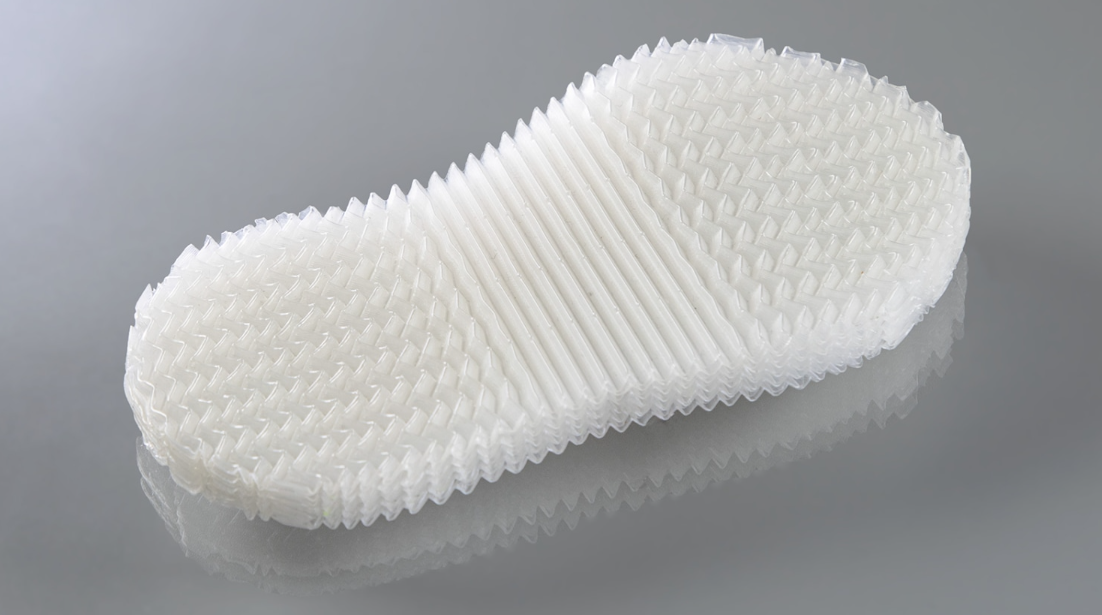
Image source: Fraunhofer Research Institution for Materials Recycling and Resource Strategies (Fraunhofer IWKS)
Customize rib structures on demand to precisely regulate material properties.
The Fraunhofer Institute has developed a new process that uses only a single raw material to produce an integrated shoe sole with multi-zone functionality. By customizing the arrangement of ribs and raised ridges, researchers can “program” the material’s deformation and mechanical behavior under external forces at the structural level.
The research team of the Fraunhofer Cluster of Excellence for Programmable Materials (CPM) has jointly completed technical validation with the sports brand Puma, confirming that the process is feasible for practical implementation and offers significant application advantages.
To further advance circular programmable material technologies, the institute introduced external collaboration in the follow-up ZiProMat project, joining forces with experts from the Fraunhofer Cluster of Excellence Circular Plastics Economy (CCPE) to tackle key challenges together. The project’s core objective is to manufacture both the sole and upper as an integrated structure using polyester-based materials, enabling their simultaneous recycling; at the same time, it aims to expand into diverse application scenarios and continuously optimize the entire recycling process.
Base material selected: thermoplastic copolyester elastomer
The team chose thermoplastic copolyester elastomer as the sole’s single base material, while the uppers and outer fabrics of athletic shoes on the market are already commonly made of polyester, making the raw material systems of the two fully compatible.
In the outsole manufacturing process, copolyester sheets are used as the raw material. After heating, the sheets are vacuum thermoformed onto a mold to preform a proprietary structure with ribs and raised ridges. The formed sheets are then stacked and bonded, allowing both the inner and outer layers of the outsole to form distinctive three-dimensional structures that determine its mechanical performance.
The research team is simultaneously developing two innovative recycling process routes:
Solvent dissolution recovery process
Perform targeted selective dissolution of waste shoe materials to completely separate impurity particles, ultimately producing high-purity recycled polyester raw materials.
Thermal pyrolysis recycling process
Depolymerize polymer materials into small-molecule monomers, then recover high-quality basic chemical raw materials such as terephthalic acid through staged separation and chemical purification for reuse in the chemical industry.
Closed-loop circulation system: not limited to athletic shoes.
The cross-disciplinary collaboration between the Fraunhofer CPM and CCPE clusters is the key to breakthroughs in this project. Researcher Hubner explained, "Multiple research institutes leverage their respective expertise to collaborate on research and development, bridging the entire industrial chain of technology and process, covering the whole process from the preparation of intelligent single substrates, the development of innovative recycling processes, to the manufacturing of next-generation high-performance finished products."
At present, the research team is still expanding the functional boundaries of programmable structures in high-performance athletic shoes, while also planning to apply this material technology to other footwear categories such as safety shoes.
【Copyright and Disclaimer】This article is the property of PlastMatch. For business cooperation, media interviews, article reprints, or suggestions, please call the PlastMatch customer service hotline at +86-18030158354 or via email at service@zhuansushijie.com. The information and data provided by PlastMatch are for reference only and do not constitute direct advice for client decision-making. Any decisions made by clients based on such information and data, and all resulting direct or indirect losses and legal consequences, shall be borne by the clients themselves and are unrelated to PlastMatch. Unauthorized reprinting is strictly prohibited.
Most Popular
-

Evonik Parts Ways With The Polyester Business! A Strategic Retreat By A Germany Chemical Giant And The Global Industry Shift
-

A Look at the Material Suppliers Behind SpaceX
-

Next-generation motors of new energy vehicles: Single-Round Thousand Horsepower, Replacing Brakes, How Powerful Are They?
-

Nike mind: Neuroscience and Foam Material Innovation Merge to Lead Low-Carbon Upgrading Technology in the Footwear Industry
-
Ethylene: Production Capacity Accelerates Expansion, Global Industry Landscape Is Being Reshaped


