



[Special Plastic Index] Futures Wobble Lower, Polyolefin Spot Prices Fall
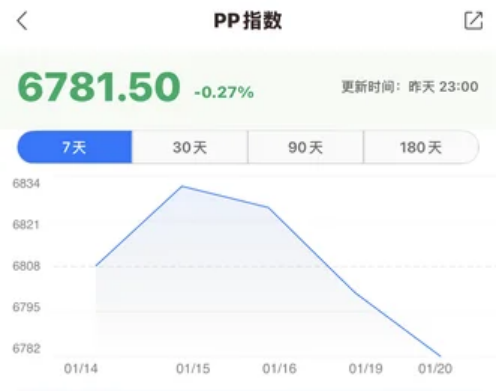
South China PP price index at 6781.5 points, down 41.52 points week-on-week, a decrease of 0.61%. Among them, raffia down 30, fiber down 20, copolymer flat, thin wall flat, homopolymer flat.
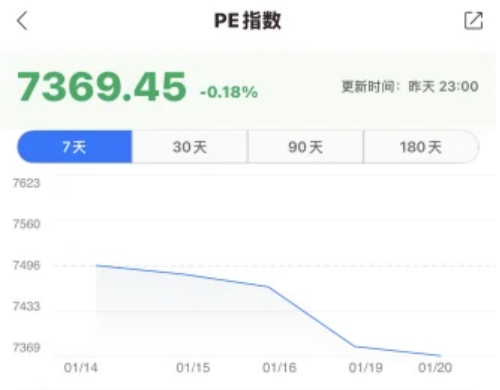
South China PE Price Index stands at 7369.45 points, a decrease of 109.73 points or 1.47% compared to last week, with linear decreasing by 100, low density decreasing by 50, and high density decreasing by 200.
This week, domestic polyolefin market prices fluctuated and declined, with spot prices falling. On the supply side, there was a slight contraction in the short term, but the expectation of restarting maintenance units is clear in the later period, and the pressure of supply recovery in the medium and long term remains. On the demand side, seasonal weakness continues, downstream operating rates are low, and the willingness to replenish inventory is not strong, which has become the core factor suppressing prices. Cost support has weakened in stages, and there is an intertwining of cooling capital sentiment and geopolitical disturbances. It is expected that polyolefin market prices will remain in a weak and volatile trend next week.
On the cost side, oil prices were initially driven up by geopolitical risks associated with Iran at the beginning of the week, but the situation subsequently eased. Coupled with news such as the US starting to sell Venezuelan crude oil, concerns about supply eased, and oil prices retreated from their highs, reducing the cost support. In addition, the operating rates of domestic coal-to-polyolefin enterprises remained relatively stable, and coal prices did not fluctuate significantly, maintaining the cost advantage of the coal-based route, which to some extent suppressed the upward space for polyolefin prices. Overall, the cost-side support for polyolefins this week exhibited a periodic characteristic and did not form a sustained positive effect.
Supply side: In terms of operating rates, PE operating rate this week was 75.47%, a week-on-week decrease of 2.94%; PP operating rate was 74.75%, a week-on-week decrease of 0.48%. This was mainly due to some units entering short-term maintenance, with 5.23 million tons of PE capacity and 8.29 million tons of PP capacity shut down, leading to a slight contraction in supply. In terms of imports: Imports showed divergence. The PE import window remained closed, and import volumes are expected to decline in the later period. The export window is closed, and the overall supply rebound will slow down. For PP, the low-price import window is closed, and the export window is open, which to some extent alleviates domestic supply pressure. However, there will be no new units commissioned in the first half of the year, and the trend of increasing domestic supply is clear.
In terms of demand, the downstream market continues its seasonal weakness. As the Spring Festival approaches, downstream product manufacturers are gradually reducing their operating intentions, and their purchasing pace has slowed, leading to insufficient demand support for polyolefin raw materials. Specifically, PE downstream operating rates are mostly flat compared to last week. Agricultural film operating rates remain at 41%, a significant drop from the peak season; packaging film operating rates are 51%, pipe operating rates are 31%, and operating rates in hollow and injection molding sectors remain around 45%-48%. Overall operating rates have slightly decreased month-on-month, suppressing PE demand. For PP downstream, woven bag operating rates are 46%, flat compared to last week; injection molding operating rates are 48%, flat compared to last week; monofilament operating rates are 45%, down 1% from last week; BOPP operating rates are 62.9%, a slight increase of 0.35% from last week. Overall demand remains stable but weak, with downstream companies maintaining a cautious mindset and general inquiry enthusiasm. The focus of actual transactions has shifted downward, providing insufficient support for PP prices.
Polyolefin market prices are expected to maintain a volatile and weak trend next week. The conflict between supply and demand remains unresolved, coupled with limited cost support, leading to overall range-bound fluctuations. On the cost side, domestic refined oil price increases will provide short-term minor support, but international oil prices are suppressed by expectations of oversupply, offering limited long-term support. Geopolitical risks will only cause short-term disturbances. On the supply side, previously shut-down units are gradually restarting, leading to a slight increase in supply. Coupled with the expected capacity release from some units, supply pressure is increasing. On the demand side, with the Spring Festival approaching, downstream enterprises' operating rates are continuously declining, and their willingness to replenish inventory is low, resulting in insufficient support from rigid demand. Inventory pressure for both major oil companies continues to accumulate, further limiting the extent of any rebound.
【Copyright and Disclaimer】This article is the property of PlastMatch. For business cooperation, media interviews, article reprints, or suggestions, please call the PlastMatch customer service hotline at +86-18030158354 or via email at service@zhuansushijie.com. The information and data provided by PlastMatch are for reference only and do not constitute direct advice for client decision-making. Any decisions made by clients based on such information and data, and all resulting direct or indirect losses and legal consequences, shall be borne by the clients themselves and are unrelated to PlastMatch. Unauthorized reprinting is strictly prohibited.
Most Popular
-

EU Changes ELV Regulation Again: Recycled Plastic Content Dispute and Exclusion of Bio-Based Plastics
-
Vynova's UK Chlor-Alkali Business Enters Bankruptcy Administration!
-
CBAM Officially Implemented In Its First Month: How Chinese Export Enterprises To Europe Complete Their First Compliance Declaration?
-

List Released! Mexico Announces 50% Tariff On 1,371 China Product Categories
-
Continental Plans to Begin Sale of ContiTech in Early 2026

