



CBAM Officially Implemented In Its First Month: How Chinese Export Enterprises To Europe Complete Their First Compliance Declaration?
In January 2026, the European Union's Carbon Border Adjustment Mechanism (CBAM) officially transitioned from its transitional period to the definitive regime. This historic shift not only marks a restructuring of global climate trade rules but also directly impacts the cost structure of exports from China, the EU's largest trading partner. Although the European Commission postponed the actual compliance deadline for CBAM certificates to 2027 through a "package" simplification plan at the end of 2025, observations at ports in the first two weeks of January 2026 indicate that compliance pressure has not eased. On the contrary, the mandatory implementation of the Authorized CBAM Declarant system and the activation of the default value penalty mechanism have led to customs clearance delays for some Chinese export goods at major ports such as Rotterdam and Hamburg.
This report, based on the latest policy developments and market observations as of mid-January 2026, provides an in-depth analysis of the transformation in the declaration process following the full implementation of CBAM, particularly highlighting the key differences from the transitional period. Through first-month simulation data from the three core industries—steel, aluminum, and fertilizers—the report examines the dilemma faced by Chinese enterprises between "actual data" and "default values." It explores the recognition crisis that China's Green Electricity Certificate (GEC) encounters under the stringent PPA (Power Purchase Agreement) requirements of the EU. Drawing on the pioneering experiences of Nordic industry giants such as Sweden's SSAB and Norway's Norsk Hydro, the report offers Chinese enterprises a practical compliance strategy.
Chapter 1: Observations in the First Month of CBAM Establishment: Sudden Changes in Regulations and Port Records
From "Transition" to "Establishment": Institutional Rupture in January 2026
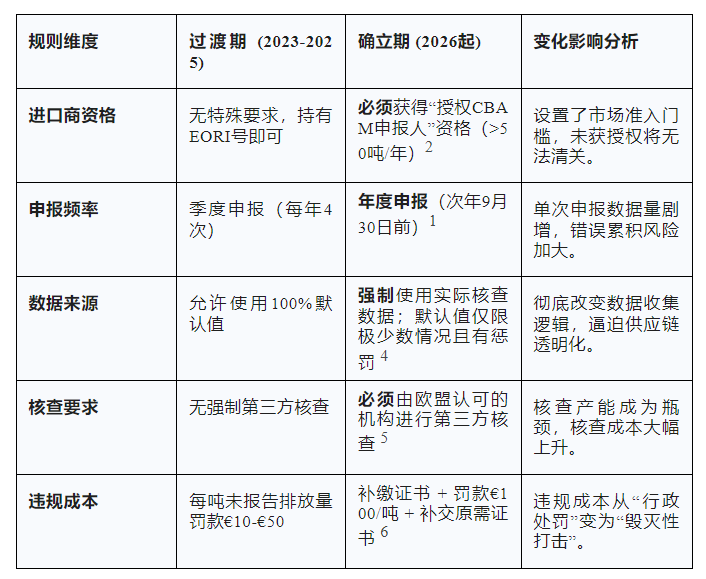
On January 1, 2026, at midnight, the legal effect of the CBAM Regulation (Regulation (EU) 2023/956) will undergo a qualitative change. The past two years of the transition period (October 2023 - December 2025) were defined as a "learning period," during which companies were only required to fulfill reporting obligations and could use default values, with no substantive penalties for data errors. However, with the start of the establishment period, the regulatory logic shifts from "data collection" to "carbon price adjustment."
The mandatory implementation of the "Authorized Applicant" system
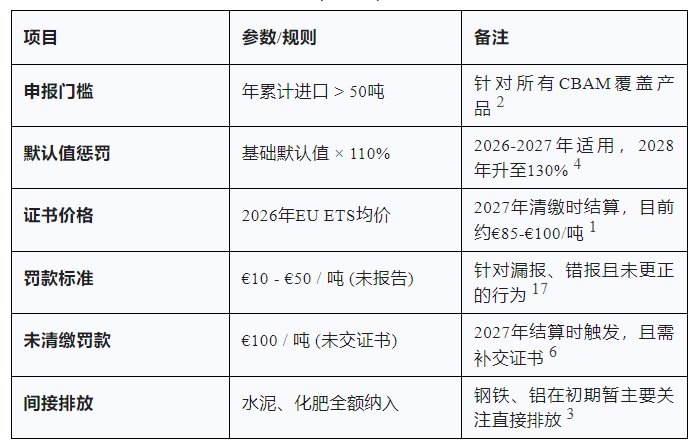
In January 2026, the most significant change is the threshold for importer status. According to regulatory requirements, importers whose annual cumulative import net weight of CBAM-covered products exceeds 50 tons must obtain the "CBAM Authorized Declarant" qualification.1This regulation triggered a chain reaction in EU customs in early January.
Port Observation:
In the first week of 2026, some goods from Chinese enterprises that had not completed their authorization applications in advance were intercepted at the EU border. Although the European Commission allowed a "grace period" policy, allowing applications to be submitted until March 31, 2026, for continued imports, in practice, the competent authorities (NCA) of EU member states interpreted the policy differently. For example, customs systems in Germany and the Netherlands required importers to present proof of having submitted their application to the NCA (such as a receipt number); otherwise, they would refuse to release the goods. This led Chinese exporters, accustomed to DDP (Delivered Duty Paid) trade terms—acting as the EU importers—to find themselves in a passive position, having to urgently commission local indirect customs representatives in the EU to remedy the situation.
Immediate Accumulation of Financial Responsibilities and Deferred Payments
The EU's simplified rules, released at the end of 2025, postpone the official sale date of CBAM certificates to February 1, 2027.1This policy adjustment has caused some misunderstanding in the market, with some companies mistakenly believing that 2026 will still be a "cost-free" year.
Risk Warning:
This understanding is extremely dangerous. Although cash outflow is delayed, the carbon liability starts accruing daily from January 1, 2026. Each ton of steel entering the EU in 2026 will correspond to a CBAM certificate that must be settled in 2027. The price of this certificate will be locked at the average auction price of EU ETS allowances for the entire year of 2026. In other words, Chinese exporting companies are currently accumulating significant off-balance-sheet liabilities at a "floating price," and they are unable to hedge against future price fluctuation risks by purchasing certificates at present.
Table 1: Comparison of Core Rules during the Transition Period and the Establishment Period (Perspective of January 2026)
1.2 Detailed Process for Initial Compliance Declaration: Breaking the "Quarterly Inertia"
After entering the establishment phase, there was a fundamental change in the compliance workflow of enterprises. The "quarterly report" mode during the transition period was abolished, replaced by an annual cycle carbon management system. However, to avoid data congestion before the September 2027 reporting deadline, a mature compliance strategy requires enterprises to initiate an internal process of "monthly closing and quarterly pre-assessment" as early as January 2026.
1.2.1 Establishment Period Declaration Process Flowchart
1. Data Collection (Real-time):
Chinese manufacturers must establish data collection points with real-time connections to their production lines in their ERP or carbon management systems. For steel companies, this involves reading the coke consumption of blast furnaces through SCADA systems; for aluminum companies, it is necessary to track the current efficiency and anode consumption of electrolytic cells. Data from January 2026 must be accurate to the "Installation" level, rather than the previous "Site" level.
Default value penalty calculation (key differences):
If actual data cannot be obtained in 2026 and default values have to be used, the EU will impose a 10% punitive surcharge on those default values. This means that if a Chinese steel plant lacks measured data, its carbon emission intensity will be calculated as "the emission level of the worst 10% of EU companies × 1.1". This punitive mechanism will be further increased to 30% in 2028, with the aim of making the use of "default values" economically unacceptable.
3. Pre-check (Quarterly Recommendation):
Despite regulations requiring annual audits, considering the risk of global audit agencies being overwhelmed in 2027, organizations like SGS recommend conducting "pre-audits" (Gap Analysis) at the end of each quarter in 2026. By mid-January, many leading Chinese companies had already initiated negotiations for annual framework agreements with audit agencies.
Certificate Purchase Planning (Financial Department Function):
Although the purchasing will not be open until 2027, the finance department of the enterprise needs to start establishing a "shadow carbon price" account in January 2026 based on daily EU ETS price fluctuations, and accrue the corresponding estimated liabilities to prevent funding gaps in 2027.
Chapter 2 Actual Case Analysis: Data Shock in the First Month of Three Major High-Carbon Industries
The actual trade data for January 2026 has not been fully disclosed yet, but based on current regulatory logic and industry average emission levels, we can construct a realistic compliance landscape for the steel, aluminum, and fertilizer industries during the first month of the establishment period.
2.1 Steel Industry: The Long Night of Blast Furnaces and the Dawn of Electric Furnaces
Steel is the industry with the largest volume covered by CBAM, and it is also the field with the most significant disparity in carbon intensity between China and Europe.
Case Background:
A large Chinese state-owned steel plant (Company A) primarily exports hot rolled coils (HRC) to the European Union. Its production process follows the traditional "blast furnace-basic oxygen furnace" (BF-BOF) long process.
Data simulation for January 2026:
●Export volume:10,000 tons.
●Actual Emission Intensity (Tier 1 Data):2.1 tons of CO2 per ton of steel (including direct emissions from mining, ironmaking, and steelmaking).
●EU Default Values (Assumptions):2.2 tons of CO2/ton of steel (based on the average value for high carbon intensity countries).
●Establishment period default value penalty: 2.2 × (1 + 10%) = 2.42 tons of CO2/ton of steel4。
Compliance Analysis:
If Company A fails to complete the monitoring and verification of actual data by January 2026 and is forced to use default values, its carbon tax base per ton of steel will be 0.32 tons higher than the actual emissions (2.42 - 2.1).
Based on the predicted average price of €90/ton for the EU ETS in January 2026, the additional cost due to "data deficiency" is:
0.32 tons/ton of steel × €90/ton of CO2 × 10,000 tons = €288,000
The additional expenditure of nearly 300,000 euros is enough to consume the entire net profit of the batch of goods.
Deep Insights:
Moreover, the steel industry is facing a severe precursor data dilemma. The CBAM regulations require that "complex products" (such as bolts, nuts, and steel pipes) must trace the actual emissions of their raw materials (steel billets). Observations in January 2026 indicated that a large number of downstream fastener companies in China were forced to use punitive default values for their raw materials due to the inability to obtain carbon data that meets ISO 14067 standards from upstream steel mills, resulting in a 15%-20% increase in the carbon costs of their final products and a loss of competitiveness in the European market.
2.2 Aluminum Industry: "Scrap Aluminum Loophole" and Data Game
In January 2026, the aluminum industry exhibits a peculiar "boom," centered around the controversial "zero emissions for scrap aluminum" rule in the CBAM calculation method.
Case Background:
A Chinese aluminum processing company (Company B) exports aluminum alloy wheels to Germany.
Compliance Logic (Establishment Period):
According to the calculation rules established during the CBAM phase, remelted scrap aluminum (Scrap) is allocated zero emissions 10.
●Path One (Primary Aluminum):The carbon emissions from using electrolytic aluminum liquid are approximately 14-20 tons of CO2 per ton of aluminum (coal-powered aluminum).
●Path Two (Recycled Aluminum):Claims to use 80% recycled aluminum and 20% primary aluminum.
Carbon emission calculation: 80% × 0 + 20% × 20 = 4 tons of CO2 per ton of aluminum.
First Month Observation:
In January 2026, there was a significant increase in the declared proportion of "recycled content" on export declarations for a large number of Chinese aluminum products. However, this has also raised extreme vigilance from EU verification agencies. European competitors, such as Norsk Hydro, have strongly accused this of being "greenwashing."
Crisis Response:
EU inspectors have begun requiring Company B to provide detailed "source proof of scrap aluminum"—not only purchase invoices but also physical inventory records of the scrap aluminum, charging records for the smelting furnace, and even video surveillance. If Company B cannot prove the genuine physical input of its scrap aluminum, the inspectors will, based on the "precautionary principle," classify it as primary aluminum, resulting in a fivefold increase in carbon tax costs.
2.3 Fertilizer Industry: "Full Impact" of Indirect Emissions
Unlike the steel industry (where indirect emissions are not considered in the initial period), the fertilizer and cement industries must fully account for them in 2026.Indirect emissionsThe carbon cost (Scope 2, i.e., emissions from purchased electricity)3。
Case Background:
A Chinese urea producer (Company C) is located in a major coal-producing province and uses grid electricity for production.
Data Analysis for January 2026:
●Direct emissions:Chemical reaction emissions in the production process.
●Indirect emissions:The power consumption is extremely high. Due to the inability to provide green electricity certification that complies with EU PPA requirements (see Chapter 4 for details), Company C must use the average emission factor of the regional power grid in China.
●Data Comparison:The average emission factor of China's regional power grid (approximately 0.6-0.9 kgCO2/kWh) is much higher than that of the EU grid.
Compliance Analysis:
In January 2026, as indirect emissions are included in the tax scope, the CBAM cost of Chinese fertilizer products may account for more than 30% of the product value. Unless Company C owns a dedicated photovoltaic power station and can supply power through a physical direct connection, its products will face a cliff-like drop in competitiveness in the European market.
Chapter 3: EU-Recognized Carbon Accounting and Certification Systems: How to Bridge the "Trust Gap"
During the establishment period of CBAM, the "authenticity" of data is no longer self-certified by enterprises, but must be endorsed by an EU-recognized certification system. The lack of mutual recognition of certification agency qualifications between China and the EU as of January 2026 becomes the biggest technical barrier.
3.1 Verification of the Exclusivity of Institutional Qualifications
According to the Delegated Act on Accreditation and Verification by the European Commission, CBAM verification bodies must be accredited by the national accreditation bodies (NAB) of EU member states.12。
●Current situation:Although domestic authoritative institutions in China (such as CQC, CEC) hold authoritative positions in domestic and international CDM/VCS projects, the CBAM verification reports they issue are legally invalid if they have not obtained specific authorization from EU NABs (such as Germany's DAkkS or France's COFRAC) in accordance with Regulation (EU) 2018/2067.12。
●Respond to: Translate the above content into English and directly output the translation result without any explanation.In January 2026, wise Chinese companies have stopped seeking "cheap" non-accredited institutions and have instead signed contracts with internationally recognized organizations such as SGS, TÜV SÜD, DNV, or joint ventures that have been granted EU authorization.
3.2 Mandatory Site Visit
The regulations established during the confirmation period clearly require that the verification process must include on-site visits to production facilities. This signifies the end of the era of "remote audits" or audits based solely on document reviews.
Strategy Recommendations:
Considering the verification congestion before the submission deadline in 2027, Chinese enterprises should invite verifiers to their factories in the first half of 2026. The focus of the verification will be on:
1.System boundary definition:Whether the direct emissions and indirect emissions are correctly distinguished, and whether auxiliary processes (such as internal transportation) are overlooked.
2.Source StreamsAre the measuring instruments for coal and gas combustion calibrated, and is the test report from a CNAS accredited laboratory?
3.Precursor tracing:Is it possible to provide the actual emission data from upstream suppliers, rather than just the suppliers' "statements"?
3.3 The "Europeanization" of Carbon Accounting Methods
The accounting methods commonly used by Chinese enterprises (such as the 24 industry guidelines by the National Development and Reform Commission) have detailed differences compared to the CBAM regulation (Annex IV of Regulation (EU) 2023/956).
●Differences:CBAM requires more detailed "device-level" accounting, and there are complex regulations regarding the allocation of emissions for "waste gas" (such as the destination of blast furnace gas).
●Utilization Strategy: Translate the above content into English and output the translation directly without any explanation.Enterprises should immediately introduce carbon management software systems that comply with EU standards, automatically mapping production data into the CBAM reporting structure. By using EU-recognized methodologies, it is actually possible to tap into emission reduction potential—for example, correctly calculating the deduction amount for waste heat recovery, which is allowed under EU methodologies to reduce the total emission intensity.
Chapter Four: The Green Power Dilemma: The Disconnection Between China's GEC and the EU's CBAM Mechanism
In January 2026, the biggest technical challenge troubling Chinese export enterprises is:"I bought green certificates, why doesn't the EU recognize them?"
4.1 The EU CBAM's Strict Definition of "Green Electricity"
Annex IV of the CBAM regulations sets a high threshold for the recognition of zero-emission electricity, with the core concept being "direct technological connection."(Direct Technical Link) or meeting specific conditions"Power Purchase Agreement" (PPA)14。
PPAThree key elements of validity (2026 edition):
1.PhysicalityThe purchaser of electricity and the electricity generator must have a real contractual relationship for power transmission, not just a financial settlement relationship.
2.No Double CountingEnvironmental attributes must be transferred and retired with the electricity and may not be unbundled for sale.
3.Temporal CorrelationThe EU is gradually introducing the concept of "hourly matching," meaning that factories cannot offset the electricity generated by photovoltaic power stations during the day when producing at night.14。
4.2 The Flaw of "Certificate-Power Separation" in China's Green Certificate (GEC)
China's current Green Electricity Certificate (GEC) system is mainly based on the "certificate-electricity separation" model. A factory in Jiangsu can purchase a green certificate from a photovoltaic power station in Qinghai, but physically uses electricity from Jiangsu's thermal power grid.
The verdict of January 2026:
The EU regulators clearly stated during the establishment period that unbundled Chinese GECs are not recognized by CBAM 16.
This means that if a company only holds GECs without a physical power purchase agreement, the verifier must mandatorily use the average emission factor of China's regional power grid to calculate indirect emissions. This will result in the company's green electricity investment being completely "in vain."
4.3 The Path to Resolution: Green Power Trading
To address this disconnection, Chinese enterprises must shift from simply purchasing certifications to actively participating.Green Power Trading(Lü Dian Jiao Yi)。
●Mechanism:The "medium and long-term green power trading contract" signed at the provincial power trading center has achieved "certificate and power integration." It includes both the delivery of physical electricity and the transfer of green certificates.
●EU recognition degree:Compared to a pure GEC, this "certificate and electricity integrated" contract is closer to the EU's definition of a PPA.17。
●Operating Suggestions: Translate the above content into English and output the translation directly, without any explanation.Enterprises should adjust their electricity procurement strategies immediately in January 2026 and retain the Settlement Slip issued by the electricity trading center. This document must clearly list the "green electricity" transaction volume and the corresponding environmental premium payment records, serving as the evidence chain to meet the CBAM PPA requirements.
Chapter 5: Lessons from the Nordic Experience: The "Way of Attack and Defense" of SSAB and Norsk Hydro
In the rules of the CBAM, Nordic companies are not only participants but also the rule makers and beneficiaries. A deep analysis of their strategies offers significant insights for Chinese enterprises.
5.1 Sweden's SSAB: Building Technological Barriers with "Zero Carbon" (Offensive Strategy)
SSAB (Swedish Steel Company) is the world's first company to focus on "fossil-free steel," which is centered around the HYBRIT technology (hydrogen metallurgy).
Trends in January 2026:
In the first month of the establishment of CBAM, SSAB not only did not panic over compliance costs, but also intensified its market offensive.
●Supply chain suppression:SSAB has issued a "data directive" to its global suppliers (including Chinese alloy suppliers) that goes beyond the statutory requirements of CBAM.18They require suppliers to provide the actual carbon footprint data for each batch of goods and threaten to exclude suppliers who are unable to provide the data.
●Market segmentation:SSAB has used CBAM to raise the cost of importing high-carbon steel, thereby narrowing the price gap between its expensive "green steel" and ordinary steel. They are essentially using CBAM as a marketing tool to prove to clients like Volvo and Scania: "Although the unit price of Chinese steel is low, when you add the cost of CBAM certificates and potential supply chain risks, the overall cost is no longer advantageous."18
Revelation:Chinese companies cannot be satisfied with merely "passing" compliance. They must realize that leading European clients are using carbon data as a criterion for supplier access.Veto item。
5.2 Norsk Hydro: Using Rule Loopholes to Counterattack (Defense Strategy)
As one of the world's largest aluminum companies, Hydro's core strategy in January 2026 is to "plug the leaks."
Lobbying Regarding the "Aluminum Scrap Loophole":
Heidru pointed out that the CBAM's regulations on zero emissions for waste aluminum could lead to "greenwashing" and "resource shuffling." They lobbied the European Commission to establish stricter verification standards for waste aluminum during the implementation period.
●Practical Impact:Under the impetus of Hydro, the EU has begun to focus on the definition of "pre-consumer scrap." If Chinese companies simply remelt production process scrap and claim it as "recycled aluminum," it will be regarded as an evasion behavior.
●Impact on China:Hydro's actions directly led to an increase in scrutiny of Chinese aluminum products.
Revelation:Chinese aluminum companies must establish an extremely stringent waste aluminum supply chain traceability system. If the source of the waste aluminum cannot be proven (such as procurement records from recycling stations), they will be rejected outright in the face of strict inspections influenced by companies like Hydro.
Chapter Six Summary and Response Roadmap
In January 2026, the establishment period of CBAM has officially begun. This is no longer a drill, but a battle for survival concerning market access.
The First Month Response Checklist for Chinese Enterprises:
1.Identity verification (immediate execution):Confirm whether the EU importer has submitted the "Authorized Declarant" application. If it is DDP trade, immediately sign the agreement for the EU indirect representative.
2.Data stop-loss (financial bleeding control): 停止依赖默认值。立即启动基于ISO 14064-1的内部实际数据监测,避免10%的罚款加成。
3.Electricity substitution (energy strategy):Stop purchasing unbundled GECs. Switch to the provincial power trading center's "certificate and electricity in one" green power trading, and keep all transaction settlement documents.
4.Verification Lock (Resource Preemption):Advance booking for the 2026 schedule of EU-recognized verification bodies such as SGS and TÜV to conduct Gap Analysis.
5.Supply Chain Transmission (Collaborative Combat):Imitating SSAB, issue a data request letter to downstream suppliers to ensure the authentic acquisition of "precursor" data, avoiding default value penalties caused by missing upstream data.
CBAM is a "carbon tariff" and a reshuffle of the global supply chain. For Chinese enterprises, only through refined data management and substantive decarbonization actions can they break through this green trade barrier battle.
Attachment: Key Data Parameters Table for CBAM Establishment (2026 Edition)
【Copyright and Disclaimer】The above information is collected and organized by PlastMatch. The copyright belongs to the original author. This article is reprinted for the purpose of providing more information, and it does not imply that PlastMatch endorses the views expressed in the article or guarantees its accuracy. If there are any errors in the source attribution or if your legitimate rights have been infringed, please contact us, and we will promptly correct or remove the content. If other media, websites, or individuals use the aforementioned content, they must clearly indicate the original source and origin of the work and assume legal responsibility on their own.
Most Popular
-

Middle East Tension Spikes Global Energy Pattern, Crude Oil and Plastic Industries Face Multiple Challenges
-
Middle East Tensions Escalate Sharply: How Polyolefins Respond Amid Soaring Risk Premium
-

Middle East Polymer Export Hub Hit in Sudden Attack, Global Supply Chain Sounds Alarm
-
[Forward-Looking Analysis] Impact of Escalating U.S.-Iran Tensions on Domestic Chemical Market
-

Futures Surge Violently, Polyolefin Spot Prices Rise Sharply in Tandem


