



Saudi Arabia Warns: Oil Prices Could Soar to $180 in April!
Saudi officials predict that in the baseline scenario: if the supply disruption caused by the Iran war lasts until late April, oil prices will surge past $180. This money Saudi Arabia may not dare to earn. A too rapid and too strong increase in prices would destroy long-term demand and also tarnish Saudi Arabia's reputation with the stigma of profiting from war.
Saudi oil officials are desperately forecasting that if the Iran conflict and resulting energy supply disruptions do not end soon, oil prices could rise to a high level, and the results they see are not optimistic.
The oil officials of the largest oil-producing country in this gulf said,The basic scenario is that if the supply disruption continues into late April, oil prices could surge above $180 per barrel.
Although this sounds like a windfall for a country still heavily reliant on oil revenue, it is deeply concerning. Such high oil prices could prompt consumers to adopt habits of reduced oil consumption—potentially long-term—or trigger a recession that similarly dampens demand. It could also tarnish Saudi Arabia’s reputation by associating the country with profiteering from a war it did not initiate.
"Saudi Arabia usually does not like oil prices rising too quickly, as it can lead to long-term market instability," said Umer Karim, a Saudi foreign policy and geopolitical analyst at the King Faisal Center for Research and Islamic Studies. "For Saudis, the ideal balance is for prices to rise moderately while maintaining stable market share."
The state-owned oil company Saudi Aramco, responsible for production, sales, and pricing, refused to comment.
Terrorist attacks on energy facilities this week have pushed up oil prices. In response to Israel's attack on Iran's South Pars on Wednesday.Natural gasIn retaliation, Tehran struck facilities at the Ras Laffan energy center in Qatar and attacked other infrastructure in the Gulf, including Saudi facilities in Yanbu, which is the Red Sea terminus for pipelines that can bypass the Strait of Hormuz.
Iran continues to attack vessels in the Gulf region, extending a series of assaults that have nearly shut down the Strait of Hormuz—a narrow passage through which 20% of the world's oil shipments flow.
Attack Drives BenchmarkBrent CrudeThe futures price rose as high as $119 per barrel on Thursday, then retreated. The contract's all-time high was 146.08 dollars in July 2008.
"Oil prices reaching $200 per barrel by 2026 is not impossible," said an analyst at energy consultancy Wood Mackenzie.
Gulf futures linked to Oman crude surged to above $166 a barrel -- a less liquid but quick-responding gauge to local supply disruptions. Oman is the benchmark for much of the oil sold by Saudi Arabia and other Middle Eastern producers.
Oil officials said some Saudi customers are reluctant to use the benchmark due to its volatility, but they added that Saudi Aramco insists it accurately reflects market supply conditions.
The war has reduced global daily supply by millions of barrels of oil. Since the conflict began on February 28, oil prices have risen by about 50%.
The modeling team at Saudi Aramco needs to assess market trends to release the official selling price of its crude oil by April 2nd. They refer to multiple inputs, including surveys of customer demand conducted by the staff responsible for oil sales.
The price of Saudi light crude oil sold to Asian buyers through the Red Sea ports has reached around $125 per barrel. Officials said that as the extra oil in inventory (part of which was shipped out of the Gulf before the war) is consumed,Physical shortages will become more severe next week, pushing prices to approach $138 to $140 per barrel.。
By the second week of April, if the supply disruption is not alleviated and the Strait of Hormuz remains closed, Saudi officials said they expect oil prices to reach $150 per barrel, then rise to $165 and $180 per barrel in the following weeks.
Oil traders are also betting on a significant rise in prices, although many expect a scenario far less pessimistic than Saudi Aramco's worst-case outlook. According to Intercontinental Exchange data, bets that Brent futures will hit $130, $140, or $150 a barrel next month were among the most popular positions in the options market on Wednesday. A small but growing number of traders are betting on an even steeper rise in prices.
Rebecca Babin, senior energy trader at CIBC Private Wealth, speaking about the end of the war, said: "The market no longer thinks this is just a matter for the end of March. I don't think it's impossible to hit $150 in another month... If we're talking about June, I'd dare say it could be $180."
Many factors could prevent oil prices from rising that high—for example, the end of fighting or increased oil supplies from sanctioned producers like Russia boosting global supply. Demand could also fall, pulling down oil prices, though this might come alongside a recession.
Energy producers are eager to find out how high oil prices need to go before buyers start reducing their consumption — a phenomenon known asDemand destruction。
“Generally speaking, people only start calculating seriously when Brent reaches $150,” Babine said.
Analysts say that at that price level, Americans might start taking the bus, working from home, or reconsidering their summer vacation plans. Manufacturers could slow down production rather than operate at a loss.
For most consumers, the more relevant price is the one at the gas pump. James West of Melius Research notes that gasoline demand typically starts to decline once prices exceed $3.50 per gallon.
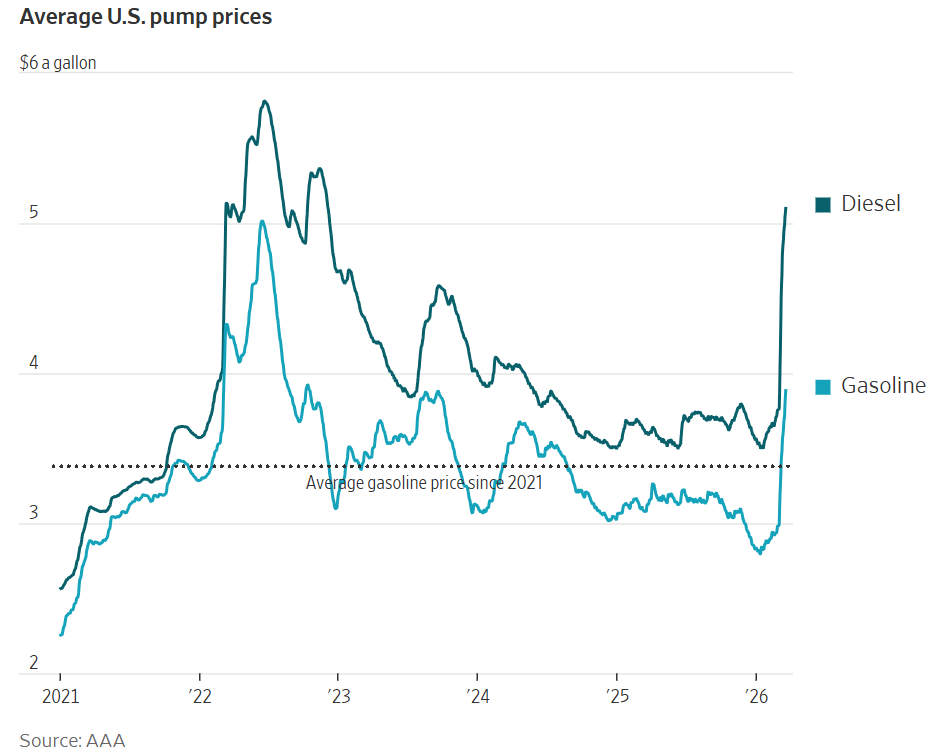
For many, prices have already reached this level. According to the American Automobile Association, the average U.S. retail gasoline price jumped to $3.88 per gallon on Thursday, up from $2.93 a month ago. Drivers in Arizona, New Mexico, and Colorado are facing the most severe price shocks.
Diesel prices have risen faster, reaching $5.10 per gallon, already impacting businesses across the U.S. that rely on this fuel to transport goods—from agricultural products to semiconductors and steel.
"Higher fuel costs act like a tax on consumers and businesses, forcing households to spend more on energy and less on other things," said Philip Blancato, CEO of Ladenburg Asset Management.
Wood Mackenzie believes another significant risk to demand comes from industrial users reducing consumption and the potential for broad economic contraction accompanying an oil shock.
This drop in demand could first impact energy-poor countries in Asia and Europe, where prices for aviation fuel, diesel, and other products are already soaring.
A consultant working with Saudi Aramco said the company is weighing a scenario:Rising oil import costs in Europe, Japan, and South Korea put downward pressure on their currencies, increase their real energy costs, push up inflation and interest rates, and ultimately slow their economic growth and demand.
Analysts warn that persistent price increases in the U.S. could eventually hit the world's largest oil producer.
Fed Chair Powell said on Wednesday local time that persistently high energy prices would intensify price pressures and dampen economic growth.
Although the United States has become a major energy exporter in recent years, Powell stated, “The net effect of an oil shock would still be downward pressure on spending and employment, and upward pressure on inflation.”
【Copyright and Disclaimer】The above information is collected and organized by PlastMatch. The copyright belongs to the original author. This article is reprinted for the purpose of providing more information, and it does not imply that PlastMatch endorses the views expressed in the article or guarantees its accuracy. If there are any errors in the source attribution or if your legitimate rights have been infringed, please contact us, and we will promptly correct or remove the content. If other media, websites, or individuals use the aforementioned content, they must clearly indicate the original source and origin of the work and assume legal responsibility on their own.
Most Popular
-

Middle East Triggers Widespread Force Majeure In Global Chemical Industry
-
Not Just MDI! Huntsman and BASF Impose “War Surcharge” Across Europe
-
Deadly Impact: Hormuz Strait Blockade Sparks Shortage of Plastic Raw Materials, Threatening Shutdowns at Japanese and Korean Chemical Plants
-

Rolling to the material end! byd expands recycled plastic production by 100,000 tons amid market headwinds, redefining auto supply chain
-

[Special Plastics Index] Geopolitical Conflicts Trigger Cost Surge, Plastics Futures and Spot Prices Rise Significantly Before Correction


