



SABIC Declares Force Majeure on Styrene Monomer and Methanol Production; Middle East Chemical Operations Halted
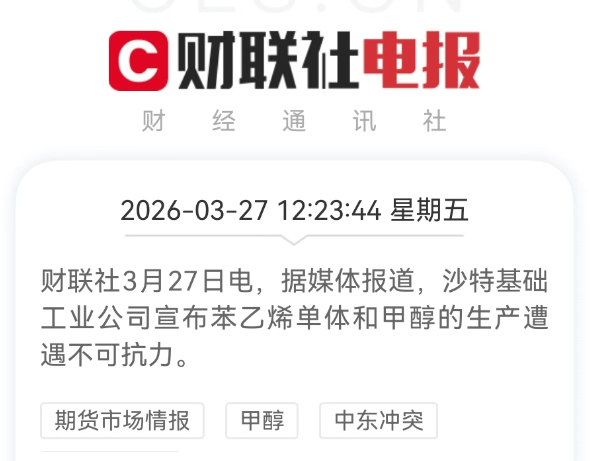
On the afternoon of March 27, according to Cailian News, Saudi Basic Industries Corporation (SABIC) announced that the production of styrene monomer and methanol has been affected by force majeure.
It is reported that SABIC owns the world's largest single methanol production base - the factory in Jubail, Saudi Arabia, with an annual capacity of 4.7 million tons, firmly controlling the core discourse power of global methanol supply. In the styrene field, SABIC is also very strong, with a total capacity of about 1.8 million tons.
The simultaneous force majeure on SABIC's two core products has directly led to an instant increase in the global supply gap for methanol and styrene.
Crisis Escalates: Uncontrollable Forces Spread Across the Middle East, Full Production Shutdown Inevitable
More notably, force majeure has spread comprehensively across Middle Eastern countries, entering a systematic and full-scale production halt phase!
From initial chemicals such as methanol and styrene to core petrochemical products including polyethylene, polypropylene, ethylene glycol, urea, and further to LNG and sulfur, the Middle East region is either facing a complete supply cutoff or experiencing extreme supply shortages, causing the entire supply chain to come to a complete halt! According to a Morgan Stanley report, this Middle Eastern production shutdown has triggered a global force majeure domino effect, impacting chemical companies across multiple countries in Asia and Europe.
The market has already reacted ahead of time: as of 15:00 on March 27, the main contract futures price of styrene rose to 10,431 yuan/ton, with a daily increase of 5.93%.
Industry insiders have issued a warning: if the Middle East situation cannot be eased promptly and production suspensions continue to escalate, the global supply gap for chemical raw materials will further widen, leading to sustained price increases that are easy to rise but difficult to fall. Downstream industries—including plastics, paints and coatings, fertilizers, automobiles, and home appliances—will face dual pressures of soaring costs and raw material shortages, potentially triggering a chain reaction of production halts and supply disruptions.
【Copyright and Disclaimer】The above information is collected and organized by PlastMatch. The copyright belongs to the original author. This article is reprinted for the purpose of providing more information, and it does not imply that PlastMatch endorses the views expressed in the article or guarantees its accuracy. If there are any errors in the source attribution or if your legitimate rights have been infringed, please contact us, and we will promptly correct or remove the content. If other media, websites, or individuals use the aforementioned content, they must clearly indicate the original source and origin of the work and assume legal responsibility on their own.
Most Popular
-
Deadly Impact: Hormuz Strait Blockade Sparks Shortage of Plastic Raw Materials, Threatening Shutdowns at Japanese and Korean Chemical Plants
-

BASF Delivers First Batch of Innovative Cathode Materials for Semi-Solid-State Batteries to Weilan New Energy
-

Middle East Triggers Widespread Force Majeure In Global Chemical Industry
-
LG Chem Shuts Down Yeosu Unit 2, Sparking Chain Shutdowns Across South Korea’s Petrochemical Industry
-
Not Just MDI! Huntsman and BASF Impose “War Surcharge” Across Europe


