Recent Innovations In Nylon Flame Retardant Technology And Market Layout
Recently, the nylon flame retardant sector has made significant progress in both technological innovation and market positioning, accelerating its shift toward high efficiency, halogen-free formulations, and multifunctionality.
I. Localization-driven Capacity Expansion by International Giants
International chemical giants are accelerating the transfer of their high-performance flame-retardant material production capabilities to Asia, particularly the Chinese market, in order to quickly respond to demands from sectors such as new energy vehicles and industrial automation.
BASF has announced that its Shanghai TPU (thermoplastic polyurethane) plant has commenced commercial production of the Elastollan® flame-retardant (FR) TPU product series. This initiative enables faster delivery and enhanced application development support for the Asia-Pacific region—particularly for the rapidly growing electric vehicle (EV) charging and industrial robotics cable industries. The series includes not only the existing halogen-free flame-retardant (HFFR) products but also newly introduced FR grades suitable for more demanding operating conditions.
II. Cutting-edge Research Achievements: Breaking the "Flame Retardancy-Mechanical Properties" Performance Bottleneck
Resolving the conflict between flame retardancy and mechanical properties is a core challenge in the industry, and recent studies have brought new insights.
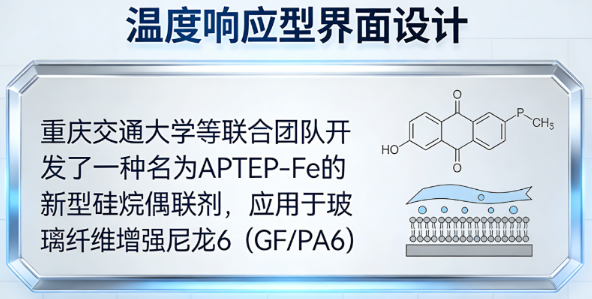
Thermoresponsive Interface Design: A joint team from Chongqing Jiaotong University and others developed a novel silane coupling agent named APETP-Fe, applied to glass fiber-reinforced nylon 6 (GF/PA6).
A clever mechanism: At a processing temperature of about 235°C, it can form a strong covalent bond with the nylon matrix, enhancing mechanical properties; when exposed to high combustion temperatures, it can rapidly catalyze the formation of a dense carbon layer on the fiber surface, effectively inhibiting the "wick effect."
Significant Implication: This strategy of “high-temperature catalytic char formation and low-temperature bond strengthening” provides a novel paradigm for simultaneously enhancing the flame retardancy and mechanical strength of composites.
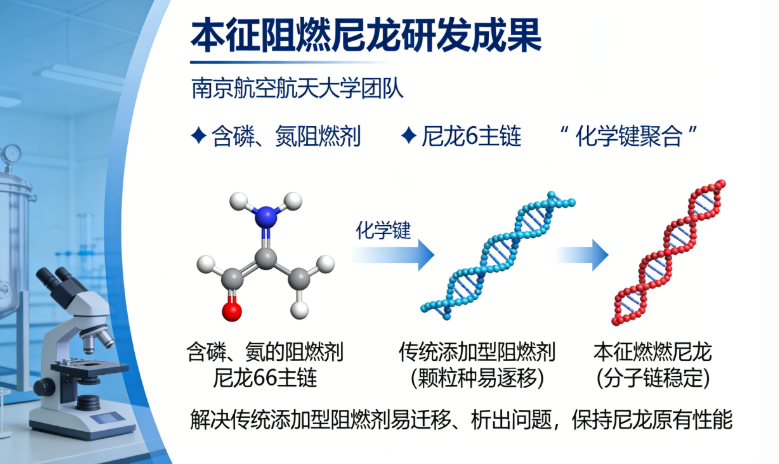
Reactive Intrinsic Flame Retardancy: A research team from Nanjing University of Aeronautics and Astronautics developed “intrinsically flame-retardant nylon” by chemically incorporating phosphorus- and nitrogen-containing flame retardants directly into the backbone of nylon 66 via covalent bonding. This approach fundamentally resolves the issues of migration and blooming commonly associated with conventional additive flame retardants, while maximally preserving nylon’s original excellent properties.
Efficient Halogen-Free New Product Release: In January 2026, US-based CAI Performance Additives launched a highly efficient halogen-free flame retardant named ST-MCA-H. This product is specifically designed for unfilled PA6 and PA66, capable of achieving UL 94 V-0 flame retardancy with as low as 4%-5% addition (conventional MCA typically requires a higher addition rate), effectively addressing the issues of decreased mechanical properties and surface blooming caused by high addition levels.
III. Application Expansion in the Industrial Sector and New Patents
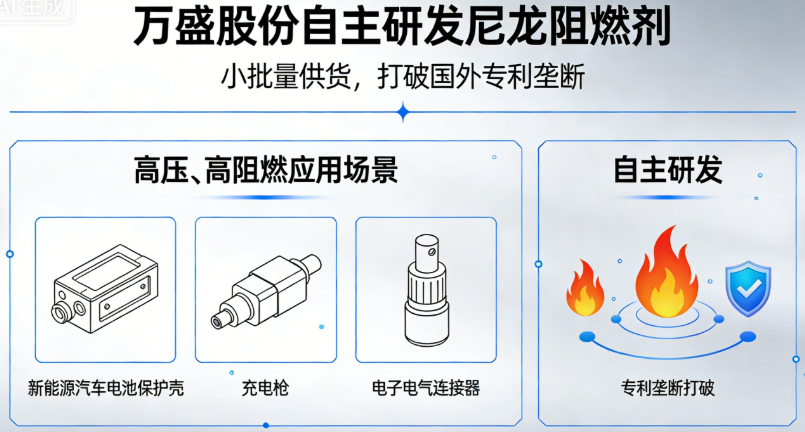
Domestic Substitution Accelerates: Recently, Wansheng revealed that its independently developed nylon flame retardant has achieved small-scale supply, successfully breaking the monopoly of foreign patents. The product mainly targets high-voltage, high-flame-retardant application scenarios such as battery protection shells, charging guns, and electrical and electronic connectors for new energy vehicles.
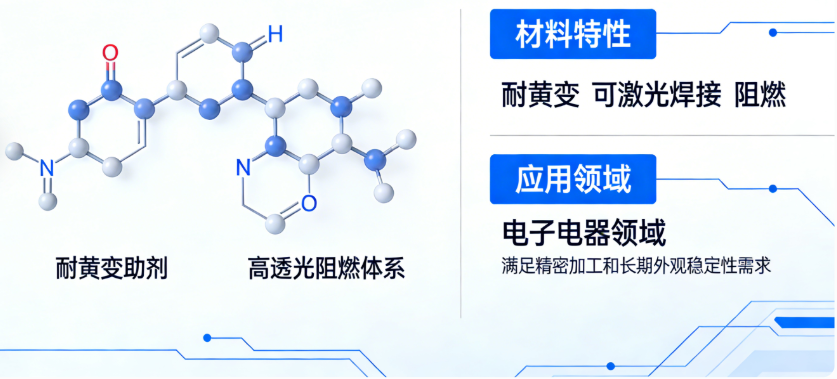
Multifunctional Integration Trend: Shanghai Prette Co., Ltd. has obtained an invention patent covering a flame-retardant nylon material possessing both yellowing resistance and laser-weldability. By incorporating specific yellowing-resistant additives and a highly transparent flame-retardant system into the formulation, this material meets the dual requirements of precision processing and long-term appearance stability in the electronics and electrical appliances sector.
Overall, innovation in the nylon flame retardant field is no longer limited to enhancing flame retardancy alone, but rather focuses more on achieving breakthroughs in the overall performance of materials through molecular design and interfacial engineering, and providing customized solutions for high-end application scenarios such as new energy vehicles, robotics, and 5G.
【Copyright and Disclaimer】The above information is collected and organized by PlastMatch. The copyright belongs to the original author. This article is reprinted for the purpose of providing more information, and it does not imply that PlastMatch endorses the views expressed in the article or guarantees its accuracy. If there are any errors in the source attribution or if your legitimate rights have been infringed, please contact us, and we will promptly correct or remove the content. If other media, websites, or individuals use the aforementioned content, they must clearly indicate the original source and origin of the work and assume legal responsibility on their own.
Most Popular
-

Middle East Triggers Widespread Force Majeure In Global Chemical Industry
-
Not Just MDI! Huntsman and BASF Impose “War Surcharge” Across Europe
-

Nike technology innovation and material application
-

BASF Delivers First Batch of Innovative Cathode Materials for Semi-Solid-State Batteries to Weilan New Energy
-

Deadly Impact: Hormuz Strait Blockade Sparks Shortage of Plastic Raw Materials, Threatening Shutdowns at Japanese and Korean Chemical Plants