



Oxazoline compatibilizer: How Is It Different From GMA, MAH, and MAA?
Oxazoline-type, glycidyl methacrylate (GMA)-type, maleic anhydride (MAH)-type, and methacrylic acid (MAA)-type compatibilizers are all reactive compatibilizers that “bridge” different polymers through chemical reactions. Their biggest difference lies in their respectiveFunctional groupThis determines their reactivity, applicable systems, and final performance.
To help you better understand, I have organized the main differences in the table below:
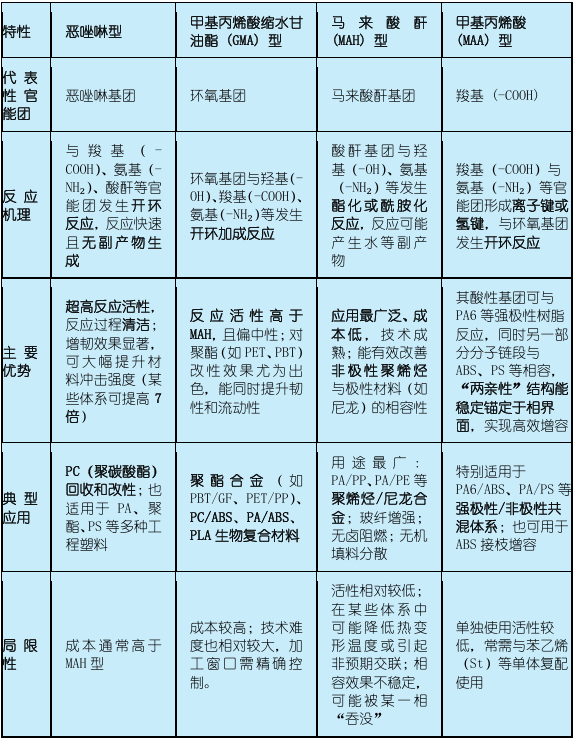
It should be noted that the above comparison is based on the typical characteristics of various functional groups, and the actual results may vary depending on the specific polymer system and processing conditions.
Detailed Interpretation and Application Recommendations
In order to make your selection clearer in practical applications, here is a selection guide for different working conditions:
Pursue ultimate performance and purity
If your application requires extremely high mechanical performance, or the product needs to be of high purity (such as for electronics, high-end consumer goods),Oxazoline typeIt is the best choice. Although the cost is relatively high, it can bring a 7-fold improvement in impact strength, and its by-product-free nature also avoids potential degradation risks.
🏭 Processing Polyester Systems and General Modification
When modifying polyester materials such as PET, PBT, and PLA,GMA typeIt is the preferred choice for performance and efficiency. Its epoxy groups exhibit high, relatively neutral reactivity with polyester end groups (-COOH/-OH), improving material toughness while also enhancing processing flowability, making it highly suitable for applications such as glass-fiber-reinforced polyester.
💰 Large-Scale Production and Cost Control
For cost-sensitive applications such as bulk polyolefin modification, glass fiber reinforcement, and wood-plastic composites.MAH typeIt is the "universal solution." Its technology is the most mature, its price is low, and its supply is stable, effectively addressing the interface issues between polyolefins and non-polar fillers.
🔬 Processing strongly polar/nonpolar blend systems
When dealing with “strongly polar–nonpolar” systems such as PA/ABS, the key is not how strong the reaction is, but whether it can be stably anchored at the interface. Although ordinary MAH-grafted products are highly reactive, they are easily “swallowed” by polar phases such as PA6. However,MAABecause of its unique amphiphilic structure, it can stably remain at the interface, making it a superior solution for this specific application scenario.
【Copyright and Disclaimer】The above information is collected and organized by PlastMatch. The copyright belongs to the original author. This article is reprinted for the purpose of providing more information, and it does not imply that PlastMatch endorses the views expressed in the article or guarantees its accuracy. If there are any errors in the source attribution or if your legitimate rights have been infringed, please contact us, and we will promptly correct or remove the content. If other media, websites, or individuals use the aforementioned content, they must clearly indicate the original source and origin of the work and assume legal responsibility on their own.
Most Popular
-

A Look at the Material Suppliers Behind SpaceX
-
Eastman France PET Depolymerization Plant: Project "Alive," But Construction Paused
-
Mitsubishi Chemical Plans To Split Petrochemical Business By 2028
-

Bola Carbon Black Announces Global Restructuring of Specialty Carbon Black and Multi-Walled Carbon Nanotube Business
-
Ethylene: Production Capacity Accelerates Expansion, Global Industry Landscape Is Being Reshaped


