



Oil Prices Rebound Sharply After Plunging 11% in a Single Week, While the Reopening of the Strait of Hormuz May Still Be a Long Way Off
Last week, driven by optimistic expectations after positive signals from the U.S.-Iran negotiations, international oil prices experienced a “cliff-like” plunge — with Brent crude futures prices falling by more than...11%…setting the worst weekly performance since mid-April. However, just a few days later, on June 1, the intraday gain of WTI crude oil futures prices once surged as high as…8%, while Brent crude oil futures rose by6.7%, touching $94.35 per barrel and $97.22 per barrel intraday, respectively.
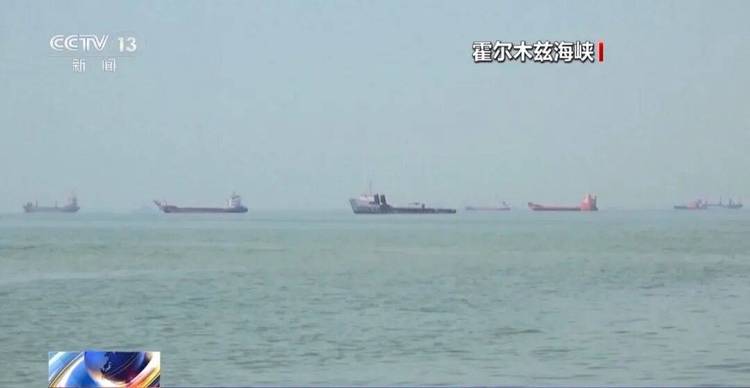
Image source: CCTV News
Overnight, market sentiment reversed completely.
It all began with a statement from Iran.
I. Deadlock: The “Illusion” of Progress in Negotiations
In late May, the indirect negotiations between the United States and Iran did indeed send some "positive signals."
On May 24, an anonymous senior U.S. official revealed that the United States and Iran had, in principle, reached an agreement that could end the war in the Middle East, but final approval from both leaders might take several days. U.S. President Trump declared on social media that Iran “very much wants to talk” and promised that the final outcome would be favorable to the United States and its allies. White House chief economic adviser Hassett even predicted that oil shipments would pass through the Strait of Hormuz within “one or two months.”
However, these optimistic statements were soon disproven by facts.
On key issues, the tug-of-war between the two sides has never truly been resolved.The first divergence is the conditions for the opening of the Strait of Hormuz.In a post on May 29, Trump demanded that the Strait of Hormuz “must be opened immediately in both directions, with no tolls, allowing shipping traffic to operate without restriction,” and claimed that the U.S. Navy’s blockade of the Strait of Hormuz was “about to be lifted.” However, the Iranian side clearly stated that there is no such clause in the text of the agreement, and that Iran will open the strait in accordance with prearranged arrangements, which may include monitoring and inspecting vessels.
The second point of disagreement concerns Iran’s uranium enrichment issue.Trump has repeatedly demanded that Iran hand over about 400 kilograms of uranium enriched to 60% and called for it to be “dug out and destroyed.” However, Iranian Foreign Ministry spokesman Baghaei reiterated that the current stage of negotiations between Iran and the United States focuses on ending the war and does not involve the specifics of Iran’s enriched uranium or uranium enrichment activities. The spokesperson for the National Security Committee of Iran’s parliament also said that, on the nuclear issue, Iran has made no commitments to the U.S.
The third disagreement concerns the issue of unfreezing funds.Iran has demanded that the United States unfreeze $12 billion of its frozen assets, and has stated that it will not enter any subsequent stage of negotiations until the funds are released. However, Trump claimed in a post that “there will be no transfer of funds.”
The root of the core divergence lies in the fundamental contradiction of the negotiation framework.The Iranian side has consistently maintained that the nuclear issue and the right to manage the Strait are not within the scope of the current negotiations; the current focus of the talks is to end the war. Trump, however, is trying to address both the disposal of nuclear materials and navigation through the Strait in the memorandum, so the two sides are not on the same track from the outset.
It was precisely these irreconcilable differences that kept statements about being “close to reaching an agreement” at the level of diplomatic rhetoric, foreshadowing the subsequent sharp deterioration of the situation.
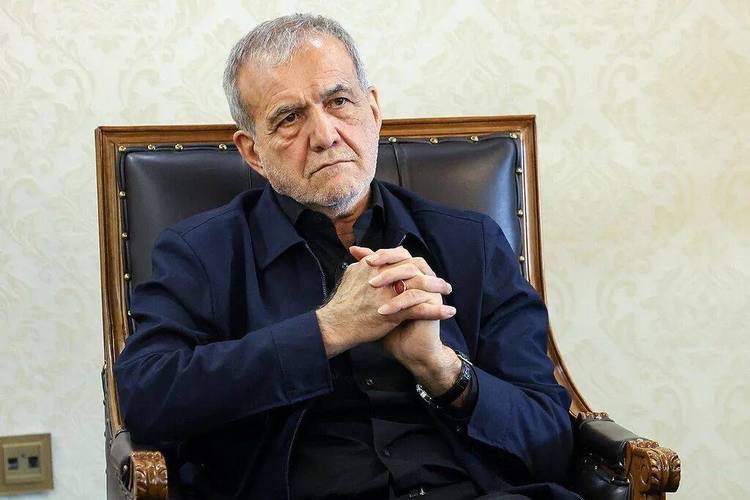
Iranian President Pezeshkian (file photo)
II. Breakout: Escalation of Blockades and Surge in Oil Prices
From late May to early June, the situation took a sharp turn for the worse. According to CCTV News, Iran launched a ballistic missile attack on a U.S. air base in Kuwait, injuring four American service members and three contractors. In response, U.S. forces carried out “defensive strikes” on radar and drone command-and-control facilities in Iran’s Goruk area and on Qeshm Island. Air raid sirens sounded across Kuwait.
Subsequently, Iran deployed its most crucial trump card.
June 1st,Iran suddenly announced a suspension of all indirect negotiations with the United States.The reason is that Israel has launched renewed strikes in Lebanon and the Gaza Strip. The Iranian negotiating delegation has halted “dialogue and the exchange of texts through intermediaries.” Israeli Prime Minister Benjamin Netanyahu has ordered the military to resume strikes on the southern suburbs of Beirut, and Israeli ground operations in southern Lebanon continue to expand.
What shocked the market even more was that,Iran simultaneously announced that it would completely block the Strait of Hormuz., and plans to open other “fronts,” including the Bab el-Mandeb Strait. Iranian Parliament Speaker Qalibaf issued a tough statement, saying: “The U.S. maritime blockade against Iran and Israel’s escalating war crimes in Lebanon clearly prove that the United States is not abiding by the ceasefire agreement. Every choice comes at a cost, and debts must eventually be repaid.”
As soon as the news broke, oil prices soared. On June 1, WTI crude oil futures prices surged by 7.01%, while Brent crude oil futures prices increased by 5.78%. On June 2, the WTI crude oil futures settlement price was reported at $92.16 per barrel, a rise of 5.49%; the Brent crude oil futures settlement price closed at $94.98 per barrel, up by 4.24%.
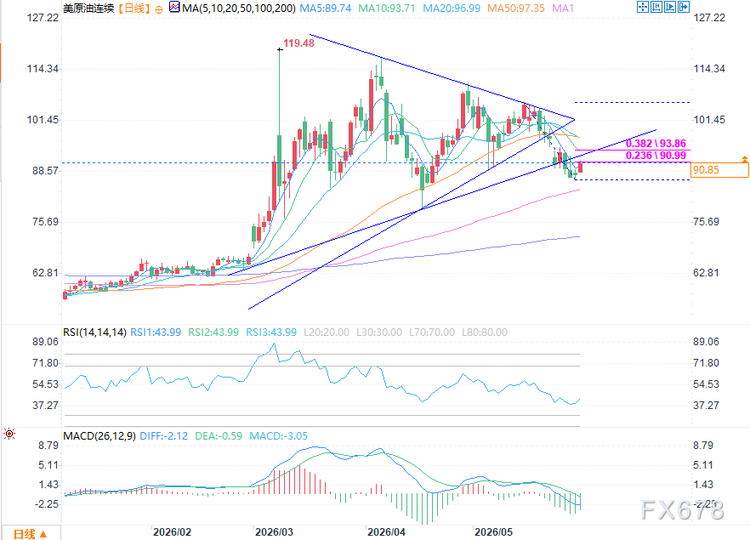
WTI Crude Oil Daily Chart Source: EasyForex
Even more alarmingly, Iran has also turned its attention to the Mandeb Strait. According to media reports, the commander of the Quds Force of the Iranian Islamic Revolutionary Guard Corps, Qani, hinted that the navigation conditions in the Mandeb Strait may be controlled similarly to those in the Strait of Hormuz. The Mandeb Strait is a vital passage connecting the Red Sea and the Gulf of Aden, through which approximately 12% of global oil transportation passed before the war. If both of the world's most important oil transport routes are obstructed simultaneously, the impact on global energy supply would be catastrophic.
3. Cooling: The Asian market is experiencing short-term pullbacks as it awaits the next shoe to drop.
After a night of emotional sell-off, oil prices saw a short-term technical pullback during the Asian session on June 2.
As of 3:30 PM Beijing time on June 2 WTI crude oil futures fell 0.98% intraday to $91.26 per barrel, after hitting a high of $92.65 and a low of $91.00 during the session. Brent crude oil futures (August contract) were quoted at $94.77 per barrel in early trading and fluctuated slightly within the $94–$95 range in the afternoon, with an overall decline milder than that of WTI.
In contrast,The main Shanghai crude oil futures contract remained relatively firm in afternoon trading.As of now, the price is 596.40 yuan per barrel, up 1.98%. During the session, it peaked at 621.5 yuan and fell to a low of 590.8 yuan. In early trading, the SC crude oil main contract opened at 594.0 yuan per barrel and briefly surged to 619.6 yuan. The domestic energy futures sector is generally performing strongly, with varieties such as liquefied gas and asphalt rising over 2%.
This price trajectory clearly reflects a shift in market sentiment: the sharp surge on the evening of June 1 was a stress response to the extreme geopolitical event of an “escalation of the blockade,” while the pullback during the Asian session on June 2 indicates that, after the initial panic, the market began to calmly assess the actual extent of any subsequent supply disruption and the direction of the strategic maneuvering among the parties involved. Both bulls and bears are waiting for the next concrete move by the United States and Iran—whether it will mean a further escalation of military confrontation or a return to the negotiating table.
IV. Standoff: The U.S.-Israel-Iran “Game of Chicken”
Why is the Strait of Hormuz so difficult to truly open? The answer lies in the deep logic of the game of interests among multiple parties.
Iran's strategy is very clear.The Strait of Hormuz is its core strategic leverage. Once it is opened for a few months, various countries will take the opportunity to replenish their crude oil inventories, significantly reducing the value of Iran's card. Therefore, Iran will use the blockade of the strait to maximize its benefits—both in terms of economic aspects such as the unfreezing of funds, and political aspects such as security guarantees.
From the actual data, Iran is not just making empty threats. Before the crisis, the Strait of Hormuz accounted for about 25% of global maritime oil trade and 20% of liquefied natural gas transportation, with approximately 20 million barrels of oil passing through daily. Analysis firm Piper Sandler pointed out that all feasible alternative routes (the Cape of Good Hope route, the Saudi East-West pipeline, and the Abu Dhabi oil pipeline) combined can only handle about 10 million barrels per day, leaving at least a 10 million barrel gap with no short-term solutions. The Strait of Hormuz could be essentially closed for six months, causing oil prices to reach new highs this summer. This structural dependence gives Iran significant leverage in negotiations.
The United States, meanwhile, faces a double dilemma.On the one hand, a surge in oil prices would sharply push up inflation and directly affect the midterm election outlook. Although Trump reportedly asked for revisions to the framework terms at last week’s White House Situation Room meeting, he still struggled to strike a balance between the need for “quiet negotiations” and the market’s need for certainty. On the other hand, Trump’s tough stance also limited room for compromise, as he continued to insist that Iran must “never be allowed to have nuclear weapons,” and hinted that if diplomatic efforts fail, the conflict could erupt again.
The United States is also exerting pressure on Iran through military means. According to CCTV News, U.S. Central Command stated that as of May 31, U.S. military maritime blockade operations against Iran had forced 118 commercial vessels to change course and disabled five vessels, affecting a total of 123 vessels. The U.S. military has also seized oil tankers linked to Iran in the Indian Ocean and used missiles in the Gulf of Oman to force cargo ships to alter their routes.
Israel is a third force that cannot be ignored. According to CCTV News, Israeli Prime Minister Netanyahu has ordered troops to cross the Jordan River and occupy key areas such as the Bofort Fortress. Israeli Chief of Staff Aviv Kohavi stated that the military's state of readiness "extends from the West Bank all the way to Tehran." Prime Minister Netanyahu discussed with U.S. President Trump the possibility of resuming military strikes against Iran. The Israeli side indicated that if the U.S. resumes military action against Iran, it is expected that the two countries will jointly launch airstrikes.
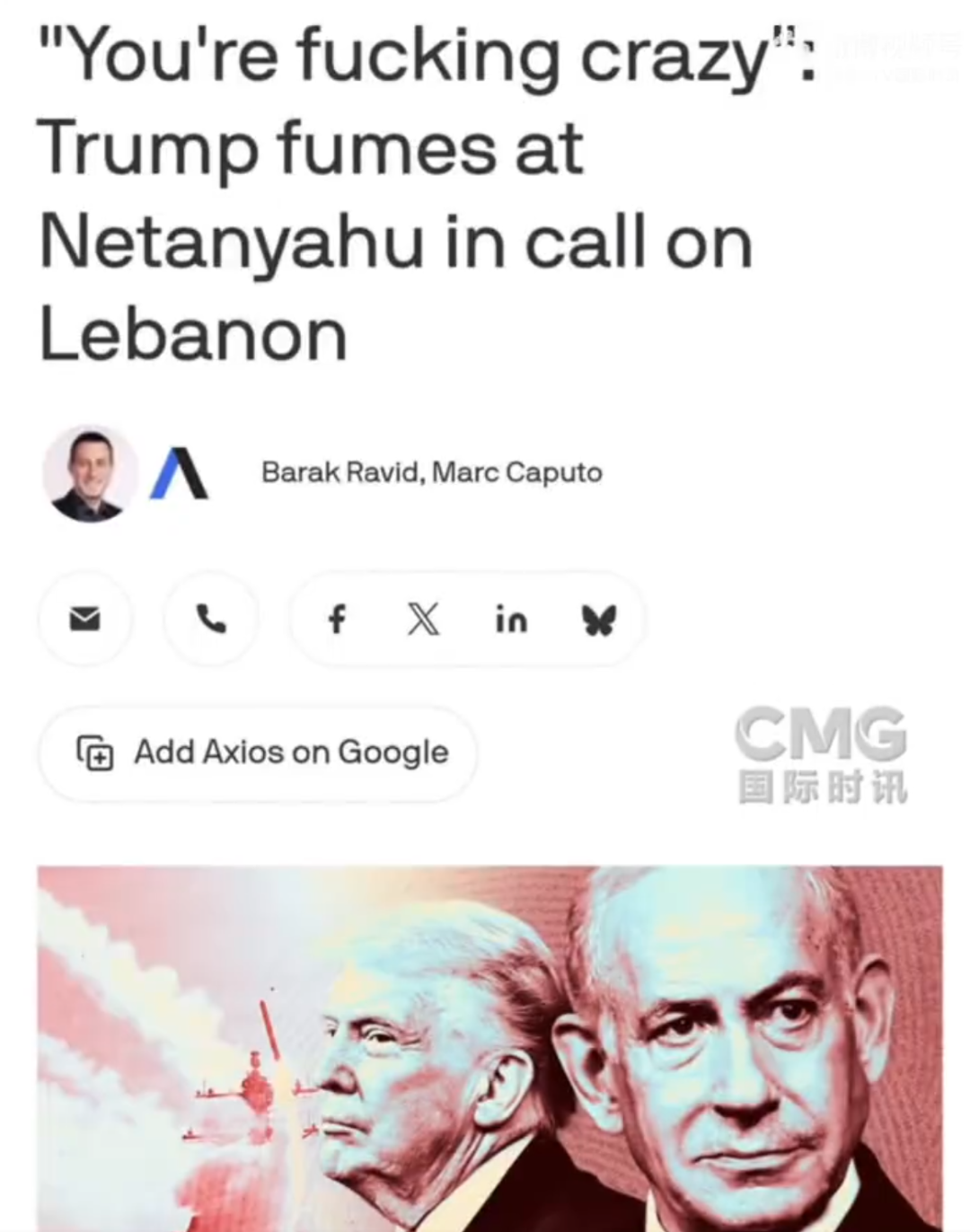
However, Trump was “deeply dissatisfied” with Netanyahu’s military escalation in Lebanon. Axios reported that during a phone call, Trump accused Netanyahu of “going too far,” even bluntly asking, “What the hell are you doing?” The reason is clear: Israel’s military actions are undermining the progress of U.S.-Iran talks, once again underscoring the complexity of the Strait of Hormuz issue, where a single move can affect the entire situation.
V. Impact: The Energy Predicament Spreads Across the Globe
The predicament in the Strait of Hormuz is not merely a geopolitical issue; its shockwaves have already deeply affected the entire world.
In Japan, well-known snack manufacturer Calbee has changed some of its potato chip packaging from color to black and white—not because of a redesign, but because color ink has become difficult to procure. In Sri Lanka, the electricity bill of a Chinese-owned company in Colombo has jumped from around 70,000 to 80,000 rupees a month to about 160,000 rupees, effectively doubling.
Global container shipping prices continue to soar, with vessel fuel costs skyrocketing by nearly 70%. UK shipping media warn that if the Channel cannot reopen soon, the market impact will further intensify.
If the peace talks ultimately break down, the consequences will be even more severe. Jorge Leon, the geopolitical analysis director at Resta Energy, warned: "If there is no agreement and hostilities between the U.S. and Iran resume, oil prices could reach $180 per barrel in August, which would trigger a severe global economic recession, particularly in Europe and emerging markets in Asia."
Returning to the question at the beginning of the article: when will the Strait of Hormuz truly reopen?
In the short term, before the core differences between the U.S. and Iran—namely the handling of Iran's enriched uranium, the scale of unfrozen funds, and the management of the Strait—are resolved, it seems difficult to see a truly "comprehensive opening." As Iranian Vice President Areef stated, "The security of the Strait of Hormuz is not free. Either ensure a free oil market open to all nations, or bear the risks that everyone will pay a huge price."
The sharp surge in oil prices on June 1 shows just how sensitive the market is to Iran’s “trump card.” Behind last week’s steep 11% weekly drop and this week’s one-day 8% spike is the market’s repeated swings between hopes that an agreement is close at hand and the reality that the blockade remains in place indefinitely. Yet even during this window of pressure on oil prices,Each side seemed to be engaged in a silent game of chicken.The United States is attempting to reach an agreement while maintaining maximum pressure on Iran, while Iran is using the Strait of Hormuz as an “attritional trump card” to maneuver against the United States. After more than 90 days of ceasefire, the fundamentals of the negotiations have not substantively changed: Iran retains enriched nuclear material, has the ability to continue blocking the Strait of Hormuz, and the costs of a military counterattack against the United States still remain.
When all rational bargaining fails to break the deadlock, the market’s answer may become more subtle: oil prices may not actually need to soar to $180 per barrel, but they may need to be pushed to a new “extreme threshold” — a red line that all sides can sense, yet dare not truly cross — in order to spur substantive action under external pressure.
Before that, the reopening of the Strait of Hormuz may still be a distant prospect.
【Copyright and Disclaimer】This article is the property of PlastMatch. For business cooperation, media interviews, article reprints, or suggestions, please call the PlastMatch customer service hotline at +86-18030158354 or via email at service@zhuansushijie.com. The information and data provided by PlastMatch are for reference only and do not constitute direct advice for client decision-making. Any decisions made by clients based on such information and data, and all resulting direct or indirect losses and legal consequences, shall be borne by the clients themselves and are unrelated to PlastMatch. Unauthorized reprinting is strictly prohibited.
Most Popular
-

A Look at the Material Suppliers Behind SpaceX
-
Eastman France PET Depolymerization Plant: Project "Alive," But Construction Paused
-
Ethylene: Production Capacity Accelerates Expansion, Global Industry Landscape Is Being Reshaped
-

Amer Sports Releases 2025 Sustainability Report, Apparel And Footwear Recycled Material Proportion Reaches 19.3%
-
Mitsubishi Chemical Plans To Split Petrochemical Business By 2028


