



Major Breakthrough! Chery Recycles 100% of End-of-Life Vehicle Plastics into New Body Panels
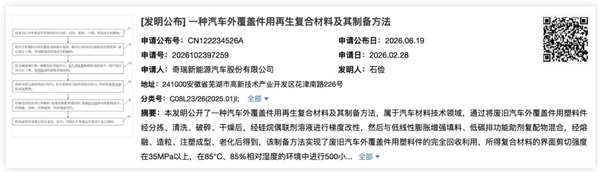
Recently, information from the China National Intellectual Property Administration shows that Chery New Energy Automobile Co., Ltd. has applied for a patent titled “A Recycled Composite Material for Automotive Exterior Covering Parts and a Preparation Method Thereof,” with the publication number CN122234526A and an application date of February 2026.
The patent abstract outlines a complete technical route: used automotive exterior plastic cover parts are sorted, cleaned, crushed, and dried, then subjected to gradient modification using a silane coupling agent solution, and mixed with a low linear expansion reinforcing filler and a low-carbon-emission functional additive blend. Finally, the mixture undergoes melt processing, pelletizing, injection molding, and aging treatment to obtain a recycled composite material.
The key breakthroughs of this technology lie in two points: first, the realization of using plastic parts from old car exterior coverings.Fully recycled No need to blend with virgin polymer.; second, the interfacial shear strength of the resulting composite material is above 35 MPa, and after a 500-hour aging test at 85°C and 85% relative humidity, the degradation rate of mechanical properties is controlled below 20%.
Why is it so difficult to "return to the outer cover"?
After end-of-life vehicles are dismantled, their plastic components can be sorted, crushed, and pelletized before entering the recycling process. However, for a long time, waste automotive plastics have more often flowed into low-value applications—being made into trash bins, flowerpots, plastic pallets, or used in downgraded ways. The real challenge is whether they can be returned to automotive components, especially to parts with higher requirements for performance and stability.
Automotive exterior panels not only have to meet basic mechanical performance requirements, but also must withstand changes in temperature and humidity, long-term aging, dimensional stability, surface appearance quality, and processing consistency. It is therefore clearly more difficult for recycled plastics to be used here than in ordinary injection-molded parts, filled parts, or low-end products. One real bottleneck is that many plastic components in automobiles contain glass fiber or other additives, and the wide variety of plastic types, with some materials used in combination, makes sorting more complicated. In addition, recycled plastics may contain residual paint, chemical contaminants, and impurities caused by mixed polymers, all of which can affect the performance of the final material.
A Twenty-Year Strategic Layout: From the Recycling End to the Materials End
Chery’s layout in the field of recycled materials began much earlier than this patent.
Public information shows that Anhui Ruisaike Renewable Resources Technology Co., Ltd., a wholly owned subsidiary of Chery, was established in 2004. Its main businesses include the recycling and trading of waste materials, end-of-life vehicle dismantling, and remanufacturing of automotive parts. In December 2006, Chery and Hefei University of Technology jointly established the Automotive Green Technology Research Center, which is dedicated to research on the use of environmentally friendly automotive materials and remanufacturing technologies for automotive parts. In March 2008, the National Development and Reform Commission approved the first batch of 14 pilot enterprises for automotive parts remanufacturing, and Chery was among them.
Ruisaike has gradually transformed from an early recycling enterprise into an integrated renewable resources company encompassing recycling, reprocessing, and remanufacturing. In May 2025, Ruisaike further completed the full “recycling–processing–regeneration” value chain.
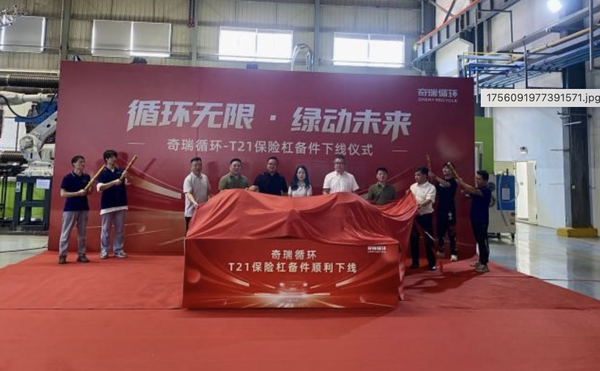
On August 20, 2025, the first bumper for the T21 model from Chery’s recycling unit using PCR (post-consumer recycled materials) successfully rolled off the production line, fully meeting requirements in key indicators such as process technology, material performance, and appearance quality. The entire process, from project initiation to product rollout, took more than four months, achieving a leap from zero to independent production.
Chery's exploration in the field of recycled materials is not limited to plastics. In 2025, Chery's independently developed "100% recycled aluminum · no heat treatment · integrated die-casting" technology won the China Regional Champion of the United Nations Industrial Development Organization's "Orange Economy Global Initiative 2025." This technology has achieved the use of 100% recycled aluminum in critical safety structural components of automobiles for the first time and has been scaled for application in Chery's mass-produced models. It is estimated that using this recycled aluminum material reduces carbon emissions at the material end by 80% compared to primary aluminum and reduces emissions at the manufacturing end by 97.5% compared to heat treatment processes.
In January 2026, Chery Automobile's zero waste-to-landfill system was awarded the "Diamond Level" certification by SGS, with a waste diversion rate of 99.27%. By the end of 2025, a total of 7 factories under Chery Group were included in the "No Waste Cell" list of Wuhu City, Anhui Province.
2026: Intensive Settlement and External Forces
Entering 2026, Chery's actions in the field of recycled materials have become more intensive.
On April 1, China Environmental United Certification Center and CATARC Data Co., Ltd. attended the launch meeting of Chery Automobile’s pilot project for recycled material evaluation in Wuhu, Anhui. The project aims to implement the provisions of the Ecological Environment Code on encouraging the promotion and application of recycled materials and establishing and improving standards and certification systems for recycled materials, with a focus on addressing the common industry challenge of how to calculate, evaluate, and certify recycled material content.
From May 27 to 28, the 2026 Automotive New Materials Conference was held in Wuhu. This marked the fourth consecutive year that Chery has co-hosted the conference, which attracted nearly 1,000 participants. In his remarks, Chery Chairman Yin Tongyue said that green materials are one of the nine core technological focus areas in Chery’s 15th Five-Year Plan. Chery continues to strengthen materials research, build an innovation system for materials, promote lightweight, low-carbon, and eco-friendly materials, and achieve recycling and reuse.
From June 11 to 13, at the 12th China (Shanghai) International Technology Fair, Chery, as the only invited automobile company by the United Nations Industrial Development Organization, showcased two green “black technologies”: 100% recycled aluminum and an in-vehicle carbon dioxide circular capture system.
The external policy environment is also accelerating. In January 2026, the National Development and Reform Commission, together with the Ministry of Industry and Information Technology, the Ministry of Finance, and four other departments, issued the Action Plan for Promoting the Application of Recycled Materials—the country’s first policy document specifically dedicated to advancing the application of recycled materials. It explicitly identifies the automotive sector as a key industry for promoting the use of recycled materials. The plan proposes that by 2030, annual output of recycled plastics should exceed 19.5 million tons. It also encourages automobile manufacturers to work with end-of-life vehicle dismantling companies, recycled material processors, and component manufacturers to jointly build a closed-loop supply system for recycled materials.
Meanwhile, the European Union is also tightening its requirements for recycled materials used in vehicles. In June 2026, the European Parliament adopted the relevant regulation, requiring that plastics used in new vehicles contain at least 15% recycled content within six years after the regulation takes effect, with this share rising to 25% within ten years, of which at least 20% of the recycled plastic must come from closed-loop recycling of end-of-life vehicles or old parts.
From “usable” to “user-friendly”
Automotive recycled plastics still face many challenges—insufficient feedstock supply, properties that still need to be improved, and inadequate chemical recycling capacity coupled with high costs. However, Chery’s practices show that through continuous technological innovation and a full value chain layout, it is not impossible for recycled plastics to return to high-value application scenarios.
From the establishment of Riserk in 2004 to lay out the recycling end, to becoming one of the country’s first remanufacturing pilot enterprises in 2008, to the rollout of PCR bumpers in 2025, and to the filing of a patent for recycled composite materials for exterior body panels in 2026—Chery has spent more than two decades attempting to build a closed-loop chain “from end-of-life vehicles to new cars.”
The “rebirth” of a discarded plastic cover plate reflects not only a carmaker’s long-term commitment to the circular economy, but also a technological leap for the industry from “functional” to “high-performing.” As Yin Tongyue said at the Automotive New Materials Conference: “Make products more competitive, make the brand climb higher, and make China’s manufacturing stronger, bigger, and greener.”
Editor: Winnie
【Copyright and Disclaimer】This article is the property of PlastMatch. For business cooperation, media interviews, article reprints, or suggestions, please call the PlastMatch customer service hotline at +86-18030158354 or via email at service@zhuansushijie.com. The information and data provided by PlastMatch are for reference only and do not constitute direct advice for client decision-making. Any decisions made by clients based on such information and data, and all resulting direct or indirect losses and legal consequences, shall be borne by the clients themselves and are unrelated to PlastMatch. Unauthorized reprinting is strictly prohibited.
Most Popular
-

A Look at the Material Suppliers Behind SpaceX
-
Next-generation motors of new energy vehicles: Single-Round Thousand Horsepower, Replacing Brakes, How Powerful Are They?
-

Evonik Parts Ways With The Polyester Business! A Strategic Retreat By A Germany Chemical Giant And The Global Industry Shift
-

United States Imposes 208.49% Tariff On Chinese Glass Fiber Products
-

Celanese Joins Forces With Aisan Industry to Reshape the Low-Carbon POM Competitive Landscape, Changing the Automotive Supply Chain


