Maintenance Wave Fails to Lift Weak Demand, Market Continues Shaky and Weak Pattern
In April, the domestic EVA market experienced a “sharp rally followed by a decline and subsequent oscillatory downward trend,” driven primarily by policy implementation and weakening demand. Entering May, frequent plant maintenance across the industry continues to support expectations of tight supply; however, demand shows no signs of recovery, intensifying the supply-demand tug-of-war.
In April 2026, the domestic EVA market experienced a “sharp rally followed by a decline and subsequent volatile downward trend,” driven primarily by policy implementation and weakening demand. At the beginning of the month, the official implementation of the policy canceling export tax rebates for photovoltaic products led to the dissipation of the earlier “rush-to-order and stockpiling” benefits, quickly plunging the market into a demand vacuum and triggering a rapid retreat from elevated price levels. Although mid-month expectations of supply contraction emerged amid concentrated maintenance shutdowns at multiple major production facilities, sluggish downstream operating rates and weak spot demand left the market in a stalemate. By month-end, widespread bearish sentiment culminated in intensified price adjustments, as traders increasingly offered discounts to accelerate sales—completely overwhelming any bullish support from maintenance-related supply constraints. Entering May, maintenance activities across the industry remain widespread, sustaining expectations of relatively tight supply; however, no signs of demand recovery have emerged, further intensifying the supply-demand standoff. Consequently, the market is highly likely to continue its volatile, slightly weakening trend.
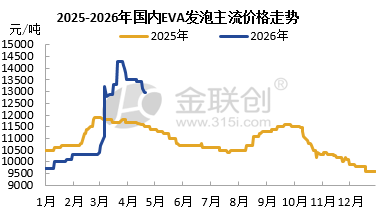
Data Source: JLC
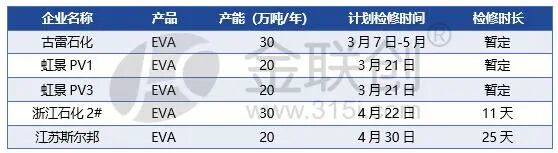
In April, the domestic EVA market prices showed an overall downward fluctuation, presenting a clear trend of "decline at the beginning of the month, stagnation in the middle of the month, and continued decline at the end of the month."At the beginning of the month, the policy eliminating export tax rebates for photovoltaic products officially took effect on April 1st, marking the end of the pre-April rush to place orders and build inventory in March. Downstream demand quickly weakened, acceptance of high-priced cargoes plummeted, and traders began cashing out and exiting the market, triggering a decline from elevated price levels. Mid-month, supply-side support emerged as multiple major production units, including Gule Petrochemical and Jiangsu Hongjing, entered scheduled maintenance, keeping industry operating rates low and providing some price support. However, weak demand persisted, with only minimal spot purchases from genuine needs. Traditional sectors such as foaming and footwear entered their off-season, resulting in sluggish end-user orders and restrained buying. Downstream buyers remained cautious, placing only small, essential orders, leading to a stalemate between supply and demand and causing prices to fluctuate within a narrow range amid persistently thin trading volumes. By month-end, pessimistic sentiment spread across the market, with bearish expectations dominating market participants' outlook. Traders increasingly offered discounts to accelerate sales and secure cash flow, prompting prices to soften once again.
EVA Plant Maintenance Schedule in China for March–April 2026
Data source: JLC
Entering May,The EVA industry is seeing an increasingly strong maintenance atmosphere, with the supply side continuing to be tight. The maintenance at Gulei Petrochemical is extended to the latter half of May, multiple facilities at Jiangsu Hongjing remain shut down, Yangzi Petrochemical has started a long-term maintenance until July, and Zhejiang Petrochemical has also initiated a phased maintenance. This keeps the industry's operating load at a low level. On the raw material side, the prices of ethylene and vinyl acetate are affected by fluctuations and shipping disruptions, making the cost support highly uncertain, with some facilities facing the risk of raw material replenishment. The supply of imported goods is limited, and overseas supplies are being diverted to the Southeast Asian market, making it difficult to alleviate the tight domestic spot market.
Demand remains weak.Both the photovoltaic (PV) and traditional downstream sectors are under pressure. In the PV sector, following the cancellation of export tax rebates, EVA/POE film manufacturers have slowed their inventory buildup, purchasing only to meet immediate demand and showing clear resistance to high prices; thus, their operating rates remain low. In traditional sectors—such as foam and footwear materials—demand is stable, but end-market orders lack highlights; downstream buyers are cautious, with no plans for large-scale inventory buildup, and small, demand-driven orders are insufficient to provide meaningful support. Traders are highly cautious and remain bearish, adopting conservative inventory management strategies, further dampening trading activity.
Overall, the EVA market in May showed a pattern of "tight supply support and weak demand drag," with a generally weak and fluctuating trend.Photovoltaic-grade EVA, influenced by weak demand, is more likely to fall than rise, while general-grade EVA, amid the interplay of maintenance and demand, maintains a range-bound fluctuation. In the short term, after the restart of the Gulei Petrochemical plant in the latter half of May, supply will marginally increase, and with no hope of demand recovery, the weak pattern may be further reinforced. Industry players need to cautiously control inventory and avoid risks.
【Copyright and Disclaimer】The above information is collected and organized by PlastMatch. The copyright belongs to the original author. This article is reprinted for the purpose of providing more information, and it does not imply that PlastMatch endorses the views expressed in the article or guarantees its accuracy. If there are any errors in the source attribution or if your legitimate rights have been infringed, please contact us, and we will promptly correct or remove the content. If other media, websites, or individuals use the aforementioned content, they must clearly indicate the original source and origin of the work and assume legal responsibility on their own.
Most Popular
-

Continental Plans to Begin Sale of ContiTech in Early 2026
-

Recycled PE/PP Morning Outlook: Market Expected to Remain Weak Within Range
-
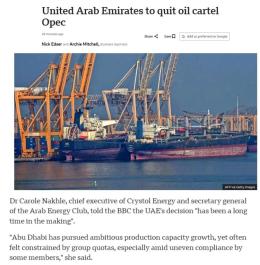
Uae abruptly withdraws from opec! price hike wave sweeps across everything—from t-shirts and sofas to smartphones
-

From passive response to proactive service: IFLYTEK Redefines the Intelligent Cockpit Paradigm
-
Mianbi Intelligence and Wutong Technology Deepen Collaboration