Macroeconomic Impact Dull, Polypropylene Enters Fundamental Competition Stage
Introduction: Currently, the geopolitical premium in international crude oil is gradually declining, and the macroeconomic impact on commodities has significantly weakened. The polypropylene market has officially moved away from the macroeconomic-driven trend, shifting towards a new phase. Supply and Demand Fundamental pricing phase of the market. In the short term, propylene supply has bottomed out and is entering an upward trend, while downstream operating rates remain generally weak and show little sign of recovery. As a result, the supply-demand balance is gradually shifting toward looseness, and prices are likely to be driven primarily by fundamentals, with a relatively high probability of trading sideways with a downward bias.
Supply Bottoms Out; Polypropylene Enters a Phase of Gradual Recovery
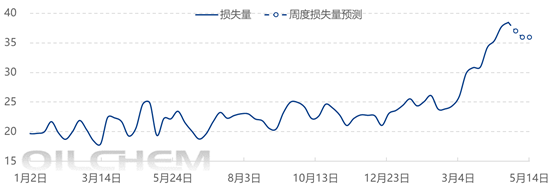
Figure 1: Weekly Maintenance Loss Forecast for Polypropylene in China
Data source: Longtou Information
From the operation of the facilities, the maintenance loss of domestic polypropylene has reached a high level. With the restart of multiple main facilities, the supply side is expected to gradually recover. Jineng Chemical's first line, Zhejiang Petrochemical's second line, and Shanghai Sinopec's facilities, which were previously under maintenance, are scheduled to restart. Only a few facilities, such as Zhenhai Refining's fourth line and Guangzhou Petrochemical's third line, are planned for maintenance. The overall maintenance loss is expected to decline slightly, but it will still remain at an absolute high level.
From an industry production perspective, energy security remains a core consideration for refining and petrochemical enterprises. As geopolitical risk premiums in international oil prices retreat, corporate production margins are gradually recovering, concurrently boosting both the willingness to commission new facilities and restart older ones. Based on integrated capacity utilization data forecasts, domestic polypropylene industry capacity utilization is expected to rebound to around 64% next week, shifting supply conditions from prior contraction toward marginal ease and becoming one of the key variables influencing market trends.
Downstream operations mostly declined, reducing the consumption capacity for raw materials.
Table 1: Operating Rate Changes of Major Downstream Industries of Polypropylene in China
|
Product |
This issue |
Previous Issue |
Fluctuation Range |
Next direction |
|
Plastic Weaving |
42.74% |
42.94% |
Reduce by 0.20 percentage points |
↑ |
|
Daily-use injection-molded PP |
52.54% |
52.98% |
Decrease by 0.44 percentage points |
↑ |
|
BOPP |
63.16% |
63.44% |
Decrease by 0.28 percentage points |
↓ |
|
PP Pipe material |
39.48% |
39.72% |
Reduce by 0.24 percentage points |
↑ |
|
PP Non-woven fabric |
41.05% |
41.50% |
Reduce by 0.45 percentage points |
↓ |
|
CPP |
45.70% |
46.40% |
Reduce by 0.70 percentage points |
↑ |
|
PP Transparent |
45.07% |
43.67% |
Increase by 1.40 percentage points |
↑ |
|
Modified PP |
66.20% |
66.41% |
Reduce by 0.21 percentage points |
↓ |
The operating rates of major downstream industries for domestic polypropylene showed a generally declining trend in this period, with only the transparent grade sector experiencing a slight increase, indicating obvious industry differentiation. The decline in downstream operations was mainly driven by three factors: first, the previous increase in raw material prices raised production costs for companies, and after consuming low-cost inventory, the transmission of high-cost raw materials was blocked; second, the end market showed low acceptance of high-priced products, resulting in insufficient orders, and companies slowed down their procurement and production pace; third, the uncertain future trends of raw materials led downstream companies to maintain low inventory levels, resulting in weak raw material consumption capacity.
PP The increase in the production of transparent materials against the trend is mainly due to the boost from holidays, with a short-term increase in orders for food packaging and daily transparent products, which supports a slight increase in industry production. Overall, in the context of a lack of strong support from supply and demand, the overall production recovery space for downstream industries is limited, and it is difficult for the raw material demand side to form an effective pull.
Future macro impact weakening, polypropylene enters supply-demand pricing situation
Figure 2: China Polypropylene Price Forecast Chart
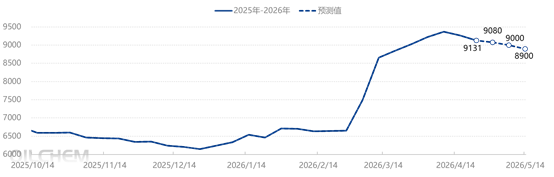
Currently, market optimism regarding the easing of geopolitical tensions has been repeatedly volatile. Iran has strengthened its control over the Strait of Hormuz, reigniting concerns about shipping disruptions and pushing Brent crude oil prices back above the $100/barrel mark. Driven by this, polypropylene futures halted their decline and edged higher starting Wednesday, while spot market trading levels also rose passively.
However, from a fundamental perspective, this round of price increase lacks real demand support. Under the high raw material prices, the downstream sector shows insufficient capacity to absorb the pressure, and enterprises remain reluctant to proactively replenish inventories. The operational model of purchasing only for immediate needs results in a slow inventory reduction process. Meanwhile, the supply side has reached its bottom, and with the gradual resumption of previously shut-down facilities, industry supply is entering a recovery phase. The marginal slackness in the supply-demand balance is gradually opening up, and the premium support from geopolitical conflicts is rapidly weakening. The pricing power is gradually diminishing, and the market is expected to face a fundamental-driven pricing scenario in the short term, with the market center likely to move slightly downward.
In summary, the short-term polypropylene market exhibits a pattern of supply bottoming out and rebounding, overall weak downstream demand with regional divergence, and a gradually loosening supply-demand fundamentals. Coupled with diminishing macro impacts, prices will primarily hinge on fundamental dynamics, trading within a range with a downward bias. Going forward, close attention should be paid to three key variables: the progress of plant restarts, the strength of downstream order recovery, and the pace of social inventory drawdown, as they will collectively determine the timing and magnitude of short-term polypropylene price movements.
【Copyright and Disclaimer】The above information is collected and organized by PlastMatch. The copyright belongs to the original author. This article is reprinted for the purpose of providing more information, and it does not imply that PlastMatch endorses the views expressed in the article or guarantees its accuracy. If there are any errors in the source attribution or if your legitimate rights have been infringed, please contact us, and we will promptly correct or remove the content. If other media, websites, or individuals use the aforementioned content, they must clearly indicate the original source and origin of the work and assume legal responsibility on their own.
Most Popular
-

Why did a century-old european dental instrument giant relocate its manufacturing hub to china?
-

$4 Billion! Medtronic Makes Another Acquisition
-

Toray Industries and SGL Carbon Establish Carbon Fiber Supply Partnership for Aerospace Sector
-
Profit and Revenue Growth Struggle to Conceal Debt Repayment Pressure; Success of Kingfa Sci & Tech's High-End Strategy Yet to Be Seen
-
Deadly Impact: Hormuz Strait Blockade Sparks Shortage of Plastic Raw Materials, Threatening Shutdowns at Japanese and Korean Chemical Plants