



Longbai’s Annual Net Profit Plunges Over 40% Amid Production Capacity Utilization Far Exceeding Industry Average and Stable Domestic Market Share at No. 1
Hui Zheng Information, Long Bai Group, a major global titanium dioxide producer, has released its 2025 annual report. The report shows that the company achieved a revenue of 25.969 billion yuan in 2025, a decrease of 5.61% year-on-year; the net profit belonging to the listed company's shareholders was 1.245 billion yuan, a significant decrease of 42.61% year-on-year. Affected by multiple factors such as a loose global titanium dioxide market supply, export obstacles, and rising raw material costs, the company's performance is under significant pressure. However, at the low point of the industry cycle, Long Bai Group is accelerating the promotion of overseas factory construction, overseas asset acquisitions, and other international layouts, aiming to achieve a new round of growth through global operations.
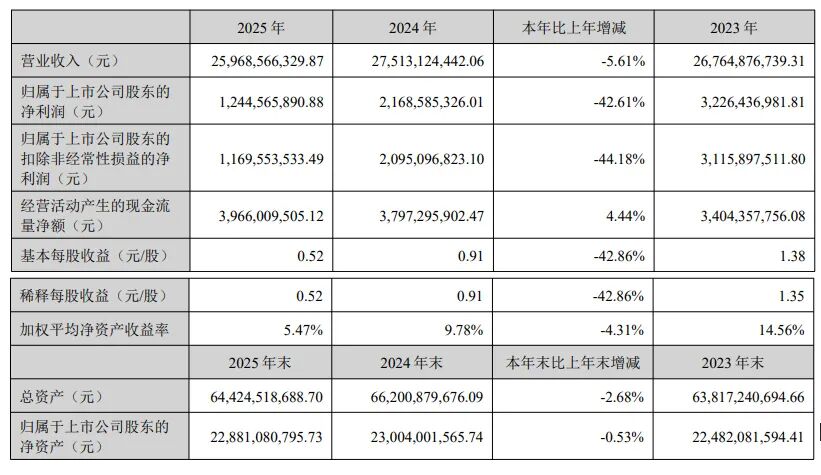
Supply-demand imbalance and rising costs squeeze profits
In 2025, the global titanium dioxide market experienced an overall downward fluctuation. Multiple countries and regions, including the European Union, Brazil, and India, successively imposed anti-dumping measures on Chinese titanium dioxide, while the United States further increased tariffs on Chinese imports. These escalating global trade barriers significantly exacerbated structural oversupply, dealing a substantial blow to Longbai Group, whose business model is predominantly export-oriented. During the reporting period, the company’s titanium dioxide segment generated revenue of RMB 16.857 billion, a year-on-year decline of 11.18%, and its gross margin dropped sharply from 31.35% in the prior-year period to 23.04%, a decrease of 8.31 percentage points.
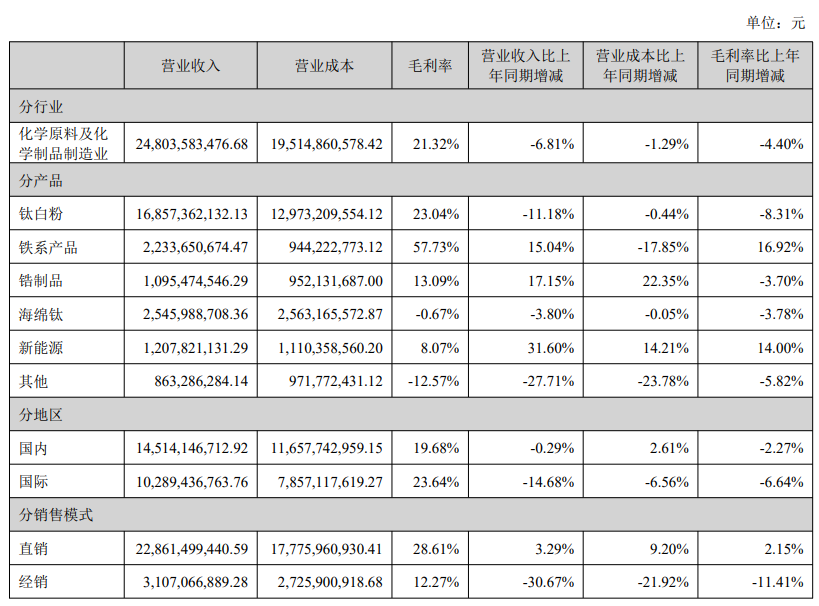
Meanwhile, severe volatility in the upstream raw materials market further eroded profit margins. Financial statements show that the prices of sulfur and sulfuric acid—key raw materials for titanium dioxide—surged dramatically during the reporting period, significantly impacting production costs. Specifically, the procurement price of sulfur soared from RMB 1,876.67 per ton in the first half of the year to RMB 2,424.43 per ton in the second half. Weak demand coupled with rigid cost increases created a double squeeze, driving the company’s overall gross margin down to 21.32%, a decline of 4.40 percentage points compared to 2024.
84.53% operating rate exceeds the industry average
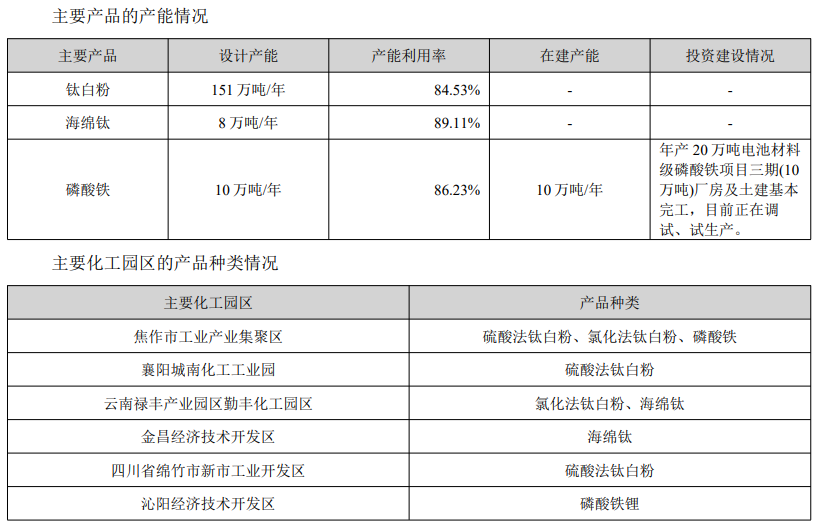
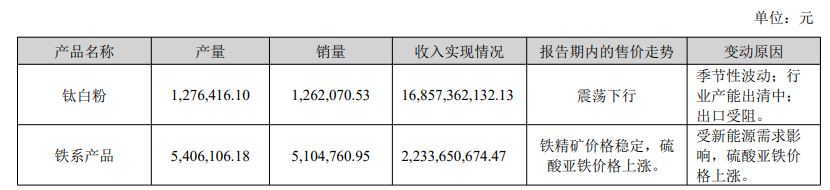
In 2025, Longbai Group's titanium dioxide production capacity utilization rate reached 84.53%, significantly exceeding the industry average. During the reporting period, the group produced 1.2764 million tons of titanium dioxide, maintaining its leading position in global production capacity rankings. The company sold 1.2621 million tons of titanium dioxide throughout the year, an increase of 0.60% compared to the previous year, with international sales still accounting for a large share of 54.51%. The new energy materials sector performed notably well, generating revenue of 1.208 billion yuan, an increase of 31.60% year-on-year. Production and sales of iron phosphate increased by 72.17% and 58.93%, respectively, demonstrating the resilience of the second growth curve. However, the sponge titanium sector was affected by market structural adjustments, with its gross profit margin turning negative to -0.67%, reflecting the industry's contradiction of "excess at the lower end and shortage at the higher end."
From 2020 to 2025, the company's titanium dioxide production volume increased steadily from 817,000 tons to 1,355,000 tons, with sales and production volumes showing consistent annual growth, fully demonstrating the counter-cyclical advantages of its large-scale, low-cost, and integrated production model.
Market share: approximately 26% in China, over 17% globally
Buy chemicals and plasticsThe top five titanium dioxide producers in China account for about 49% of the domestic market. Longbai Group leads with a market share of 26%, significantly ahead of the second-place company, China Nuclear Titanium White (about 9%). Eight companies with production capacities of 200,000 tons or more account for 58% of the total domestic capacity, while 37 small enterprises with capacities of 150,000 tons or less remain, showing a clear "small and scattered" characteristic in the industry's tail end.
From a global perspective, Lomon Billions Group has a market share of 17%. At the 2025 World Manufacturing Convention, the Marketing Director of Lomon Billions publicly stated that the company's global market share has reached 17%, and its market share in the Asia-Pacific region has reached 20%.
Accelerating overseas capacity expansion to counter trade barriers
Faced with the severe international trade situation, accelerating global layout has become the core strategic focus for Longbai Group in 2025. To get closer to overseas end markets and avoid trade frictions, the company is accelerating its overseas production layout in Malaysia, the UK, and other regions.
During the reporting period, the company has identified Malaysia as the first overseas location for establishing a factory, and the "Construction of a 200,000 tons/year Titanium Dioxide Post-treatment Green Factory in Malaysia" project has completed the environmental assessment approval. Meanwhile, the company, through its subsidiary BLM Europe, is actively acquiring the titanium dioxide business-related assets held by Venator UK, aiming to enrich the product matrix of chloride process titanium dioxide. The financial report clearly states: "This acquisition will help the company advance its global industrial layout... truly achieving a fundamental leap from 'leading in China' to 'global leader'."
In addition, the company completed the strategic investor share repurchase of Yunnan Guotai Metal Co., Ltd. within 2025, further enhancing its control over the company. Yunnan Guotai has now become the core operating entity of the group's sponge titanium business, maintaining independent operations in production and R&D.
Integrated cost reduction and technological innovation build a moat
Amidst a sluggish industry climate, Longbai Group strengthens its cost advantage by leveraging a vertical integration and horizontal coupling green economy model. The company uses the by-product ferrous sulfate generated from sulfuric acid process titanium dioxide production as raw material for lithium iron phosphate cathode materials, achieving a "titanium-lithium coupling" industrial closed loop, effectively reducing the production costs of the new energy sector.
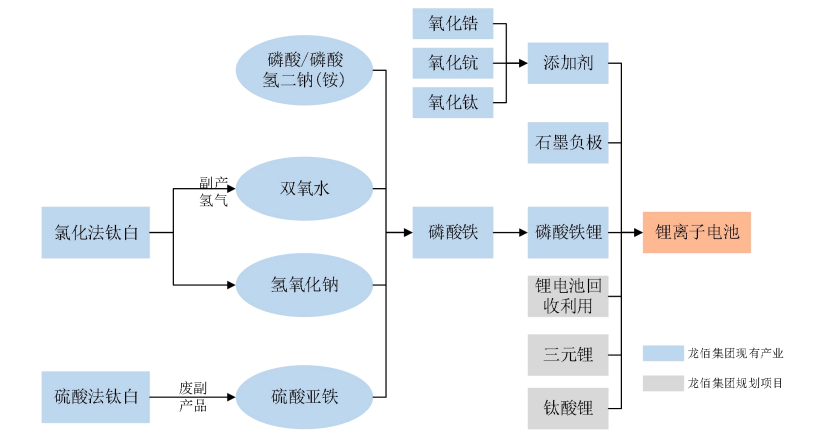
At the technological innovation level, the company disclosed that its R&D investment in 2025 reached RMB 1.134 billion, accounting for 4.37% of its operating revenue. During the reporting period, the company successfully completed technological breakthroughs in fourth-generation high-density lithium iron phosphate and sponge titanium specifically designed for 3C applications; some projects have entered pilot-scale testing or industrial validation stages.
Outlook for 2026: Q1 performance remains sluggish; awaiting industry consolidation.
Looking ahead to 2026—the opening year of the 15th Five-Year Plan—Longbai Group has set development goals centered on advancing the “joint development of the two mines in the North Hongge Mining Area” and the “Xujiagou Iron Mine project” to strengthen its self-sufficiency in upstream raw materials. Meanwhile, in 2026, the company has accelerated the actual operation of its overseas assets to diversify risks associated with reliance on a single market and enhance its global market share.
However, with the release of the company's first-quarter 2026 report, the short-term operating pressure has not eased. Data shows that in the first quarter of 2026, the company achieved revenue of 7.154 billion yuan, representing a 1.42% year-over-year increase; however, the net profit attributable to shareholders was only 187 million yuan, a significant 72.74% decline year-over-year. The company's report attributed the decline mainly to a drop in titanium dioxide prices and high costs of raw materials such as sulfuric acid. According to Mobaikusu Research Institute, the titanium dioxide industry is still in a bottom period characterized by "excess supply and high costs." Although titanium dioxide prices have recently rebounded, the industry's loss-making ratio continues to expand. Amid ongoing capacity elimination and accelerated elimination of marginal enterprises, Longbai Group, leveraging its comprehensive cost control advantage and early-mover advantage in global layout, is likely to benefit first in the next industry cycle.
The company will navigate the current cyclical downturn through diversified measures, including further increasing the proportion of chloride-process production capacity, optimizing operational efficiency at overseas bases, and accelerating R&D of vanadium-titanium energy storage materials.
【Copyright and Disclaimer】The above information is collected and organized by PlastMatch. The copyright belongs to the original author. This article is reprinted for the purpose of providing more information, and it does not imply that PlastMatch endorses the views expressed in the article or guarantees its accuracy. If there are any errors in the source attribution or if your legitimate rights have been infringed, please contact us, and we will promptly correct or remove the content. If other media, websites, or individuals use the aforementioned content, they must clearly indicate the original source and origin of the work and assume legal responsibility on their own.
Most Popular
-
Continental Plans to Begin Sale of ContiTech in Early 2026
-
Recycled PE/PP Morning Outlook: Market Expected to Remain Weak Within Range
-
Uae abruptly withdraws from opec! price hike wave sweeps across everything—from t-shirts and sofas to smartphones
-
From passive response to proactive service: IFLYTEK Redefines the Intelligent Cockpit Paradigm
-
Mianbi Intelligence and Wutong Technology Deepen Collaboration


