Global Sea Freight Sparks Another “Price Surge Storm”: What Impact Will It Have on Chemical Companies?
As soon as June began, the global shipping market was hit by a new round of “price hikes.” Several leading shipping companies collectively announced freight rate increases, while peak season surcharges (PSS) were also raised. Freight rates on many routes have doubled outright, and the surge in ocean freight costs has had a direct impact on the global chemical industry chain. As a result, many domestic chemical companies are facing operational pressure, with cost pressures rapidly being passed downstream along the industrial chain.
Data from the Ningbo Shipping Exchange shows that the freight rate index for the Europe route rose by 3.6% week-on-week, the U.S. East Coast route rose by 9.0%, the U.S. West Coast route rose by 7.2%, and the India-Pakistan route surged by as much as 45.4%, making it a truly “all-round rally.” The daily charter rate for very large crude carriers has jumped from $43,000–$58,000 to over $200,000, an increase of nearly fourfold.
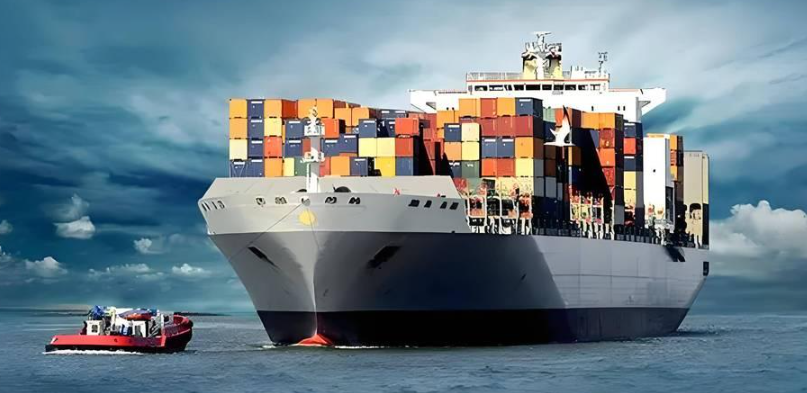
“Due to the suspension of navigation in the Strait of Hormuz, charterers are undergoing a dual restructuring of supply chain patterns and pricing systems,” said Chen Yang, general manager of Xinde Marine News.
Maersk announced that from June 1, it will impose a surcharge on shipments from Greater China to West Africa (excluding Senegal). “Since the outbreak of the Middle East conflict, Maersk’s monthly fuel costs have doubled to about $500 million, but these additional costs have now been fully ‘passed on’ to customers through surcharges and fuel adjustment mechanisms,” said Maersk CEO Vincent Clerc.
As a vital global energy corridor and a key transportation hub for global chemical products, any disruption to shipping through the Strait of Hormuz would directly impact the stability of the global chemical industry chain. It is reported that several domestic chemical companies, including Wanhua Chemical, Miracll Chemicals, Huafon Group, and LB Group, have successively raised prices, with cost pressures rapidly being passed downstream along the industry chain.
In the second quarter, the global tire industry has seen a new wave of widespread price increases. According to incomplete statistics, more than 80 tire manufacturers at home and abroad have already followed suit in adjusting their prices. The reasons given for the increases are basically the same: the prices of major raw materials used in tire production have remained high, while costs for freight, logistics, energy, and other expenses have continued to rise, significantly increasing the overall manufacturing cost of tires.
Liu Guanmin, a chemical industry researcher at the COFCO Futures Research Institute, also noted that in the second quarter, soaring insurance costs for shipping through the Strait, obstructed vessel passage, and significantly extended transportation cycles directly pushed up the risk premium on global energy and chemical products, leaving China’s entire polypropylene industry chain in a passive predicament marked by rising raw material costs, production losses, and weakening demand.
"The current round of sea freight rate increases is likely to continue until the end of the third quarter," said Xie Fulong, General Manager of Wan Hai Shipping. Industry insiders also indicated that it will be difficult for freight rates to drop in the short term. For chemical companies under pressure, the best approach is to plan ahead and manage costs meticulously, so as not to let freight charges "eat away" the hard-earned profits.
Currently, the factors determining the prices of chemical products are expanding from "raw material costs + supply and demand relations" to "raw material costs + logistics risks + inventory safety + policy variables + downstream acceptance capacity." Chen Yang believes that, for the chemical market, it is essential to focus on whether the prices of crude oil and natural gas continue to experience high volatility, whether key shipping routes such as the Strait of Hormuz restore stability, and whether freight and insurance costs decline in the near future.
Facing the sharp surge in shipping costs, domestic enterprises are taking proactive measures to respond to this round of impact based on their own realities.
Hebang Biotechnology stated on the interactive platform that, in view of the sharp fluctuations in ocean freight rates and the long lead times for shipping capacity scheduling during periods of tight logistics, the company has established an ocean shipping team to improve logistics efficiency and achieve cost control for minerals and Indonesian glyphosate. Jiang Sujie, General Manager of Shenghui Chemical, said that the company is actively working on cost reduction and efficiency improvement, optimizing formulations, and promoting energy conservation and emissions reduction to tap internal potential. Gao Feng, Chairman of Shandong Taimao Chemical Technology Co., Ltd., also said that the company adheres to the business philosophy of “being responsible to customers” and promises not to raise prices within six months, in order to maintain long-term and stable customer relationships.
【Copyright and Disclaimer】The above information is collected and organized by PlastMatch. The copyright belongs to the original author. This article is reprinted for the purpose of providing more information, and it does not imply that PlastMatch endorses the views expressed in the article or guarantees its accuracy. If there are any errors in the source attribution or if your legitimate rights have been infringed, please contact us, and we will promptly correct or remove the content. If other media, websites, or individuals use the aforementioned content, they must clearly indicate the original source and origin of the work and assume legal responsibility on their own.
Most Popular
-

A Look at the Material Suppliers Behind SpaceX
-
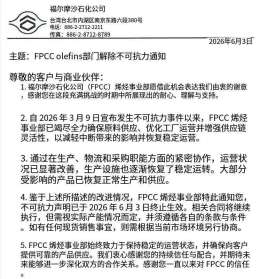
Breaking news! formosa petrochemical olefins division lifts force majeure! asia olefins supply and demand dynamics face another reversal
-
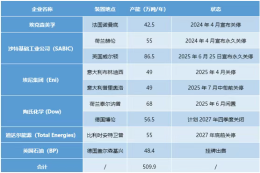
Ethylene: Production Capacity Accelerates Expansion, Global Industry Landscape Is Being Reshaped
-
Breaking News! Suzhou Fuyang Chemical Explosion! Exclusive Analysis By Plastics World Of 4 Major Impacts On The Chlor-Alkali Industry Chain
-

Target To Reduce Plastic By 30%! South Korea Enters Plastic Recycling Controversy, Involving National Interests