



Four Consecutive Limit-Up Days! Despite a Huge Loss of 6.9 Billion Yuan, Sinochem International Still Pushes Ahead With Acquisition! Can It Stage a Comeback by Riding the PPE Boom?
The booming AI and 5G industries have driven strong demand for high-end specialty resins, and China’s domestic PPE sector is now seeing major capital moves.
On the evening of June 10, Sinochem International (600500.SH) officially disclosed its Report on the Issuance of Shares to Purchase Assets and Related-Party Transaction (Draft). The company plans to issue approximately 601 million shares at RMB 3.51 per share to its controlling shareholder, Bluestar Group, to acquire 100% equity interest in Nantong Xingchen Synthetic Material Co., Ltd. for a total transaction consideration of RMB 2.11 billion. Upon completion, Bluestar Group will hold a 14.35% stake in Sinochem International, with the shares acquired subject to a three-year lock-up period.
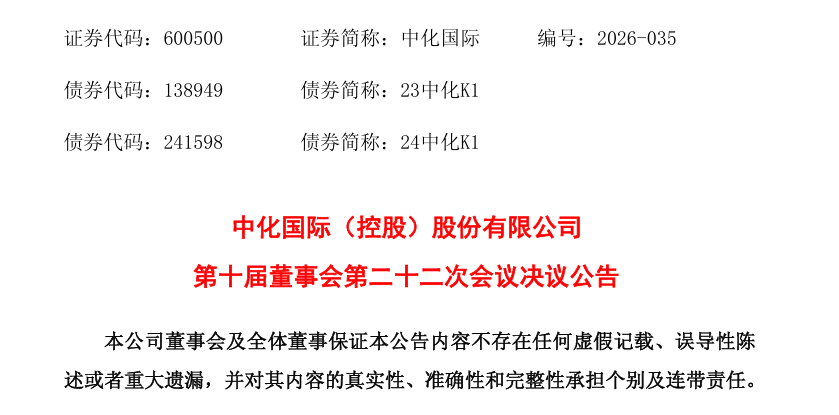
Image source: Sinochem International
Why is the market sensitive to this acquisition?
Sinochem International’s acquisition has drawn considerable market attention. On the morning of June 11, Sinochem International hit the daily limit-up immediately at the open, with its “one-line limit-up” pattern showing no sign of loosening. Buy orders at the limit exceeded 890,000 lots, and its market value surpassed 25.8 billion yuan. On June 12, Sinochem International hit the limit-up again, marking its fourth consecutive daily limit-up.
Nantong Xingchen was established in August 2000 with a registered capital of RMB 800 million. It has Nantong Zhonglan Engineering Plastics Co., Ltd. under its umbrella, as well as three branches in Ruicheng, Wuxi, and Specialty Materials. Its main products include fine chemical products such as polyphenylene ether (PPE), PBT engineering plastics, epoxy resin, and bisphenol A. Its major customers include Kingfa Sci. & Tech., subsidiaries of BASF, and enterprises affiliated with Sinochem China.
As of the date of signing of the draft, Nantong Xingchen had a total production capacity of over 500,000 tonnes, including 150,000 tonnes of bisphenol A, 160,000 tonnes of epoxy resin, and 72,000 tonnes of PBT,Basic PPE: 50,000 tons; specialty PPE: 780 tons (1,500 tons under construction).and 56,100 metric tons of modified engineering plastics.
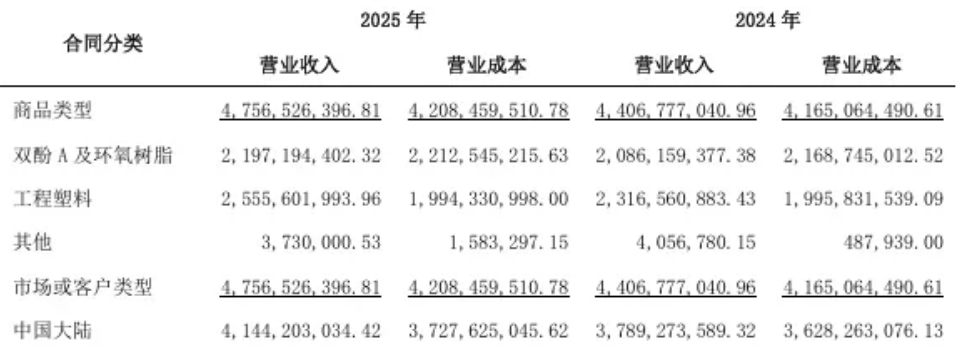
Figure: Breakdown of operating revenue and operating costs disclosed by Nantong Xingchen (Source: Nantong Xingchen)
What really excites the market is the PPE line.
Nantong Xingchen is China’s first PPE manufacturer, with 50,000 tons of general-purpose PPE production capacity, ranking first in China and second globally, and isThe world’s only manufacturer that simultaneously masters both the solution method and precipitation method, the two major mainstream PPE synthesis processes.In addition, the company is also constructing a 1,500-ton special polyphenylene ether renovation project and a new production line with a capacity of 10,000 tons.
The performance structure is undergoing subtle changes: the engineering plastics sector (including PPE and PBT) is projected to generate revenue of 2.556 billion yuan in 2025, with a gross margin of 22%; while the gross margin for the bisphenol A and epoxy resin sector is only -0.70%. Currently, Nantong Xingchen's profitability is almost entirely reliant on the engineering plastics sector, and PPE, especially specialty PPE, is the core support for that sector.
The two PPE markets are completely different.
Polyphenylene ether (PPE, also known as PPO) is a thermoplastic engineering plastic with exceptionally comprehensive performance: it has high temperature resistance (with a heat distortion temperature exceeding 190°C), excellent electrical insulation properties, dimensional stability, and extremely low water absorption. It exhibits minimal dielectric loss in high-frequency and high-speed transmission scenarios.These features make it one of the core substrates for high-speed copper-clad laminates (CCL) used in 5G base stations and AI servers.
It is precisely for this reason that PPE has formed two distinctly different markets:
General-grade PPE (high molecular weight)The main downstream applications are engineering plastics for automotive, home appliances, and industrial equipment. Global production capacity is concentrated among a few giants such as SABIC, Asahi Kasei, and Mitsubishi Gas Chemical, with Nantong Xingchen holding a leading position in China.
Electronic-grade (specialty) PPE (low molecular weight)This is a special type of copper-clad laminate for 5G/AI high-frequency circuits. This niche market has higher technical difficulty and fewer suppliers, with about 95% of the global market share concentrated in three companies: SABIC, Asahi Kasei, and Mitsubishi Gas Chemical. In China, only a few companies such as Shengquan Group (605589), Dongcai Technology (601208), Yinhai Technology (300221), and Nantong Xingchen can supply on a large scale, and the overall production capacity is insufficient at less than ten thousand tons.
It was precisely at this juncture that an unexpected incident instantly put the entire industry on edge.
Since the beginning of this year, due to natural gas supply issues, the global major PPE resin supplier SABIC has seen its production capacity limited by 25%-30%. Coupled with the situation in the Middle East driving up toluene costs,The price of specialty PPE monomers has risen from 650,000 yuan/ton to 1,000,000 yuan/ton.According to data from the China Chemical Information Center, domestic demand for electronic-grade PPE is expected to reach 2,600 tons in 2026, and the main domestic manufacturers with mass production capability are Shengquan Group and Nantong Xingchen.
The Three Layers of Logic Behind the Acquisition
Next, let’s look at the logic behind the acquisition.
Image source: Sinochem International
The first layer is strategic considerations.
In May 2021, the State-owned Assets Supervision and Administration Commission of the State Council merged Sinochem Group and ChemChina to form Sinochem Holdings. At the time, the group had a large number of similar assets scattered across different subsidiaries—Sinochem International (600500.SH) and China National Bluestar (Group) Co., Ltd. both held assets in epoxy resin, bisphenol A, and engineering plastics, creating a typical horizontal competition scenario. To address this, Sinochem Holdings made a clear commitment in 2021 to steadily advance the integration of the relevant assets and businesses within five years and resolve the issue of horizontal competition. Sinochem International’s acquisition of Nantong Xingchen is a concrete step by Sinochem Holdings to fulfill this five-year commitment.
The second level concerns performance considerations.
Sinochem International recorded a cumulative net loss attributable to shareholders of RMB 6.908 billion from 2023 to 2025, while the cumulative net loss attributable to shareholders after deducting non-recurring gains and losses was even higher at RMB 8.172 billion. In the first quarter of 2026, the net loss attributable to shareholders still amounted to RMB 216 million, and revenue continued to decline by 10.23% year on year.
Against this backdrop, Nantong Xingchen recorded a net profit of RMB 256 million in 2025, up 560% year on year. Bluestar Group also provided a four-year performance commitment for the transaction: if the transaction is completed in 2026, Nantong Xingchen’s committed net profits for 2026 to 2028 will be no less than RMB 345 million, RMB 367 million and RMB 388 million, respectively; if the transaction is postponed and completed in 2029, the committed net profit for that year will be no less than RMB 341 million. Compensation will be made first with the shares received in this transaction, with any shortfall made up in cash.
This means that Sinochem International, by issuing shares and without using cash, has locked in a guaranteed minimum profit of more than RMB 1.099 billion over the next three years. For a listed company that has suffered losses for three consecutive years, this is not only an industrial strategic move, but also a practical tool for repairing its financial statements.
The third layer is the puzzle piece of the industrial chain finally coming together.
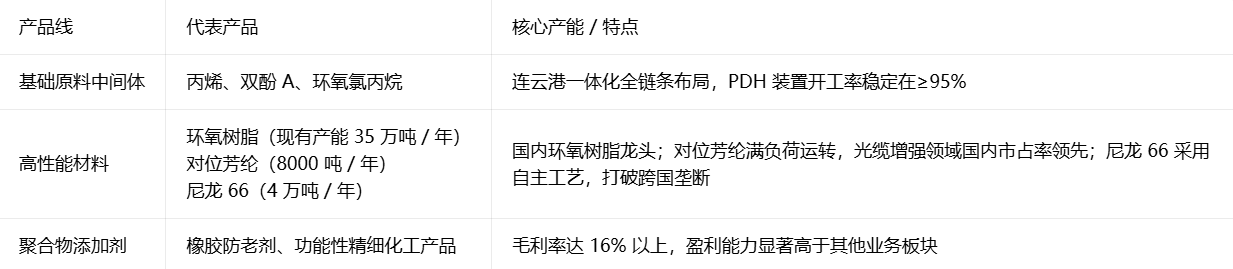
Figure: Main categories of materials of Sinochem International currently.
After integration is completed, Sinochem International will establish a complete industrial chain of “bisphenol A → epoxy resin → engineering plastics → modified materials.” Specifically, this will be reflected in:
Epoxy resinExisting capacity of 350,000 tons/year + Nantong Xingchen approximately 160,000 tons/year, after merging approximately 510,000 tons/year, will rise to the top.No. 1 in China;
Engineering plasticsAdd Nantong Xingchen’s PPE (50,000 tons/year, ranking first in China), PBT, and modified materials to form a full-coverage system encompassing ABS, PA, and PPE.
Increased self-sufficiency rate of bisphenol ANantong Xingchen itself also has bisphenol A production capacity. After the merger, its combined bisphenol A capacity will exceed 630,000 tonnes, significantly improving the self-sufficiency ratio across upstream and downstream operations and effectively offsetting the erosion of epoxy resin gross margins caused by fluctuations in bisphenol A prices.
Two concerns worth noting.
Overall, this acquisition enables Sinochem International to complete its chemical industry chain, secure stable profits, and capitalize on the opportunity to enter the booming specialty PPE segment. However, opportunities and challenges coexist:
1. The Quagmire of Bisphenol A
The other side of Nantong Xingchen is its bisphenol A and epoxy resin business. In 2025, the combined revenue from these two segments will account for 46.26%, but the gross profit margin is only -0.70% (compared to -3.96% in 2024). Sinochem International itself has a bisphenol A production capacity of 480,000 tons, but the capacity utilization rate is only 64.34%. After the merger, the combined bisphenol A capacity will exceed 630,000 tons. In the context of lackluster demand for downstream epoxy resin and polycarbonate, how to enhance the profitability of this capital-intensive segment is a significant challenge.
2. The competitive window for specialized PPE is closing.
The expansion speed on the supply side has already led industry institutions to lower their expectations. Shengquan Group, Dongcai Technology, and Yinhai Technology have successively advanced their capacity expansion plans; in February 2026, Kangda New Materials and Shanghai Jiarong announced new capacity additions; Jingteng Haohua has plans for a 10,000-ton expansion; whether the restart of SABIC's Dutch plant with a capacity of 32,000 tons remains uncertain.
Nantong Xingchen itself also admits in the draft prospectus that market supply will remain ample over the next five years, putting pressure on product prices, which are expected to decline year by year. The global consulting firm Prismark forecasts that demand for specialty PPE will grow at a compound annual rate of about 28% over the next five years, but some manufacturers have already begun cutting prices to seize future market share. Industry insiders expect that once the capacity of new facilities is gradually brought on stream in 2027, supply and demand will basically be balanced.
This means that the window for high-priced PPE is only about one and a half to two years.
Whether the brief window of opportunity can be seized and underperforming assets revitalized will be key to determining the success or failure of this multi-billion acquisition.
Editor: Lily
Source:
【Copyright and Disclaimer】This article is the property of PlastMatch. For business cooperation, media interviews, article reprints, or suggestions, please call the PlastMatch customer service hotline at +86-18030158354 or via email at service@zhuansushijie.com. The information and data provided by PlastMatch are for reference only and do not constitute direct advice for client decision-making. Any decisions made by clients based on such information and data, and all resulting direct or indirect losses and legal consequences, shall be borne by the clients themselves and are unrelated to PlastMatch. Unauthorized reprinting is strictly prohibited.
Most Popular
-

A Look at the Material Suppliers Behind SpaceX
-

Government's Triple Action, Enterprises' Three Arrows in Five Days, Semiconductor Reshuffle! What Signal Does Japan's Chemical Industry Release?
-
Global Chemical Giants Accelerate Production Capacity Restructuring, Dow and Celanese Optimize Global Industry Layout
-
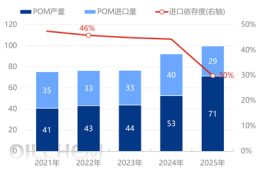
Name change without tax change: POM Anti-Dumping Duty Rate Inheritance Implemented
-
Fire breaks out at jiangsu meiside!


