EU Project Provides Lightweight Bio-Composites For Sustainable Transport
The EU-funded forest project has developed lightweight bio-composites for automotive, aerospace, and bus applications, achieving up to a 35% weight reduction while maintaining performance and safety standards.
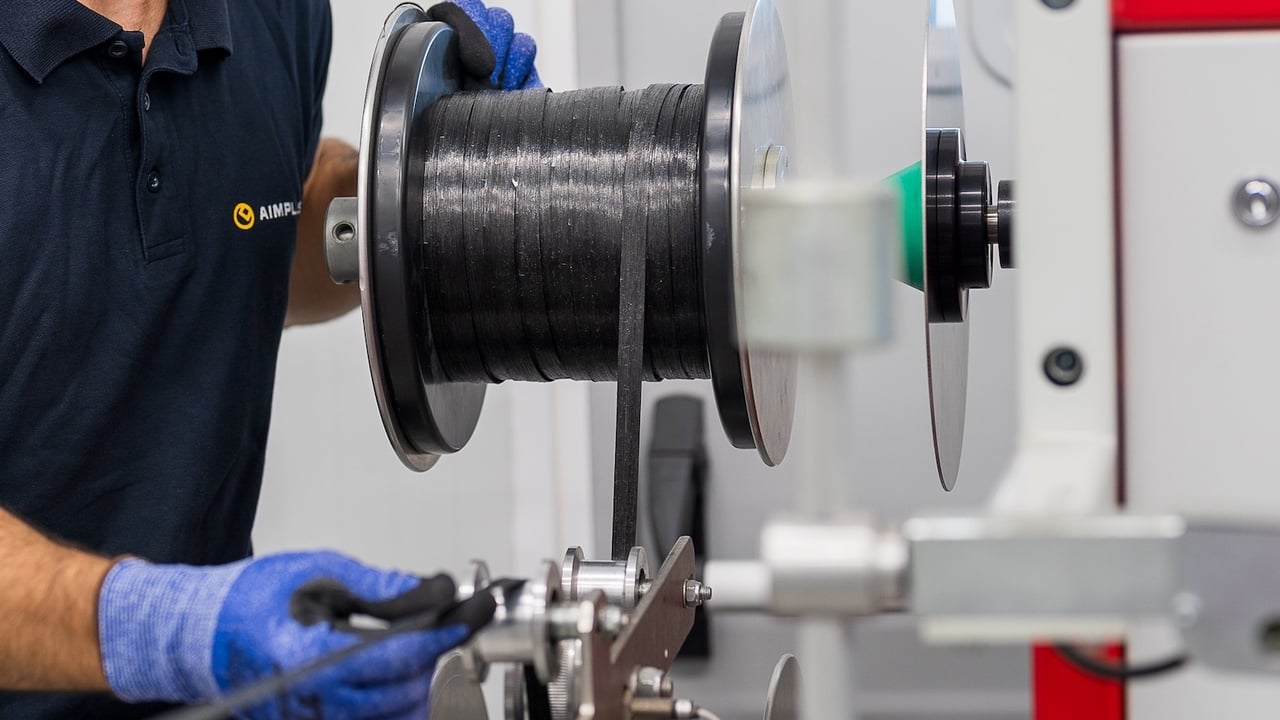
Reducing vehicle weight is one of the most effective ways to improve transport efficiency and reduce emissions. In this context, the EU-funded FOREST project, coordinated by the Spanish Plastics Technology Center Aimplas, has developed and validated advanced lightweight bio-composites for automotive, aerospace, and bus applications. These materials achieve up to a 35% weight reduction compared to traditional components, while maintaining performance, safety, durability, and electromagnetic interference shielding.
The project results demonstrate that it is possible to develop transportation components containing more than 50% sustainable materials by combining bio-based raw materials, recycled carbon fibers, and functional additives, without compromising performance, safety, or industrial feasibility.
Manufacturing Efficiency and Sustainability
Compared with traditional methods, the optimization of biocomposite processing reduces energy consumption by 15–20%, driven by accelerated curing chemistry that shortens cycle times by 20–40%, a one-shot manufacturing approach that eliminates intermediate processing steps, and the removal of frozen storage requirements. Furthermore, engineering costs are reduced by 15–20% through simplified tooling, fewer mold iterations, and improved process robustness.
“The [Forest Project] demonstrates that sustainability, lightweight design, and safety are not competing goals. Fernando Ramos, coordinator of the Aimplas Forest Project, stated: ‘By integrating bio-based chemistry, recycled carbon fiber, and multifunctional performance, we are reshaping advanced composites for the future of mobility.’”
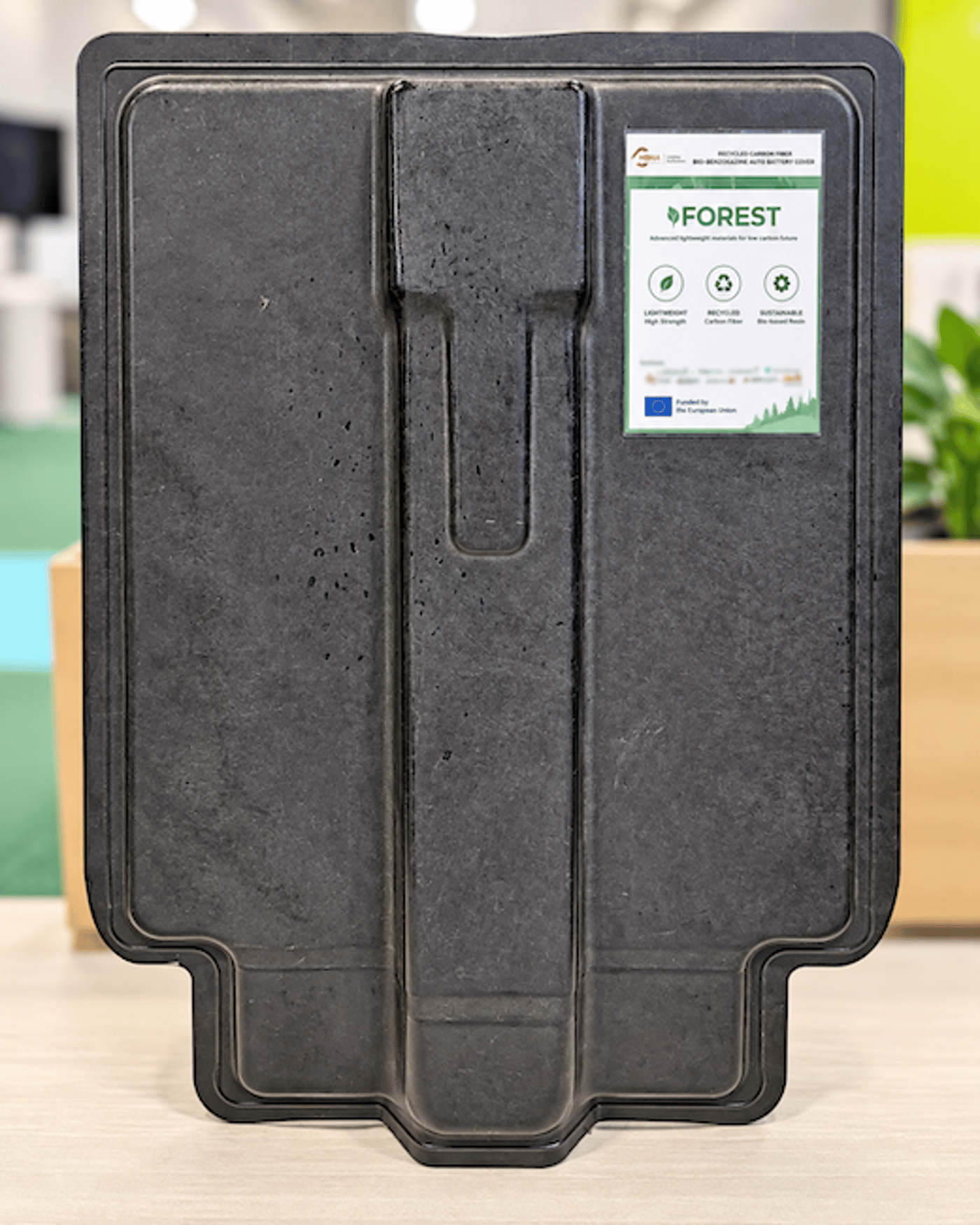
The AnEV battery cover, developed in collaboration with Stellantis, is one of the bio-composite outcomes of the Forest project. Image provided by Aimplas.
Real-world proof
To demonstrate the industrial feasibility of the developed materials and manufacturing processes, the Forest project designed, manufactured, and validated three demonstrators to address key challenges in automotive, aerospace, and public transportation applications.
Electric vehicle battery coverThermoset compression-molded housing using a bio-based benzoxazine matrix, reinforced with recycled carbon fibers and incorporating bio-based flame retardants and EMI shielding additives, validated for structural performance, fire resistance, and electromagnetic interference shielding.
Aircraft cockpit ceiling panelA lightweight thermoplastic composite solution that uses recycled carbon fiber organic sheets for reinforcement and bio-based polyamide (PA) for overmolding, offering improved sustainability and aerospace performance equivalent to traditional phenolic resin panels.
Bus roof pultrusion profile:Continuous structural profiles produced by combining recycled carbon fiber yarns with bio-based PA through thermoplastic pultrusion represent a scalable and automated route for high-performance bus roof components.
Pilot-scale bio-based resin
The development of these demonstrators marks another major milestone for the project: the pilot-scale development, optimization, and validation of three bio-based resin systems tailored to the specific requirements of different transportation applications. These three systems—bio-acrylic resin, bio-benzoxazine resin, and bio-PA 6—meet the requirements for integration into the final demonstrators, showcasing advancements in bio-based content, processability, and multifunctional performance.
Arkema’s Elium bio-based acrylic resin system—a low-viscosity, in-situ polymerizing thermoplastic acrylic composite resin—delivers a stable formulation with approximately 25% bio-based content, while maintaining recyclability, processability, and thermomechanical performance. Its integration with recycled carbon fibers has been demonstrated using compression resin transfer molding (C-RTM) and organic sheet processing.
The bio-based benzoxazine resin system achieves approximately 85–87% renewable carbon content, with catalyst selection and post-curing improving curing behavior, thermal stability, and mechanical properties, making it suitable for sheet molding compound (SMC) compression molding in automotive applications.
The bio-based PA system is developed in both semi-bio and fully bio-based versions. The Forest project demonstrates the feasibility and scalability of compounding, optimizing viscosity, fiber impregnation, and compatibility with pultrusion and overmolding processes.
Close the carbon fiber cycle
In addition to increasing the use of bio-based materials, the project also focuses on the valorization of carbon fiber waste to support more circular solutions in the transportation sector.
Carbon fiber is one of the most energy-intensive materials in transportation. The project aims to recycle up to 100% of carbon fiber waste and convert it into high-quality semi-finished materials for new applications. The project has confirmed that properly recycled fibers retain a significant proportion of their original mechanical properties, a key finding for the circular composite value chain.
As summarized by Forest, the project provides a clear example of how European research and innovation can help the transport industry reduce weight, lower process energy demands, increase the use of sustainable materials, and add value to carbon fiber waste. Its demonstrators show that circular, lightweight, and safe composite solutions are no longer just laboratory concepts, but verified prototypes with a pathway toward industrial adoption.
【Copyright and Disclaimer】The above information is collected and organized by PlastMatch. The copyright belongs to the original author. This article is reprinted for the purpose of providing more information, and it does not imply that PlastMatch endorses the views expressed in the article or guarantees its accuracy. If there are any errors in the source attribution or if your legitimate rights have been infringed, please contact us, and we will promptly correct or remove the content. If other media, websites, or individuals use the aforementioned content, they must clearly indicate the original source and origin of the work and assume legal responsibility on their own.
Most Popular
-

Mexico Imposes Tariff Up to 36% on Cross-Border E-Commerce Products, Effective January 1, 2026; Plastic Shows Partial Fluctuation Today
-
4.5 Million Tons! Wanhua Chemical Dominates Globally in MDI, Heavy Investment in Battery Materials Spurs New Storm
-

Trump Delays Tariff Increase on Furniture, Cabinets, and Vanities
-
Wanhua Chemical Invests $27.3 Billion, 2026 Investment Map Revealed, $1.1 Billion Bet on Battery Materials
-
Back-to-back major joker moves! covestro’s 1.32 million ton mdi dual-line expansion and hdi acquisition reshape global polyurethane landscape