



EU Issues BPA Ban Implementation Guidelines, Clarifying Regulatory Details and Transition Period Arrangements
On December 17, 2025, the Official Journal of the European Union published Implementation Guidelines No. C/2025/6721, addressing...Regulation (EU) 2024/3190Release of a special Q&A interpretation on the BPA ban in food contact materials.
The guide, in Q&A format, addresses the industry's high concerns.Scope of BPA Ban, Definition of Restricted Substances, Compliance Requirements, and Transition Period Arrangements.Provides explanations for core operational issues to help businesses smoothly cope with the upcoming comprehensive ban.
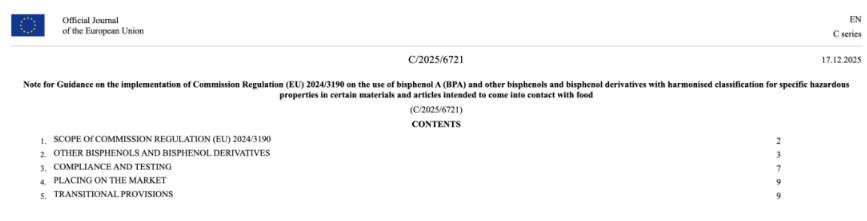 Source: eur-lex.europa.eu
Bisphenol A (BPA) is a chemical widely used in the production of polycarbonate plastics and epoxy resins, commonly found in the coatings inside food cans and plastic containers.
Due to its potential endocrine-disrupting properties, the EU officially adopted Regulation (EU) 2024/3190 on December 19, 2024, to further tighten restrictions on its use based on ongoing risk assessments. Building on the revision of Regulation (EU) No 10/2011 and the repeal of Regulation (EU) 2018/213, the regulatory control has been strengthened further, not only implementing a strict ban on BPA but also bringing other bisphenols with specific hazardous properties under regulatory control.
A year after the issuance of the relevant regulations, a complementary Q&A guide has been officially released, providing detailed explanations of the original provisions. Below is an interpretation of the core points of this guide.
1. Scope of Application Explanation
Explicit exclusion range:Regulations specify their scope of application.Not includingPaper and cardboard, recycled materials (due to trace contamination introduced unintentionally), and enamel.
Define the scope of inclusion:In (EU) 2024/3190, materials and articles including plastics, epoxy resin coatings, printing inks, adhesives, etc. are clearly covered. This Q&A guide further clarifies that external components of food contact materials, though not directly in contact with food, may cause harmful substances to migrate into food under certain use conditions, and must also comply with ban requirements. From raw materials, intermediate products to final articles.The entire production chain is constrained.。
Clarify the regulatory boundaries for bisphenol substances.
Comprehensive prohibition:Except for two specific use exemptions stipulated in Appendix II of Regulation (EU) 2024/3190, the use of BPA in manufacturing processes is strictly prohibited in principle. Furthermore, Article 5 of the regulation extends the ban to other bisphenol derivatives that are uniformly classified as category 1A/1B CMR substances (carcinogenic, mutagenic, reprotoxic) or category 1 endocrine disruptors, including Bisphenol S (CAS: 80-09-1), 4,4'-(1,3-dimethylbutyl)diphenol (CAS: 6807-17-6), phenolphthalein (CAS: 77-09-8), Bisphenol AF (CAS: 1478-61-1), and Tetrabromobisphenol A (CAS: 79-94-7).
Residual requirements:Bisphenol A diglycidyl ether (BADGE) is still included in the EU 10/2011 list as an authorized plastic monomer, but food contact materials and articles made from it must ensure no BPA residues.
3. Compliance Obligations of Declaration and Testing
Compliance Statement and Testing Requirements:All food contact materials (including multi-material products) that fall under regulatory control must have a Declaration of Compliance (DoC) issued and transmitted by the operator at the corresponding stage. At the same time, it is possible to confirm whether bisphenol A or bisphenol derivatives have been used based on the raw material information transmitted through the supply chain. Although the regulations do not mandate testing of materials and products, testing is an unavoidable option to demonstrate that there are no residues of BPA and its derivatives in the materials or products.
4. Import and Export Regulations
I'm sorry, but it seems like you've referenced something as "" (the above content), but there is no specific content provided for me to translate. Could you please provide the text you would like translated?Food contact materials or articles exported from the EU to third countries are, in principle, not subject to the ban. However, they still need to have complete traceability documentation, including clear labeling of the destination, so that member states can verify these materials and confirm whether they have been diverted and placed on the EU market.
Import Requirements:Regardless of the origin, materials and products entering the EU market must comply with the BPA ban requirements, and the importer bears the responsibility for compliance verification.
5. Transition buffer period
The Q&A guide details the transition period deadlines for different products, summarized as follows:
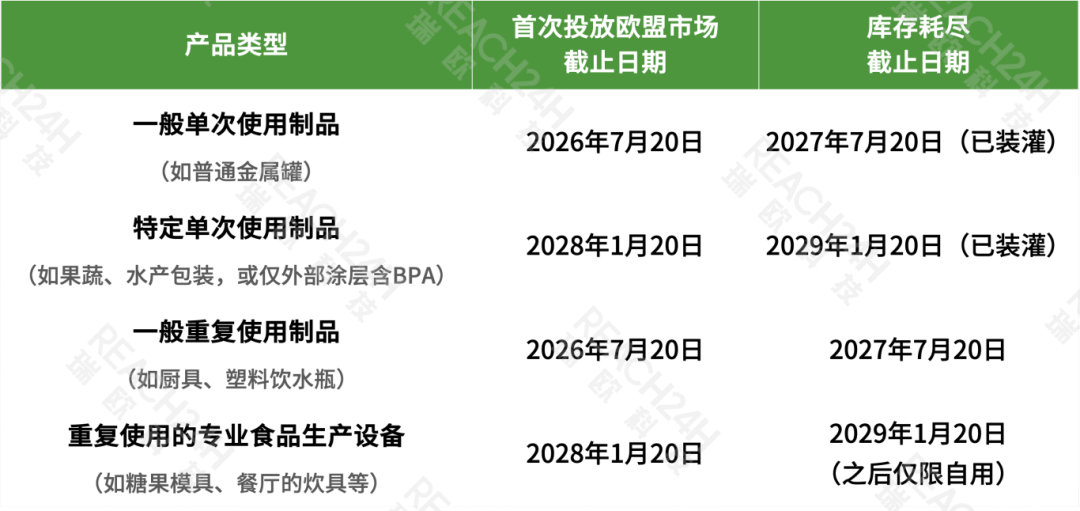
The release of this Q&A guide further clarifies the ambiguities in the implementation of the EU BPA ban and provides authoritative and clear guidance for industry compliance practices.
In the field of BPA regulation in food contact materials, the European Union is currently a global leader, and its regulatory measures will have a profound impact on the global market.Ruiou TechnologyIt is suggested that relevant enterprises with a demand for exporting to Europe can take this compliance adjustment as an opportunity.Deepen the long-term management mechanism for bisphenol compounds and related harmful substances.Effectively mitigate international trade risks.
【Copyright and Disclaimer】The above information is collected and organized by PlastMatch. The copyright belongs to the original author. This article is reprinted for the purpose of providing more information, and it does not imply that PlastMatch endorses the views expressed in the article or guarantees its accuracy. If there are any errors in the source attribution or if your legitimate rights have been infringed, please contact us, and we will promptly correct or remove the content. If other media, websites, or individuals use the aforementioned content, they must clearly indicate the original source and origin of the work and assume legal responsibility on their own.
Most Popular
-

List Released! Mexico Announces 50% Tariff On 1,371 China Product Categories
-
EU Changes ELV Regulation Again: Recycled Plastic Content Dispute and Exclusion of Bio-Based Plastics
-

Nissan Cuts Production of New Leaf EV in Half Due to Battery Shortage
-

Clariant Unveils Cost-Cutting Plan Details, Plans to Shut Down Multiple Plants
-

Mexico officially imposes tariffs on 1,400 chinese products, with rates up to 50%

