



Donglei tests heat-resistant film capacitors
Donglei Industry has successfully tested a prototype film capacitor featuring a proprietary heat-resistant film at 150°C, potentially halving the size of cooling systems for inverters in electric vehicles and aircraft.

Donglai Industrial Company announced today that it has successfully tested a 150°C inverter using prototype film capacitors, which incorporate a proprietary heat-resistant film as the dielectric.
Efforts to decarbonize transportation are accelerating the electrification of automobiles, aircraft, flying cars, and other forms of next-generation mobility. A drawback of high-output drive systems is that the heat resistance of film capacitors, which stabilize power within inverters, limits system design. This is particularly critical for flying cars, as smaller and lighter thermal management structures are essential for extending flight range, thereby increasing the demand for film capacitors capable of withstanding higher temperatures.
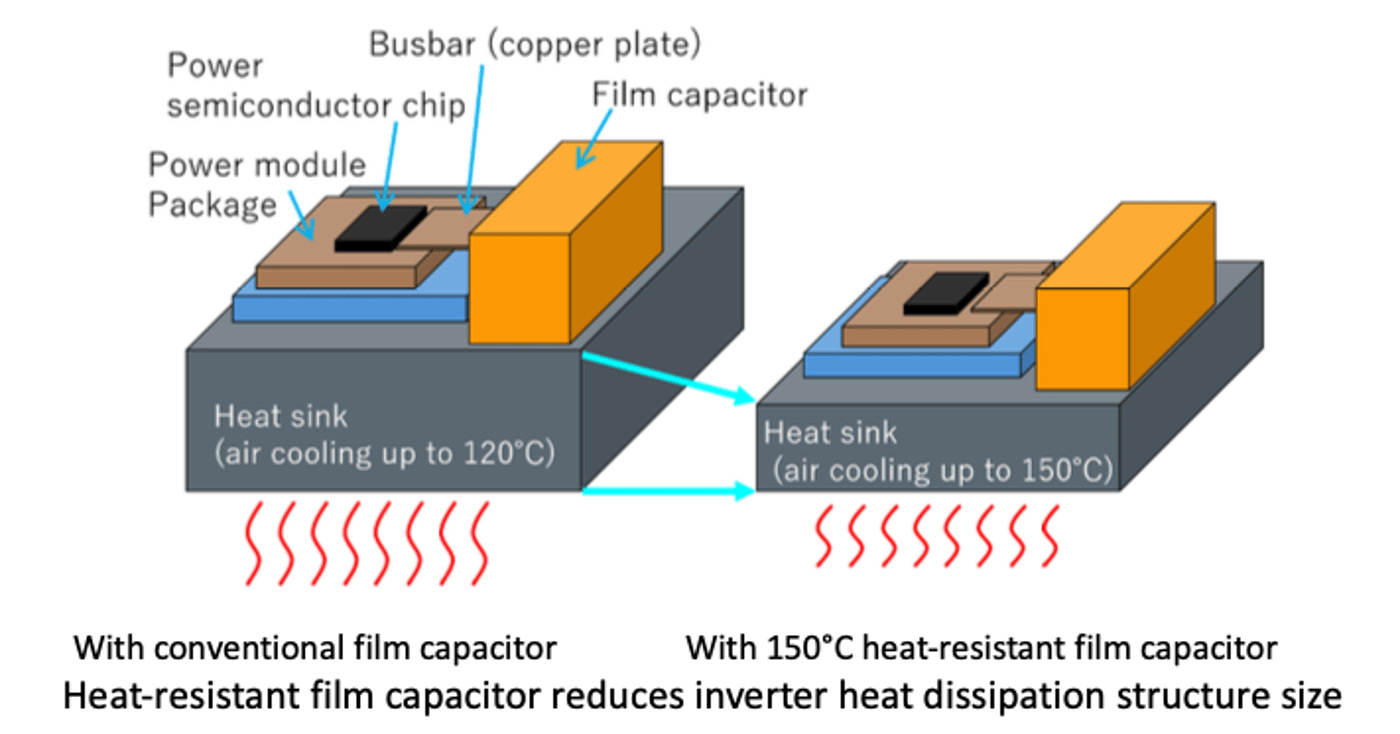
Image provided by Toray
According to the company, joint research with Professor Masayoshi Yamamoto of the Institute of Materials and Systems for Sustainability at Nagoya University has demonstrated that capacitors using a 150°C heat-resistant film can operate stably in prototype inverters even under high-temperature conditions. Thermal simulations have also confirmed the potential to halve the size of the heat dissipation structure.
This breakthrough addresses a key challenge in advanced polymer films for electrical applications. As the demand for electrification grows, the plastics industry must develop specialized films that maintain dielectric performance under extreme temperatures, thereby opening up new markets for high-performance polymer materials in the automotive, aerospace, and emerging mobility sectors.
Toray and universities will develop and evaluate the film with the aim of commercializing 150°C capacitors. The New Energy and Industrial Technology Development Organization (NEDO) supports this effort through a project focused on developing high-heat-resistant films for next-generation mobility film capacitors.
【Copyright and Disclaimer】The above information is collected and organized by PlastMatch. The copyright belongs to the original author. This article is reprinted for the purpose of providing more information, and it does not imply that PlastMatch endorses the views expressed in the article or guarantees its accuracy. If there are any errors in the source attribution or if your legitimate rights have been infringed, please contact us, and we will promptly correct or remove the content. If other media, websites, or individuals use the aforementioned content, they must clearly indicate the original source and origin of the work and assume legal responsibility on their own.
Most Popular
-

Mexico Imposes Tariff Up to 36% on Cross-Border E-Commerce Products, Effective January 1, 2026; Plastic Shows Partial Fluctuation Today
-
4.5 Million Tons! Wanhua Chemical Dominates Globally in MDI, Heavy Investment in Battery Materials Spurs New Storm
-

Trump Delays Tariff Increase on Furniture, Cabinets, and Vanities
-
Wanhua Chemical Invests $27.3 Billion, 2026 Investment Map Revealed, $1.1 Billion Bet on Battery Materials
-
Back-to-back major joker moves! covestro’s 1.32 million ton mdi dual-line expansion and hdi acquisition reshape global polyurethane landscape


