



Domestic Production Capacity Under Pressure, PP Non-Woven Fabric Industry Seeks Export Breakthrough
[Introduction] In recent years, the PP nonwoven fabric industry has faced the dual challenges of overcapacity and declining demand, entering a period of profound adjustment. A turning point is expected in the market in 2025, with a slight recovery in global demand. Exports, in particular, are performing strongly, becoming a key driver of industry growth. Data shows that Japan, Vietnam, and Indonesia are emerging as the top three core markets for China's nonwoven fabric exports, reflecting regional supply chain restructuring and the strong resilience of demand in emerging markets. 。
|
Image 1 2021-2025 PP Nonwoven Fabric Production Capacity Change Trend Chart (Unit: 10,000 tons) |
|
|
|
Data source: Longzhong Information |
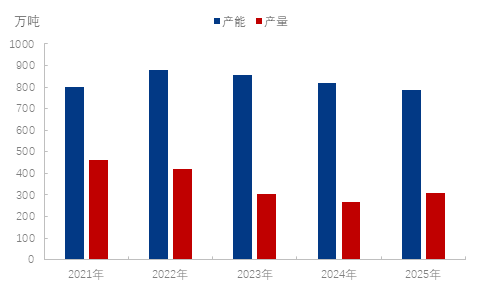
The demand for PP non-woven fabric from 2021-2025 is expected to show a trend of falling first and then rising. Affected by the public health crisis in 2021-2022, the overcapacity in China's PP non-woven fabric industry increased significantly. As industry demand declined, the overcapacity entered a period of adjustment. By 2025, with the elimination of excess capacity and the active expansion of non-woven fabric enterprises into new demanding industries, the annual output will increase slightly. 。
|
Figure 2 China PP Non-woven Fabric Consumption Structure Change Chart (10,000 tons) 2021-2025 |
|
|
|
Data source: Longzhong Information |
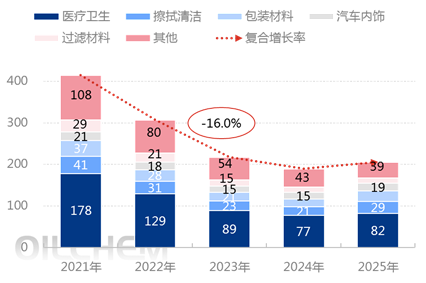
China's PP non-woven fabric consumption showed a trend of a sharp decline followed by a slight increase from 2021 to 2025, with an average annual compound growth rate of -16% over the five years. In 2025, the top five application areas for PP non-woven fabrics will be medical and hygiene, wiping and cleaning, packaging materials, automotive interiors, and filtration materials. Among these, the proportion of medical and hygiene applications is decreasing year by year, mainly due to health events and declining birth rates. Conversely, as the penetration rate of disposable wiping products increases, the demand for wiping and cleaning materials is rising. Additionally, with the increasing penetration of new energy vehicles, the demand for automotive fabrics is showing a year-on-year growth trend. 。
|
Figure 3 2021-2025 China PP Nonwoven Fabric Annual Export Volume Trend Chart (10,000 tons) |
|
|
|
Data source: Longzhong Information |
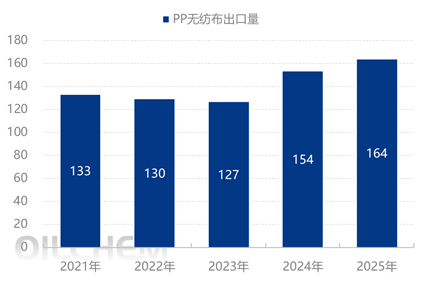
In terms of exports, China's PP non-woven fabric export volume has shown a trend of rebound after a decline in the past five years. From 2021 to 2023, the export volume decreased year by year, and in 2025, the export volume increased. From 2021 to 2023, due to the impact of the public health event and the domestic lockdown, exports were restricted, leading to an overall decline in export volume. From 2024 to 2025, it is in the capacity adjustment period after the public health event. China's production capacity is oversupplied, and the industry competition is excessive and intense. Under severe internal competition, enterprises are shifting their attention to overseas markets. In addition, with the support of policies such as the Belt and Road Initiative in recent years, demand in emerging markets such as Southeast Asia, the Middle East, and Africa has risen, and domestic export volume has gradually increased. Although trade friction has led to a significant decline in exports to the United States, most orders have been transferred to other countries, which has had little impact on domestic export volume. In 2025, China's PP non-woven fabric export volume will be 1.64 million tons, a year-on-year increase of 6.49%. 。
|
Figure 4 2021-2025 China's PP Nonwoven Export Volume by Destination (10,000 Tons) |
|
|
|
Data source: Longzhong Information |

Faced with overcapacity in China's PP nonwoven fabric industry, exports offer a temporary solution. However, trade frictions primarily affect export destinations in Asia and Southeast Asia. In 2025, China's top five PP nonwoven fabric export partners are projected to be Japan, Vietnam, Indonesia, the Philippines, and the United States, accounting for 15.32%, 12.4%, 11.02%, 8.23%, and 7.77% of total exports, respectively. These top five partners constitute 54.75% of China's total PP nonwoven fabric exports.
Overall, the nonwoven fabric industry is currently in a state of: Stock optimization and Incremental development and coexistence. The industry is currently in a phase of [specific phase, if known, otherwise: adjustment and transformation]. Domestic companies are addressing overcapacity through technological upgrades and product restructuring, while diversification of export markets, particularly the in-depth exploration of emerging markets in the Asia-Pacific region, provides a crucial growth buffer and new development space for the industry. 。
【Copyright and Disclaimer】The above information is collected and organized by PlastMatch. The copyright belongs to the original author. This article is reprinted for the purpose of providing more information, and it does not imply that PlastMatch endorses the views expressed in the article or guarantees its accuracy. If there are any errors in the source attribution or if your legitimate rights have been infringed, please contact us, and we will promptly correct or remove the content. If other media, websites, or individuals use the aforementioned content, they must clearly indicate the original source and origin of the work and assume legal responsibility on their own.
Most Popular
-
EU Changes ELV Regulation Again: Recycled Plastic Content Dispute and Exclusion of Bio-Based Plastics
-
CBAM Officially Implemented In Its First Month: How Chinese Export Enterprises To Europe Complete Their First Compliance Declaration?
-

100% Recycled Plastic Bricks: A New Tool to Replace Traditional Concrete and Combat Floods
-
Vynova's UK Chlor-Alkali Business Enters Bankruptcy Administration!
-
List Released! Mexico Announces 50% Tariff On 1,371 China Product Categories

