



Cost Down 40%, Price Still Far Exceeds PE! Why Are the Five Giants Joining Forces to Bet on PHA?
Around 300 billion disposable paper cups are consumed worldwide each year. You may use these paper cups every day—for your morning coffee, takeout soup, or convenience store sandwich tray.
But did you know? These paper cups are almost impossible to recycle.
To make the cup waterproof and oil-resistant, the inner wall of a paper cup is coated with a layer of plastic film—traditionally, this has been a PE (polyethylene) lamination. This film is only 15–20 microns thick, as thin as a cicada’s wing, yet it turns the recycling of the entire paper cup into a nightmare. The PE film is difficult to separate from the paper base, causing the vast majority of “eco-friendly paper cups” to end up incinerated or landfilled. The so-called “paper replacing plastic” has become nothing more than an empty slogan.
2026In this year, this dilemma is being addressed by something calledPHATear notch of polyhydroxyalkanoate material.
From April 21 to 24, the 38th CHINAPLAS International Exhibition on Plastics and Rubber was held at the National Exhibition and Convention Center (Shanghai). Among the exhibitors, one booth stood out in particular—Booth 1.2D72, where Microconstruct and Dubocheng jointly showcased the Bioten™ PHA bio-based waterborne barrier coating solution. The solution was included by the exhibition organizer in the official guide to the five hottest themed highlights, making it a key attraction in the field of sustainable packaging.
At almost the same time, domestic biobased product leader Hengxin Life (301501) won the "2025 Environmental Paper Industry Product Innovation Award" for its PHA coated paper cup product, receiving the "Innovation Iteration Star" award. The judging panel consisted of 12 experts from across the entire industry chain, including paper industry, chemicals, brand companies, and research institutions.
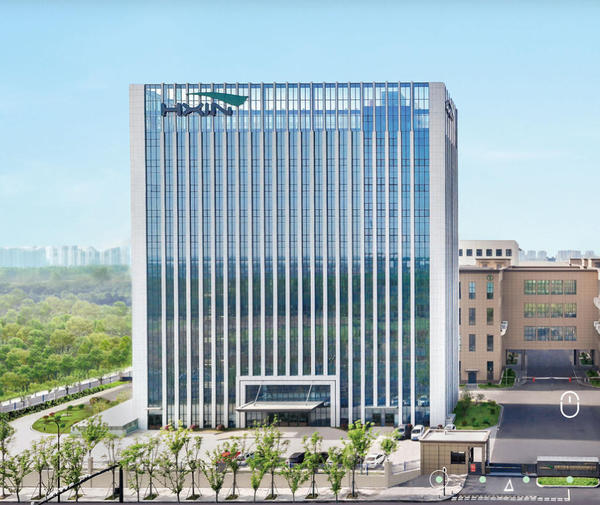
Image source: Hengxin Life
In January 2026, Angel Yeast, V-Factory, Duboucheng Group, APP (Asia Pulp & Paper), and Hengxin Life jointly announced the establishment of an industry-wide collaborative cooperation mechanism for paper-based barrier coatings centered on PHA biomaterials, covering the entire industrial chain of “technology R&D — large-scale manufacturing — high-end applications.”
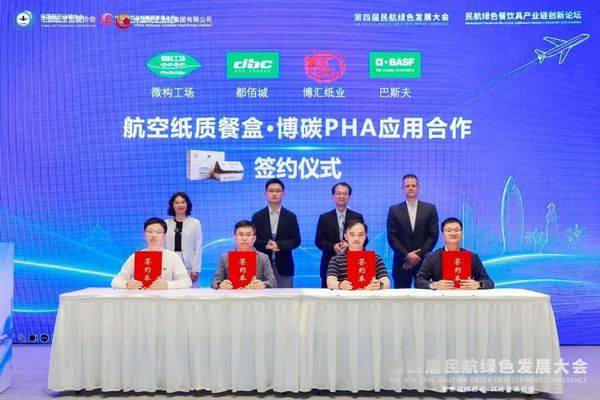
Signing ceremony of Microstructure Factory, Dubi City, Bohui Paper, and BASF (Image source: Microstructure Factory)
From trade show debuts to industry alliances, from validation for civil aviation catering ware to recognition by leading brands such as Starbucks, Luckin Coffee, and McDonald’s, PHA coating is accelerating its transition from a laboratory concept to the mainstream of the paper cup industry.
The question is: Translate the above content into English and directly output the translation result without any explanation.Why is it Translate the above content into English, and output only the translation result directly, with no explanation.PHAWhy is it now?PHA?
All industries are keeping an eye on it.PHARelease Film: A Materials Race Driven by Regulation
To understand why PHA suddenly became so popular, we first need to take a clear look at the driving forces behind it.This is not a bottom-up technological upgrade, but a top-down compliance storm.
PPWR:2026 8Fully effective in that month
The EU Packaging and Packaging Waste Regulation (PPWR) will come into effect.2026 8 12 It will be fully enforced. This new regulation, dubbed the “strictest packaging law in history,” has three core requirements: mandatory constraints on recyclability ratings, compulsory quotas for bio-based content, and disclosure of full life-cycle carbon footprints. Specifically for food-contact packaging, the 2040 targets are 24% bio-based content for PET packaging, 44% for other food packaging, and 20% for single-use packaging. This means that all Chinese paper cup manufacturers exporting to Europe, if they are still using PE lamination, will face substantive market-access barriers in just six months.
PFASPrecision Strike of the Ban
Starting in 2025, the U.S. FDA will cancel 35 food contact notifications for PFAS (per- and polyfluoroalkyl substances). PFAS were once widely used for grease-resistant treatment in paper packaging, but have come under global scrutiny due to their nature as “forever chemicals” (extremely difficult to degrade in the environment). Although traditional water-based barrier coatings (such as EAA emulsion systems) are promoted as alternatives to PE, some formulations still rely on fluorinated compounds to achieve oil resistance—an approach that is now being closed off.
Threefold strengthening of domestic policies
The driving force of the Chinese market is equally strong.
According to industry news citing research data from the China National Packaging Federation, the market size of disposable paper cups in China is expected to exceed 45 billion yuan by 2025, with biodegradable products accounting for 38% of the market. The market size for biodegradable paper cups is projected to exceed 20 billion yuan by 2026, with an annual growth rate of over 25%. 78% of consumers are willing to pay a premium of 5%-10% for eco-friendly paper cups—policy pressure and market demand are forming a combined force.The conclusion is very clear: for the paper cup industry, the issue is not whether to switch materials, but which materials to switch to and when to complete the transition.
2. Why Use ItPHAThe life and death of the four technical routesPK
Currently, there are four mainstream PE lamination replacement solutions in the market.
Route 1: PLA Extrusion Coating
PLA (polylactic acid) is the first biodegradable plastic to be commercialized on a large scale, but it has a fatal weakness:Only biodegradable under industrial composting conditions.(requiring a high-temperature, high-humidity environment above 58°C), while degradation in home composting and natural environments is extremely slow. More importantly, PLA-coated paper cups often contaminate ordinary wastepaper pulp streams in actual recycling systems (because sorting systems cannot distinguish them), making the “biodegradable” label misleading.
Route 2: Waterborne Acrylic Coating
This is currently the alternative route with the highest market share. International giants such as BASF and Wanhua are developing acrylic-based waterborne coatings for paper packaging coatings. Its advantages are clear: simple processing, low cost, and direct compatibility with wastepaper recycling streams. However, the core issues lie in:Acrylic resin is essentially still a petroleum-based material and is not biodegradable.Facing the EU PPWR's stringent requirements for biobased content, this path is becoming increasingly narrow.
Route 3: PBS/PBAT Coating Lamination
Kingfa Science & Technology’s PBS paper lamination solution, prominently launched at CHINAPLAS 2026, is a representative example of this approach. PBS offers relatively good mechanical properties and biodegradability, and Kingfa Science & Technology has achieved cost optimization by leveraging its self-produced bio-based BDO. However, PBS lamination still essentially falls within the category of “plastic lamination” processes, and is less favorable than water-based coating routes in terms of processing energy consumption and recycling friendliness.
Route 4: PHA Water-Based Barrier Coating
PHA has three inherent advantages:
First, true degradation across all environments.PLA requires industrial composting, whereas PHA does not—it can fully biodegrade into carbon dioxide and water in a variety of natural environments, including home composting, freshwater, and marine settings. Xingxin Life’s products have obtained the world’s first PHA home & industrial composting DIN CERTCO certificate (2024), as well as BPI home composting certification (2025).
II. Water-Based Coating Process = Recycling-friendly.Brocarbon PHA adopts an emulsion-modified water-based coating process. The coated paper cups can be directly sent into the waste paper recycling stream, where the fibers and coating are repulped together without the need for separate separation treatment. This is crucial for meeting the PPWR “recyclability” rating.
Third, excluding.PFASEnsure compliance in advance.Botan PHA solution has passed the 95°C coffee leakage test, heat resistance test, and food contact safety test, while using no PFAS compounds throughout the entire process, perfectly aligning with the new U.S. FDA regulations and the global defluorination trend.
Core Differences Among the Four Routes: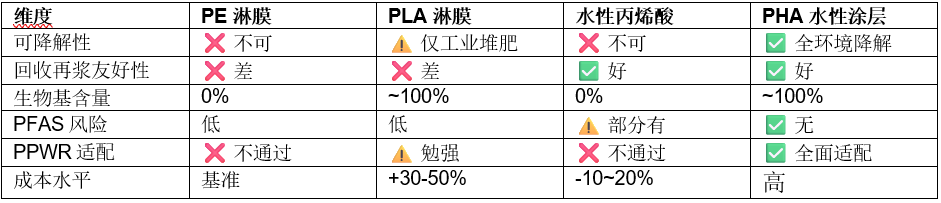
One-sentence summary: If you only consider cost, choose acrylic acid; if you only consider degradability, choosePLAIf biodegradability also needs to be satisfied+Recyclable+Biobased+ PFAS,PHAIt is currently the only all-encompassing answer.The cost disadvantage is being rapidly erased by scaling.
3. Challenges and Bottlenecks of PHA: The Gap from the Laboratory to Mass Production
PHA is not a new concept.
As early as the 1980s, Imperial Chemical Industries (ICI) in the United Kingdom attempted to commercialize PHA production, but was forced to abandon the effort because production costs exceeded USD 8 per kilogram (while PET cost only about USD 1.5 per kilogram during the same period). For the following three decades, “PHA is good, but too expensive” became the industry consensus.
The turning point occurred in the past two years. The core breakthrough that propelled PHA out of the laboratory came from two directions:
1 Technological Breakthrough: Halophiles Rewrite the Rules of the Game
The Tsinghua University team discovered halophilic bacteria (Halomonas) in Ayding Lake, Xinjiang, which completely overturns the traditional PHA fermentation logic. This extremophile can survive in high-salinity environments and synthesize PHA, bringing three revolutionary changes: open continuous fermentation (high salinity inhibits contaminants, eliminating the need for strict aseptic operations); seawater culture medium (significantly reducing freshwater consumption); and continuous flow processes (greatly enhancing production efficiency). This system, known as "Next Generation Industrial Biotechnology" (NGIB), will lower the production costs of PHA.decrease by more than40%。
2 Industrialization Milestone: Commissioning of a 10,000-Ton Production Line
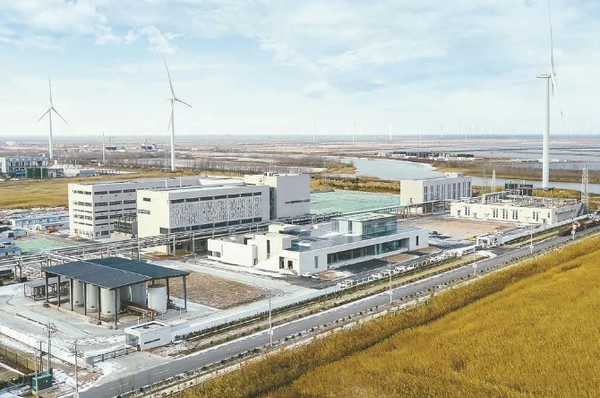
In 2025, Micro Factory and Angel Yeast formed a joint venture.Hubei Weiqi Biotechnology Co., Ltd. Annual Production3 PHAPhase I of the project (1(10,000-ton Production Line) Officially Commenced Operationmarking the delivery of the country’s first 10,000-ton PHA production line. The total investment in the project was RMB 1.05 billion, with an automation rate as high as 90%. By the end of 2025, the total global PHA production capacity is expected to reach approximately4.52 among which China accounts for1.48 。
Bluepha Microbiology’s first-phase annual 5,000-ton PHA production facility at Lansu Company in Yancheng, Jiangsu, has been completed and put into operation.
However, the PHA industry still faces three hurdles to overcome:
First, the absolute cost remains relatively high.Even after a 40% decline, the current price of PHA pellets remains roughly 1.5–2 times that of PLA and 3–4 times that of PE. For the paper cup industry, where profit margins are already very thin, cost sensitivity is extremely high. Only economies of scale can bring prices down to an acceptable range.
Secondly, the processing technology window is narrow.PHA has relatively poor thermal stability, and the extrusion temperatures used in conventional PE extrusion coating would cause PHA to degrade. Therefore, the process must follow a “waterborne emulsion coating” route rather than a “melt extrusion coating” route, which requires modifications to the entire production line. Bocan PHA has overcome the technical challenges of achieving stable high-speed coating, but this capability is still currently mastered by only a small number of companies.
Third, the supporting supply chain is inadequate.Compared with PE’s mature supply chain operating at an annual scale of tens of millions of tons, PHA has only a handful of mature suppliers at every stage. This is precisely why the five-party alliance is so important—without supply chain collaboration, isolated breakthroughs are meaningless.
Four, Conclusion: The essence of material transformation is system engineering competition.
Returning to the original question: Will PHA extrusion coating replace PE? In the short term, it will not completely replace PE. In the medium term, it will be the first to scale up in high-end niche segments such as airline catering, export packaging, and branded chain coffee and tea beverages. In the long term, it will depend on the speed at which three variables converge:Capacity expansion speed, cost reduction speed, regulatory enforcement intensity。
In the past, green packaging was all about concept labels—just slapping on a “biodegradable” or “plastic-free” tag was enough. Now, behind every paper cup there is an evidence chain: Is the material source traceable? Does the barrier performance meet the standard? Is it food-contact safe? Does it comply with PPWR? Can it enter the waste paper recycling system? Is there a viable composting fallback pathway?
At CHINAPLAS 2026, Shanbo Carbon PHA is showcasing not just a new material, but a full-chain solution covering “raw materials — emulsification modification — paper coating — product forming — end-use applications.” At the Haikou Civil Aviation Green Development Conference, Dubuicheng, Maker’s Cell, and BASF joined hands with six leading paper manufacturers to launch collaborative validation across six civil aviation sub-scenarios, further taking this systems-engineering mindset to the extreme.
The future competition in paper cups will no longer be about whose cups are cheaper, but about who can provide a complete chain of green evidence.PHA is just a symbol in this transformation - what truly changes the game is the system capability that is responsible for the entire lifecycle.
Editor: Lily
Sources: CHINAPLAS 2026 official reports and exhibitor information, China Economic Times, Eastday.com, China Chemical Industry Information Weekly, Hexun.com, China Securities Journal, etc.
【Copyright and Disclaimer】This article is the property of PlastMatch. For business cooperation, media interviews, article reprints, or suggestions, please call the PlastMatch customer service hotline at +86-18030158354 or via email at service@zhuansushijie.com. The information and data provided by PlastMatch are for reference only and do not constitute direct advice for client decision-making. Any decisions made by clients based on such information and data, and all resulting direct or indirect losses and legal consequences, shall be borne by the clients themselves and are unrelated to PlastMatch. Unauthorized reprinting is strictly prohibited.
Most Popular
-

A Look at the Material Suppliers Behind SpaceX
-
Eastman France PET Depolymerization Plant: Project "Alive," But Construction Paused
-
Ethylene: Production Capacity Accelerates Expansion, Global Industry Landscape Is Being Reshaped
-

Amer Sports Releases 2025 Sustainability Report, Apparel And Footwear Recycled Material Proportion Reaches 19.3%
-
Mitsubishi Chemical Plans To Split Petrochemical Business By 2028


